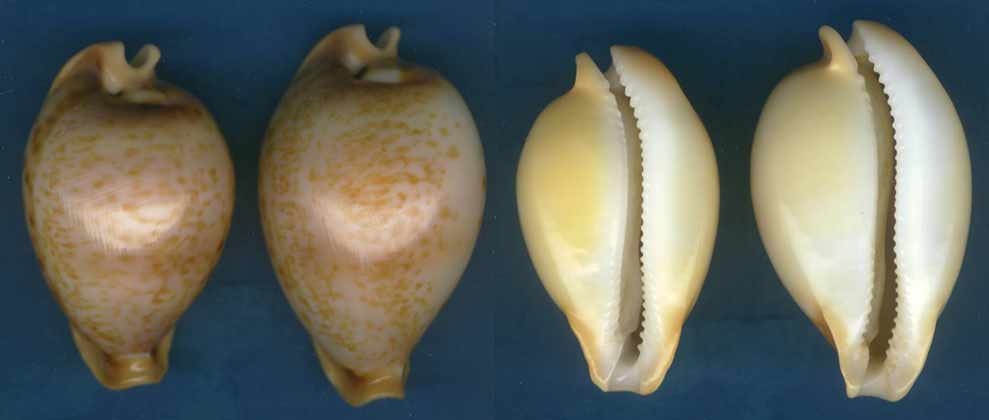
Nesiocypraea teramachii Kuroda
Nesiocypraea teramachii is one of the rarer deep water
species in the family Cypraeidae whose conchological features
are generally considered archaic.
The flanged and rostrated extremities,
the large spire and the fading dentition on columellar side are
such features.
Molecular data places teramachii at the base of the cowries,
ascertaining the archaic nature of the shell, which resembles forms of
the Eocene (assigned to the extinct genus Eopustularia).
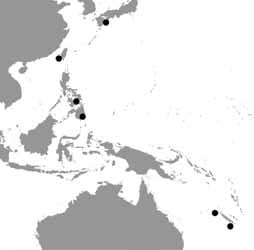
Thre populations are known in the western Pacific,
subdivided into separate subspecies since 2002:
Conchologically, the Taiwanese and Japanese shells (type locality)
are most similar.
The shell is heavy, the base and the left margin
callous, the dorsal frame of spots dense and confluent.
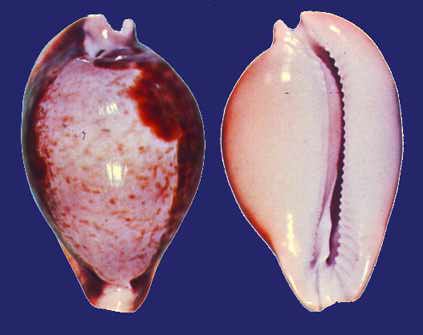
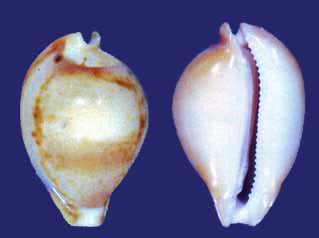
In these shells, the columellar teeth are reduced but not totally
absent midways.
The specimens from New Caledonia are smaller (47-55)
in average and otherwise similar to those from Japan and Taiwan.
They have an even brighter colouration.
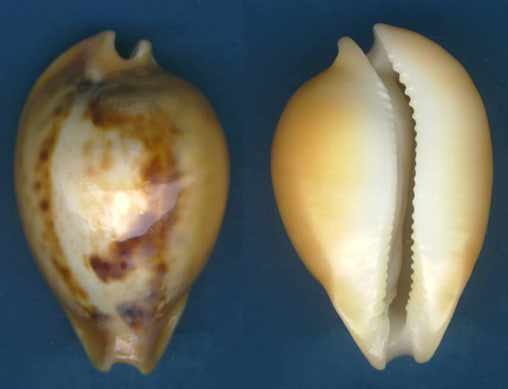
Philippine specimens are characterized by the more elongate shape,
the absence of callus on the columellar margin,
the absent columellar teeth int eh midsection, the finer and more defined marginal frame
of spots, and the less callous spire.