Subfossil Cowries
When dead cowry shells wash ashore, they lose their colours, and first of all, their nacre. The same happens when the empty shells stay on the seafloor, exposed to the attacks of drilling sponges, algae and chemical processes destroying the colours and the gloss. In some incidences, however, a fresh shell reaches the beach, with the original nacre well preserved, literally a gem. Such shells have been cast ashore immediately after the animal's death (by strong currents, without much erosion processes having taken place).
One would think that the longer the shell is dead, the stronger is the degree of erosion and loss in colour and pattern. In very rare cases, however, a single shell or even an entire cowry population got covered by sand or mud within a short period of time (a few days). Under certain circumstances the mechanical and chemical processes destroying the shells are stopped or considerably. If the deposition in this environment lasts, cowries may retain their nacre, but a pellucid appearance develops, and all darker colour components are lost. After a few thousand years, all colour is changed to shades of orange and yellow. Such shells have started their process of fossilization - the exchange of the chemical shell-components. The term subfossil may be used, independently from the actual age of the shells, as long as this process is not complete. We know gradual transitions from moderately fresh subfossils to fossil specimens of several cowry-species, always depending on the type of deposition. The age of these shells is often difficult to determine.
Quite a few subfossil cowries have been proposed as separate taxa. Some examples are: C. capensis galactina Sulliotti 1924, B. rashleighana eunota Taylor 1916, C. esontropia translucida Melvill 1888.
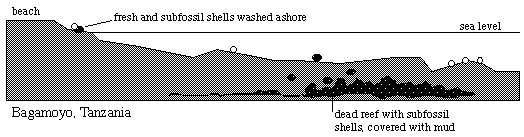
One of the best known sites bearing subfossil cowries is the long strip of muddy beach at Bagamoyo, the former capital of German East Africa, about 50 north of Dar-es-Salaam, Tanzania. Today, Bagamoyo is a run down place with some offroad-tourism but little other economy, but in former days it used to be the trade centre with an important dhow-harbour from which slaves were shipped to Zanzibar and Arabia. At Bagamoyo, extensive populations of some shell-types have been deposited in a deep layer of mud, presumably some ten-thousand years ago. After strong stroms with high tides, these shells are washed out of their substratum onto the beach. Some of these subfossils are rather common, the most famous ones being the "golden" Conus textile, and "golden" Naria helvola argella and Erronea caurica elongata.
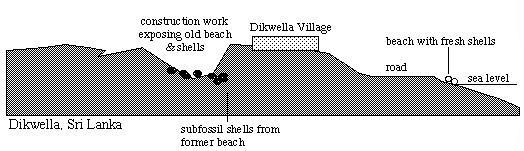
Another fantastic site for subfossils was discovered during railway construction in the extreme south of Sri Lanka, near a village called Dikwella. It is supected from the quality and the characteristics of the shells found here that a former strip of beach got covered by a greyish mud and was subsequently conserved. Movements of the coastline have transferred the former beach and perhaps the adjacent litoral zone to dry land over the years. On digging in this area some ten years ago exposed the old beach with all the treasured subfossil shells showing up.
Many very outstanding specimens have been found, but much rarer than e.g. in Bagamoyo. Some of the subfossil cowries are in excellent condition, and they often differ completely from the forms and variations of the same species known today. There is, for instance, a variation, or perhaps a separate species, closest to Naria moneta. The forms of this species known today all lack the marginal pitting characteristic for other species of Naria. In the subfossils from Dikwella, however, distinct marginal pitting can be observed - perhaps an indication that the direct ancestors of modern days' moneta were indeed pitted marginally.
Here is a (certainly incomplete) listing of some subfossils-bearing sites known to me.
Bagamoyo, Tanzania: shells washed ashore, mostly Naria helvola and Erronea caurica, many Conus textile. Many shells in good condition. Age probably less than 10.000 years.
Dikwella, Sri Lanka: shells found by railroad construction. Many Cypraeid species, many of which quite different from living relatives, several Strombidae but few Conidae. Few shells in really good condition. Age probably 500.000 to 1 mill. years.
Male Atoll, Maldives: shells found inbetween old reef pieces dredges from construction works. Many cowries, especially Naria erosa. Age probably less than 10.000 years.
Port Louis, Mauritius: Shells found in Harbour dredgings. Plenty of Cribrarula esontropia and other species were found, many of which is good condition. Age around 10.000 years.
Seychelles: Shells found from Harbour dredgings and construction works. Plenty of smaller cowries are found, some of which is good condition. Age probably less than 100.000 years.
South Africa: Shells are found on the shoreline to several kilometres inland. They are usually deposited in fine sandy gravel resembling an ancient beachgrit. At Jeffreysbay, the formations containing the subfossil shells are exposed during construction work, at Fullers bay (near East London) the shells are found in ledges along the beach. The shells are often worn and bleached. C. capensis and C. edentula are quite common. Age around 250.000 to 1 mill. years. Very rarely, subfossil shells are also dredged with mud from several hundred metres.
Giftun Islands, Egypt: Shells found close to the beach in old coral rubble. There is a complete progression from subfossil to fossil shells in some places. Naria nebrites is most common. Most shells are in very poor condition. Age: a few hundred to more than 1 mill. years
Philippines, Indonesia and the Solomons: Subfossil shells are found wherever old coral rubble is deposited along the shoreline but sometimes also further inland (e.g. in the Solomons). These deposits originate from slight fluctuations of the sea level, and rarely from lifting of the land. Age ranges around 10.000 years, older deposits are usually fully fossilized.
Hawaii: Most subfossil cowries in collections originate from the Big Mouth Cave at Waianae, Oahu, Hawaii, at 20-25 m. Famous examples are golden coloured T. rashleighana ("eunota"). Large L. tessellata, and golden N. ostergaardi. Age: less than 2.000 years.
One may say that the nicest golden coloured and shiny specimens are coming from East Africa, the Mascarenes and Sri Lanka, but some really beautiful specimens are also known from Hawaii. Subfossil shells retaining the original nacre and rich yellow or golden colours can usually be considered valuable collector's items. The pale colours may, however, be simulated also by baking cowries. The difference between these frauds and true subfossils is the pellucid appearance and the richer orange compared to the more yellow-cream baked shells, which also tend to have fine cracks in the nacre.
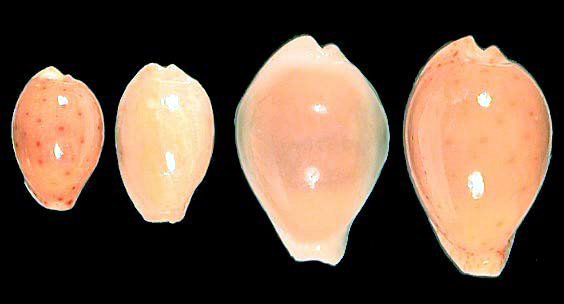
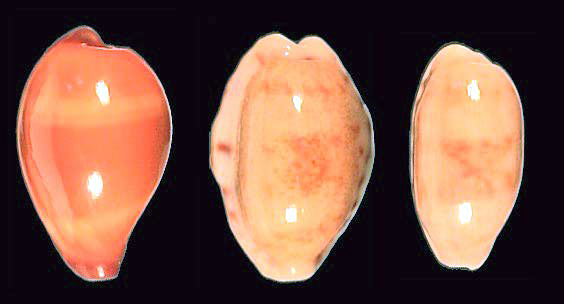
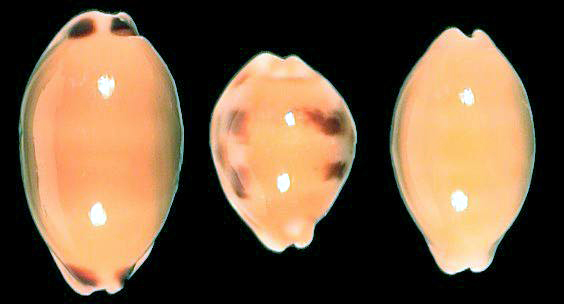
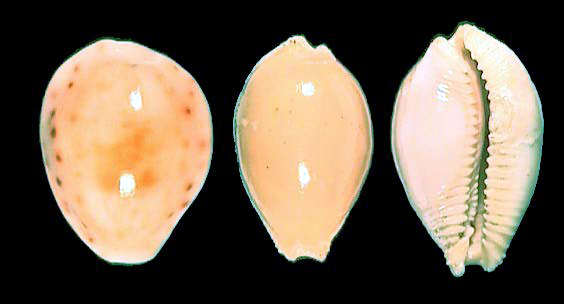
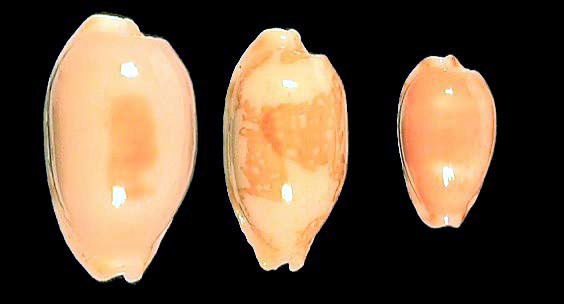
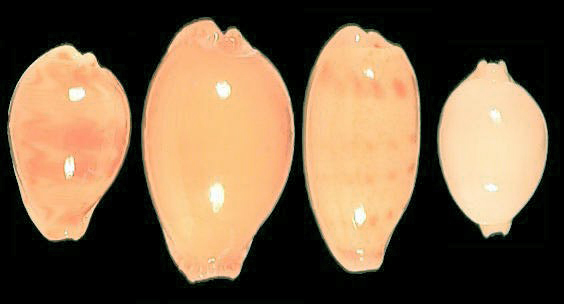
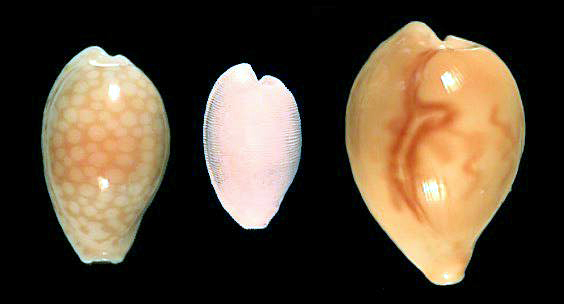
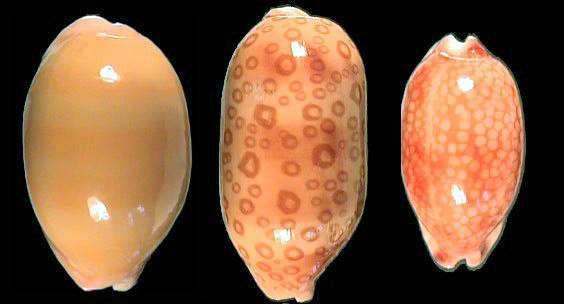
The following gallery shows some exceptional subfossil specimens from various localities.
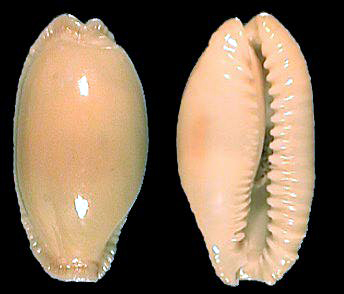
Naria erosa var. (Sri Lanka)
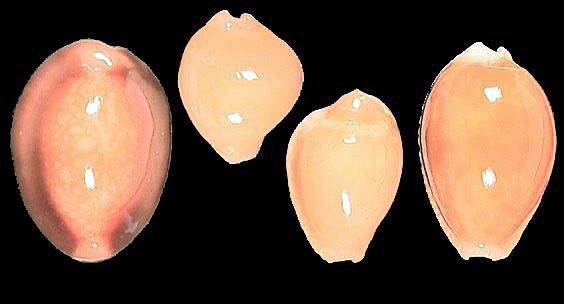
Left: Monetaria caputserpentis (Sri Lanka), middle: N. helvola argella, freaks (Bagamoyo), right: N. helvola argella (Bagamoyo)
Left: two N. ocellata (Sri Lanka), middle: N. miliaris (Philippines), right: N. lamarckii (Bagamoyo)
Left: Erronea adusta (Bagamoyo), middle: E. caurica dracaena f. corrosa (Sri Lanka), right: Talostolida teres pellucens (Bagamoyo)
Left: Luria pulchra (Egypt), middle: Luria tessellata (Hawaii), right: Lyncina carneola propinqua (Solomon Is.)
Left: Talostlida rashleighana "eunota", middle and right: Staphylaea semiplota (both Hawaii)
Left: Bistolida diauges (Bagamoyo), middle: B. stolida rubiginosa (Sri Lanka), right: B. owenii (Mauritius)
From left: Palmadusta diluculum (Bagamoyo), Staphylaea limacina interstincta (Bagamoyo), Blasicrura interrupta (Sri Lanka), Pustularia globulus (Maldives)
Left: Cribrarula esontropia (Mauritius), middle: Cypraeovula capensis (Fullers Bay, SA), right: Barycypraea fultoni fultoni (Natal, SA, dredged)
Left: Lyncina leviathan titan (?Somalia), middle: L. argus contrastriata (Pemba), right: Mauritia histrio var. (Sri Lanka)
first uploaded: Sept. 2001, revised 2021