
Snowflake-Dots in Zoila
| The
quality of a shell is an important financial
and aesthetical aspect. Dealers and collectors usually have completely
different ideas of what a perfect shell should be like, and an
interesting question raised on my forum was dealing with white or
greyish callused dots commonly found on the base and along the margins
of Zoila-shells. The question asked was whether these dots are actually
a flaw or, obviously being caused by the animal, merely a feature that
does not deplete the shell's value or quality in a strict sense of
grading. My personal opinion is that these dots are indeed a flaw,
although a natural one, comparable to blisters in the nacre found in
many species of Zoila in particular. Whether or not this influences the
value and the price is another question. In most cases, I feel that
those white dots actually contribute to the character of a shell, and
then it is in the eye of the beholder whether they diminuish the value
or not. Interestingly, these white dots have never been given a
universally accepted name, or technical term (such as "overcasting" now
commonly used to describe shells that have a greyish or greenish
cover overlaying the pattern). The name I am proposing for the white
dots particularily common in Zoila shall herewith be "SNOWFLAKE-DOTS"
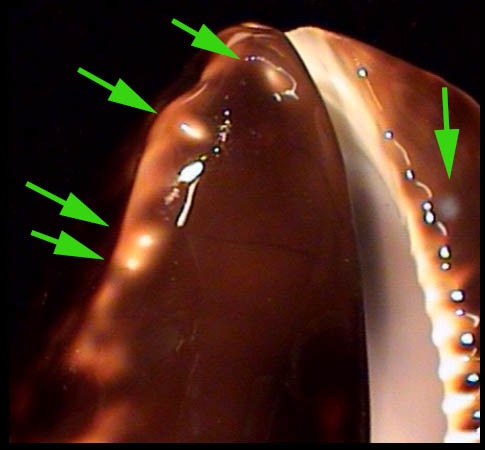
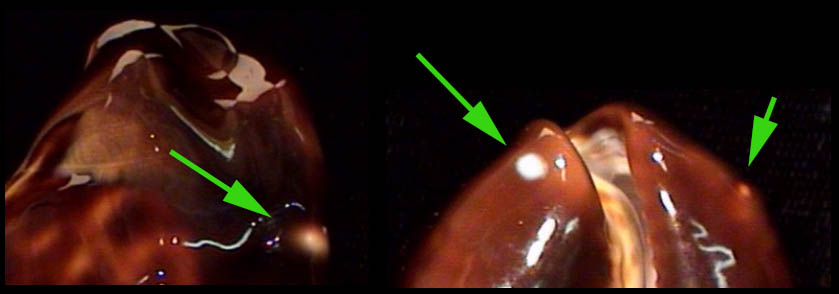
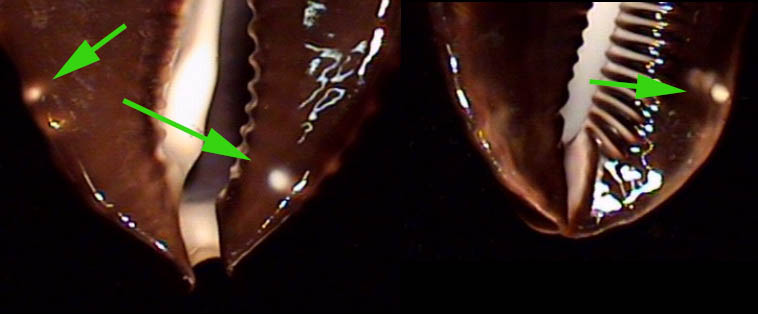
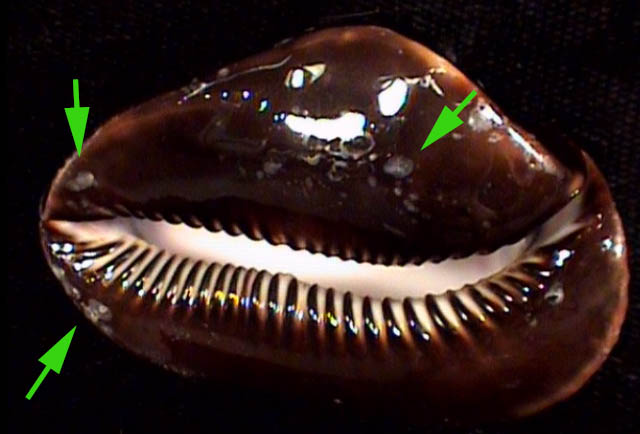
This name was suggested to me by my friend Dr. Marco Chiapponi, a true expert of Cowries and experienced collector of Zoilas.How do they develop? First of all, in early growth of the Zoila shell there is a phase in which wrinkles and dimples develop along the margins, while callus is being deposited. These wrinkles may become covered with callus that is not of the same consistence as the rest of the shell, but that represents repair-material usually found where the animal encorporated mud or repaired damages to the shell. In such cases when mud or sand is encorporated in the shell by the mantle, snowflake-dots may form, as well as in places where a predator tried to drill a hole into the base. The pictures show different types of snowflake-dots. |
||
 |
 |
|
| In the beginning, small wrinkles form, often lacking coloration |
Later, these wrinkles get covered with callus that is of whitish color |
|
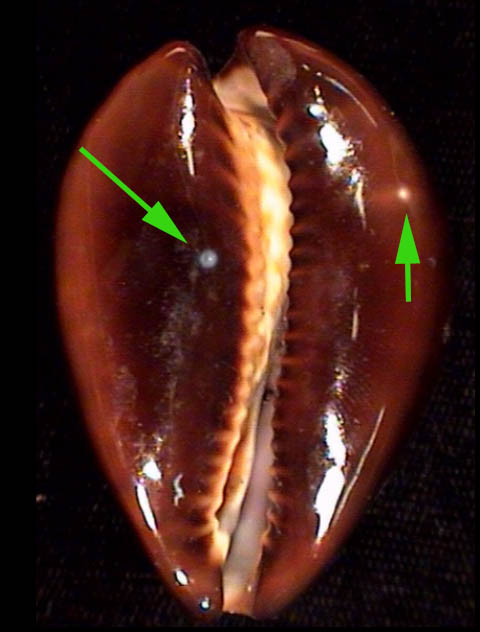 |
 They are mostly found along the margins |
|
| They may be of very small size, and sometimes they may develop on top of a small mud-inclusion |
||
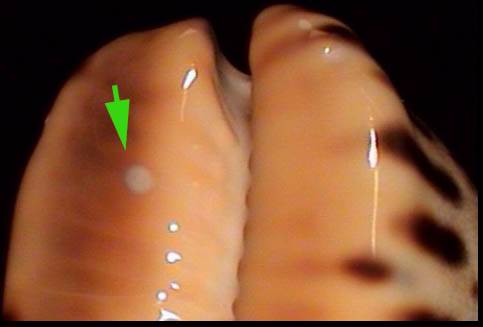 Snowflake-dots are not necessarily found only in black-based species as this example of Zoila eludens shows. In this case, the snowflake-dot covers an attempted drill-hole on the base. This is an indication that the whitish callus is indeed repair-material |
 |
|
| Snowflake-dots must not be confused with
"Blisters" or "Nacre-lifts" as seen in many mature Zoila, such as this
Z. rosselli. These blisters are a nuisance and even worse so when
somebody tried to polish them away. Whereas snowflake-dots are a
feature found in "good shells", blisters are a serious flaw that
downgrades a shell considerably. However, there are a few forms in
which 90% of the shells have the blisters (e.g. northern Z. rosselli). |
||
uploaded 2009