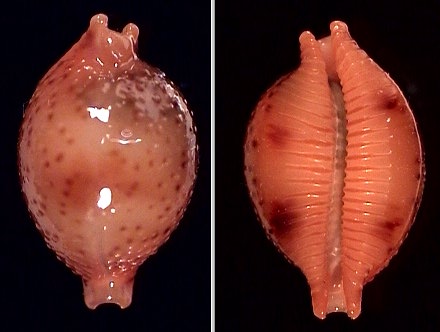
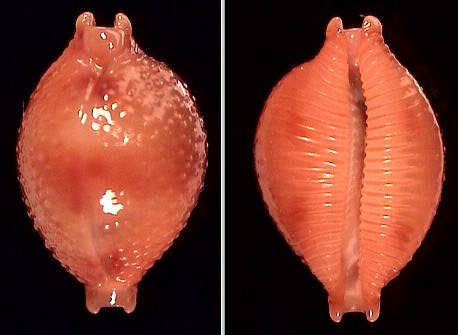
The rediscovery of
Pustularia bistrinotata keelingensis Schilder & Schilder
It was quite a surprise when I found a pair of dead,
strange pale bistrinotata at WangiWangi, an Atoll south
of Sulawesi in October 01. The shells had thickened extremities,
short teeth and coarse granules. The dorsum was not humped. They
resembled the description of keelingensis given by the Schilders
in their treatise of the Dautzenberg-collection (1952). Early
this year, J.P. Barbier sent me a shell he thought to be chiapponii,
a rare species from the eastern Philippines. His specimen was
from the south of Palawan. It was not chiapponii, but what
turned out to be the true keelingensis, large and perfect. Subsequent
research in the area so far kept secret produced several more
of these jewels which are here shown for the first time in color.
Note the coarse extremities, strong teeth and bright orange color.
The shells measure between 19 and 21 mm. They are more brightly
orange colored, much heavier and less humped compared to other
Philippine bistrinotata. The basal spots, however, are
not as produced as in the nominate form. Apparently, keelingensis
is distributed in the southwest of the regular bistrinotata-distribution.
It is still under study.