
In the recent issue of Visaya Vol. 2 No. 1 p. 4-42, the well
known cowry and ovulid expert Luc Dolin proposed Ransoniella
as a new genus-name for "Notadusta" punctata
and chose atomaria as type species of the genus. He indicated that according to Meyer (2003), the genetic differences
between subspecies was often greater than between species. On the basis of 131 specimens of punctata
from the Sulu Sea he proposes 16 separate species of punctata-like
shells, introducing 13 new names and elevating synonyms to species
rank. Without wanting to comment at all on the various taxa he
introduced, I would like to comment why I do not at all agree
with the procedure he chose to define his taxa.
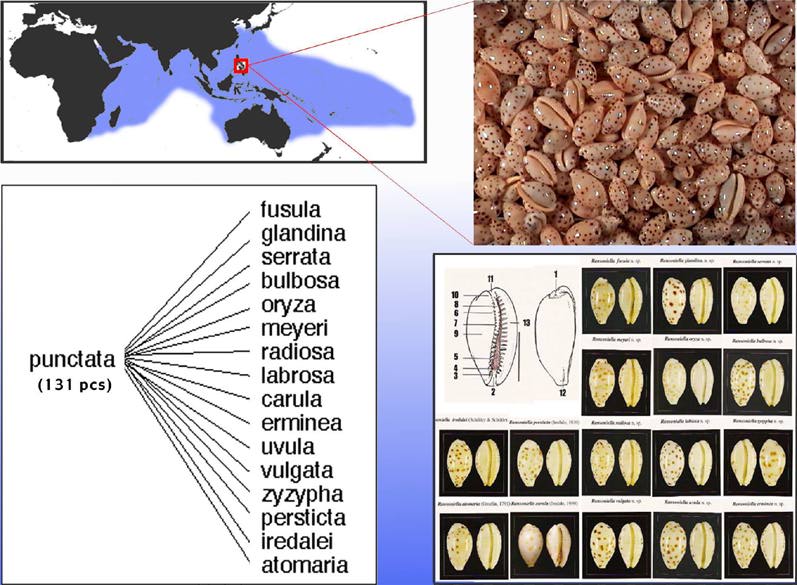
The main problem with this work is that the author is using
only shell characteristics that are known to be highly variable,
such as the shape of the umbilicus, the margins, the callosities,
the number of teeth, 12 features in total. He discusses briefly
how the various species differ in the combination and development
of these features, using terms such as "more produced"
and "less developed" but completely omits a statistical
analysis to prove the claimed consistency of the chosen characteristics.
These gradually vary from "developed" to "absent", from "numerous" to "few", without a gap that can be expressed numerically or in consensus with geography or bathymetry, hence all those new names in the way they have been proposed are quite worthless**. The reader has to try and align shells with the numerous, admittedly brilliant, illustrations. But any other choice and combination of features would lead to different results. Even though I have no doubt that Dolin acted in good faith and the belief that what he was doing was valuable scientific work, the paper lacks any bit of science: The features for subdivision are not consistent but qualitative. A statistic to disprove this graduality is not made and is also not possible - due to the statistically irrelevant small amount of specimens opposed to the high amount of arbitrarily split units ("new species"). Therefore, the results are not reproducible - and this is the most important aspect of any scientific work.
In other words, it is as if you pour a bag of shells on a table and see how many matching pairs of groups one could create. Then, those shells that could not be assigned to any of these groups are declared as "sp. A", "sp. B" and so on (in fact, this is exactly what happened in the Dolin-paper!***). If you take a look at my treatise of diluculum (which is meant as a comedy) you will feel reminded of this procedure. The same could have been done with a container of tiger-cowries or a bag of cribrarias, the results would have been a similar or even greater amount of "new species".
So, are there any species hiding among the punctatas in the Philippines at all? Let us look at DNA-studies on the group first:
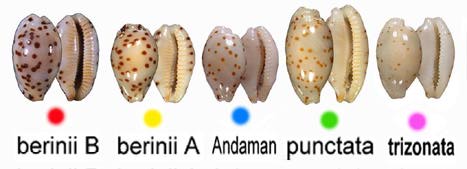
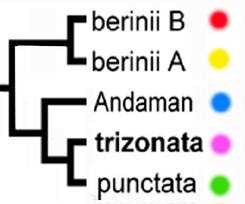
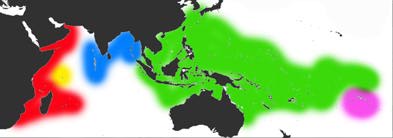
In citing Meyer's work on the DNA of cowries Dolin only creates the implication that "there is more to it than meets the eye, and I have looked into it". The opposite is the truth. There is no genetic difference between Philippine punctata (Meyer, pers. comm. 2007), the opposite is the case: there are differences between the traditional subspecies recognized by Hubert and myself, plus one from the Seychelles and a population from the central Indian Ocean that might deserve consideration. Whether any of the taxa validated and introduced by Dolin really do represent valid species that have been hiding among the vast amount of punctata-variations from the Philippines is so far unknown. If it turns out that there are indeed sibling species of punctata in the Philippines, we now have a lot of names to choose from....
Finally, why did President and Director of the magazine Visaya allow the paper to be published. Why was there no independent referee giving at least some feedback to the author to improve the paper? For sure, Dolin has managed to cause discussion and debate, even if not so much on the subject itself.
*: I fully agree with this step, I have already challenged the traditional usage of Notadusta in New Worldwide Cowries, p. 141 (2002).
**: The 13 new names as such have been introduced in a taxonomically correct way, which means, if somebody wishes to use them for shells that resemble those in the illustrations, he may well do so. However, to evaluate their value as species or subspecies, a lot of revisionary work is now necessary - unless one agrees to lump them into synonymy with punctata altogether. This is not my intention at this point.
***: Before writing any of this, I have attempted to compare and measure approximately 400 punctata from the Philippines and indeed managed to find many specimens matching exactly one or the other of the 16 "Dolin-species". However, more than half of my shells would be somewhere inbetween the various combinations of features, and the alphabet does not provide enough letters for all of them.