
Another new species of Cypraeidae from Madagascar
(Mollusca: Gastropoda, Cypraeidae)
Cribrarula pellisserpentis sp. nov.
Description:
Shape and structure: Greatly inflated, oval. The margins are callous
on both sides, slightly bent uo towards dorsum. The base is convex
and callous. The spire is umbilicate, partly covered with callus.
The extremities are slightly rostrate. The labral teeth are coarse
and distinct, reaching towards the middle of the lip. The columellar
teeth are confined to the aperture, very fine and indistinct midways,
the last anterior columellar tooth is thickened. The fossula is
slightly projecting, showing five small denticles, the columellar
peristome is faintly ribbed.
Coloration: The ground colour of the dorsum is a uniform pale
olive green, pinkish in one paratype. There is a regular but fine
coast of brown netting which forms large, round lacunae, most
of are overlapping. There is a wide, distinct dorsal line on the
labral third of the dorsum. The ground colour of the base is plain
white, changing into pink towards the margins. These, and the
extremities, are densely spotted with large, indistinctly outlined
dark bown spots of variable size. This spotting is reaching far
towards the aperture basally, on both sides of the shell. Its
density varies in the paratypes. Animal characteristics: The mantle
of the partly preserved animal of the holotype is brownish, with
short, unbranched papillae.
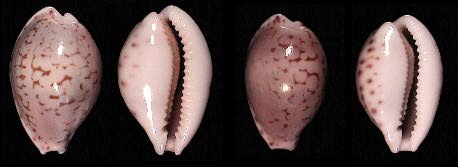
C. pellisserpentis, typical specimens
Material: three live collected specimens and twelve fresh dead
shells have been studied, three specimens were available as types:
Holotype: 23,8 x 15,8 x 13,2 17 : 19 (coll. HNC Cismar)
Paratype 1: 23,0 x 15,6 x 12,2 21 : 19 (coll. Chiapponi, Lecco)
Paratype 2: 22,8 x 15,6 x 12,0 17 : 15 (subadult specimen) (coll.
Blöcher, Duisburg)
Paratype 3: 24,8 x 15,1 x 13,0 20 : 19 (coll. Van Heesvelde, Gent)
Paratype 4: 25,2 x 16,3 x 13,7 19 : 19 (coll. Gabrielli, Neuss)
(length x width x height (mm), labral : columellar teeth, (depository))
Distribution and habitat: All specimens so far known were collected
on beaches or by divers in depths ranging from 15 to 35 m from
an area south of Tulear to Fort Dauphin, Southern Madagaskar.
The species seems to inhabit reef areas with deep crevices that
are difficult to access.
Ethymology: The name pellisserpentis (lat. pellis: skin,
serpens: snake) refers to the narrow dorsal netting of the new
species, resembling the scaly skin of a snake.
Discussion:
In the western Indian Ocean, there are several similar taxa in
the genus Cribrarula, which should shortly be summarized
here:
Cribrarula esontropia (Duclos 1833):
Distribution: Mauritius and La Reunion
Shape: oval, callous to narrow cylindrical (var. cribellum
(Gaskoin 1849))
Labral side: rounded, callous
Columellar margin: often very callous, bent up
Marginal spotting: dense, distinct, reaching onto base
Ground colour: pale orange to pink, with two paler transverse
bands
Cribrarula cribraria abaliena Lorenz 1989:
Distribution: Kenya to northern Mozambique, Natal (deep water)
Shape: oval, callous
Labral side: rounded, callous
Columellar margin: very callous, bent up
Marginal spotting: absent
Ground colour: pale orange, no conspicuous transverse banding
Dorsal netting: wide, complete, pale brown, forming large lacunae
Cribrarula cribraria ganteri Lorenz 1997:
Distribution: Sri Lanka
Shape: Elongate-cylindrical to oval, callous
Labral side: distinctly margined, slightly callous
Columellar margin: very callous
Marginal spotting: fine, often distinct on both sides, reaching
onto base
Ground colour: orange to pale purple, faint darker transverse
band
Dorsal netting: broad, dark, distinct, forming small lacunae
Cribrarula cribraria comma (Perry 1911) Variation A
Distribution: Somalia to Tanzania
Shape: Elongate oval to cylindrical
Labral margin: rounded, hardly callous
Columellar margin: hardly callous
Marginal spotting: rarely faint spotting along upper labral margin,
absent on base and columellar side
Ground colour: pale purple, very faint transverse banding
Dorsal netting: coarse, rather dark brown, forming small lacunae
Cribrarula cribraria comma (Perry 1911) Variation B
Distribution: Mozambique to Natal, Madagascar
Shape: Oval, often callous
Labral margin: rather callous, rounded
Columellar margin: often rather callous
Marginal spotting: Often distinct spotting along the upper labral
margin, some spotting rarely on columellar margin, base always
unspotted.
Ground colour: Saturate purple, with distinct darker transverse
band
Dorsal netting: very dark brown, forming small lacunae
The presence or absence of marginal spotting in Cribrarula
is not a specific feature, as long as no other characteristics
exist. It is noteworthy, however, that within a species, the character
of the marginal spotting can be used to safely identify geographic
populations (including subspecies).
In Madagascar and Mozambique, an interesting variation of Cribrarula
cribraria comma (Perry 1811) occurs (variation B), which differs
from typical specimens (variation A) by distinct spotting along
the dorsal edge of the labral margin. This spotting, however,
is not present along the columellar margin or on the base. This
feature is a fundamental difference to the Mascarenan Cribrarula
esontropia Duclos, which has lead to confusion in the past,
e.g. by myself (see Lorenz 1998). The true Cribrarula esontropia
(including its subspecies cribellum) seems really endemic to Mauritius
and La Reunion, while all records of the species from other areas
in the Indo Pacific and the Persian Gulf seem to be based upon
exceptionally well spotted specimens of cribraria comma, cribraria
ganteri and the new taxon described herein, Cribrarula
pellisserpentis sp. nov.
Cribarula pellisserpentis sp. nov. differs from the sympatric
Cribrarula cribraria comma by the presence of marginal
spotting on both sides of the shell and also on base, the finer
columellar teeth, the projecting fossula and the narrow, incomplete
dorsal netting. These are also the differences from Cribraria
esontropia (Duclos 1833), except for the dense marginal spotting,
which is found in both, the new species and C. esontropia.
In latter, the callus of the columellar margin reaches further
towards the dorsum than in pellisserpentis sp. nov.
As already mentioned, the new species has been mistaken with C.
esontropia on account of this superficial resemblance, whereas
the consistent differences in dentition and fossula have been
overlooked. The slightly projecting, finely denticulate fossula
is a feature only found in the eastern Pacific Cribrarula cumingii
(Sowerby 1832). The set of shells investigated suggests that the
narrow, incomplete dorsal netting, along with the uniform greenish
to pinkish ground colour (without transverse banding as seen in
most other taxa of the genus), the distinct dorsal line in Cribarula
pellisserpentis sp. nov. and the features of the dentition
are specific characteristics that do not lie within the variation
range of any other member of the genus.
Acknowledgements: Many thanks to Mr. Jo Van Heesvelde, Gent-Wondelgem,
and Mr. Manfred Blöcher, Duisburg, who, independently from
each other, drew my attention to the group of Cribrarulae from
Madagascar. Dr. Marco Chiapponi, Lecco, and Mr. Ludwig Gabrielli,
Neuss, who made their beautiful specimens of C. pellisserpentis
available as paratypes.
References:
Lorenz, F. & Hubert, A. (1993): A Guide to Worldwide Cowries,
Chr. Hemmen Verlag, Wiesbaden
Lorenz, F. (1997): A new species of Cribrarula cribraria
from Sri Lanka (Gastropoda: Cypraeidae). Schriften zur Malakozoologie
10:1-3
Lorenz, F. (1998): Kauris von Ostafrika. Schriften zur Malakozoologie
12: 1-150