
The many faces of Naria ocellata
Alex Hubert once told me that "if ocellata was
rare it would be the most expensive of the cowries".
He was right. There hardly is another species with
a pattern- composition more beautiful and fascinating.
The following pictures shall illustrate some forms
and variations that I believe are fairly constant.
Probably
none of them really constitutes a geographical subspecies, yet
a certain geographical pattern can be observed
even
in this variable species.
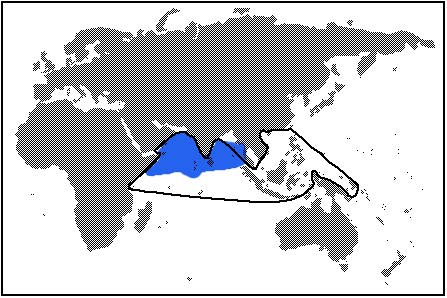 First of all, forget about the map in our "Guide"
(black lines).
First of all, forget about the map in our "Guide"
(black lines).
Many of the localities we were
given have proven incorrect, on top of all those from New Guinea were thought to be based on an error.
It turned out, however, that the species has indeed been found there, around the Goodenough Islands,
Milne Bay Province, at 45 m in 1963. There are no other confirmed occurrences in the Oacific.
This map shows those localities that to my best knowledge
really have living populations of E. occellata (blue color)
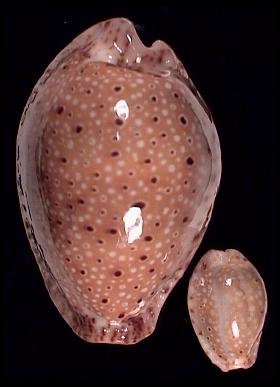 The size range of the species known to me is from 11
mm to 40 mm.
The size range of the species known to me is from 11
mm to 40 mm.
The shells shown here are not those
extremes (beached shells).
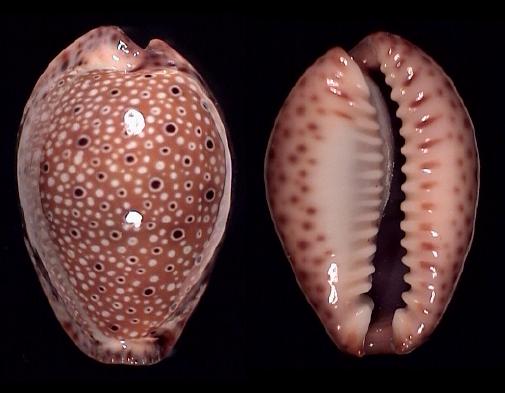 These are typical occellata from Trincomalee,
Sri Lanka.
These are typical occellata from Trincomalee,
Sri Lanka.
Note the fairly distant teeth which
may be tinted, the fine spotting on the base and the moderately
large black dorsal spots.
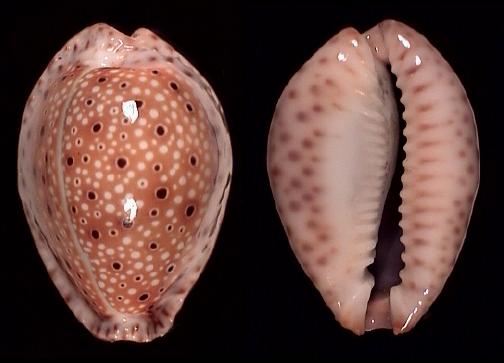 These are from Somalia. They resemble closely the typical
ones from Sri Lanka.
These are from Somalia. They resemble closely the typical
ones from Sri Lanka.
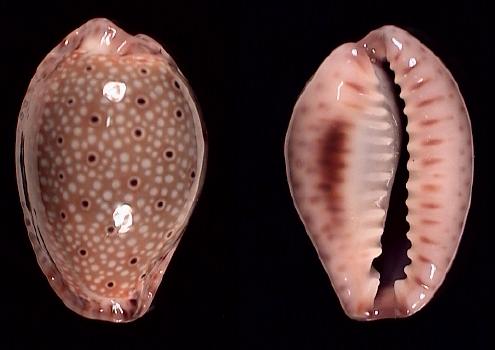 Another one from Sri Lanka. Note the basal blotch-
it is an accumulation of the spotting.
Another one from Sri Lanka. Note the basal blotch-
it is an accumulation of the spotting.
Such shells
are found among larger series of shells from anywhere, they are
not really remarkable.
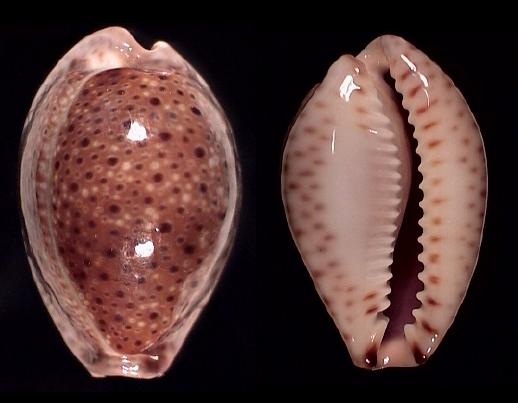 This beauty is from India. The dense and dark dorsal
spotting is rather unusual for this locality,
This beauty is from India. The dense and dark dorsal
spotting is rather unusual for this locality,
whereas
the long and dense teeth and the fine spotting on dorsum is.
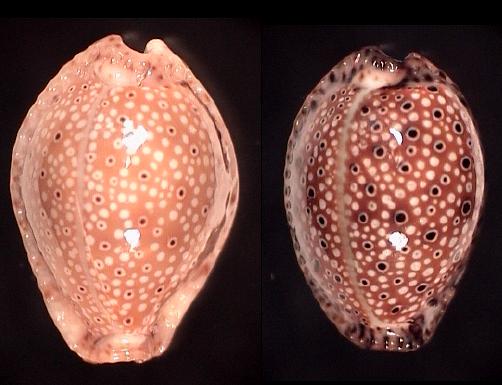
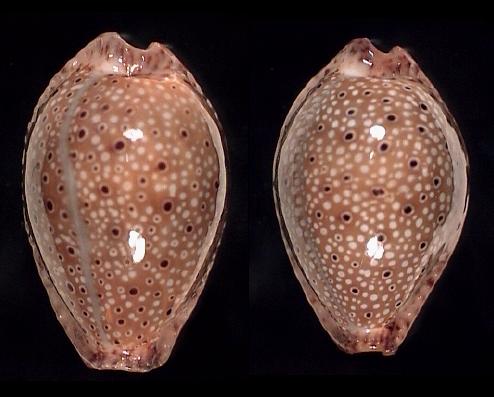
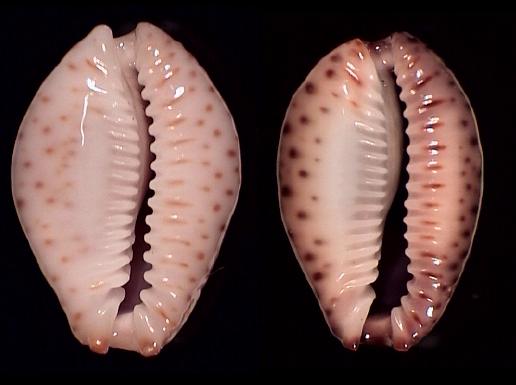 On left: a typical ocellata from India (Kerala). Note
the smaller black dorsal spots,
On left: a typical ocellata from India (Kerala). Note
the smaller black dorsal spots,
the dense and
long teeth, the more pronounced margins and the fine and dense
basal spots on pale background.
On right another
typical one from Sri Lanka (Beruwala area).
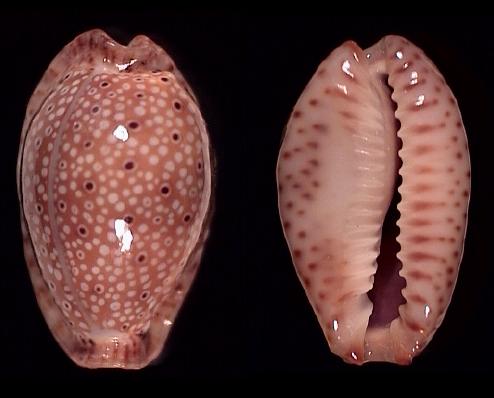
 Shallow water specimens from India vary from a cream
color to almost green.
Shallow water specimens from India vary from a cream
color to almost green.
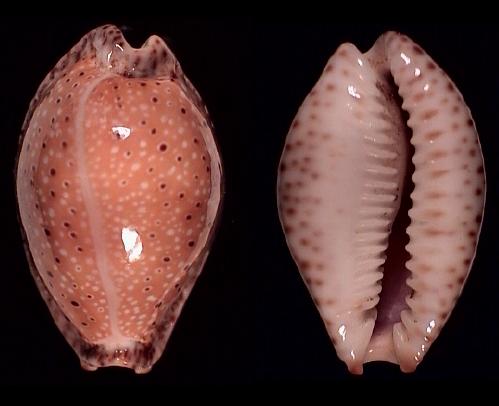 The pellucid reddish forms are found by shrimpers at
depths of 60-90 m in the south of India and
The pellucid reddish forms are found by shrimpers at
depths of 60-90 m in the south of India and
the
north of Sri Lanka, namely the Jaffna area.
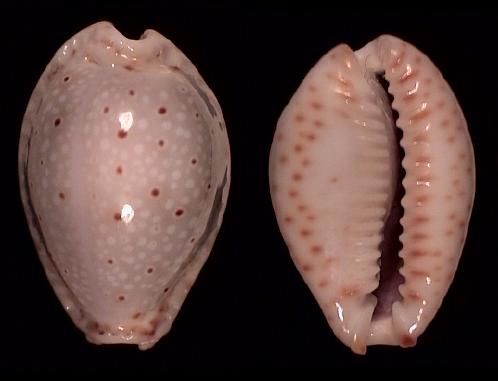
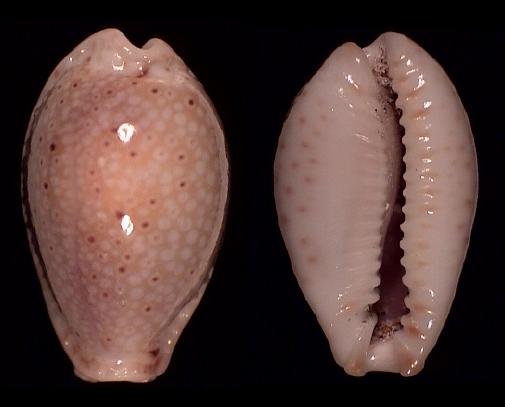 Jaffna, trawled off 80 m. Here they are. Such pale,
pellucid shells are rather rare, as their home is one of those
Jaffna, trawled off 80 m. Here they are. Such pale,
pellucid shells are rather rare, as their home is one of those
areas of the world where peace is urgently needed!
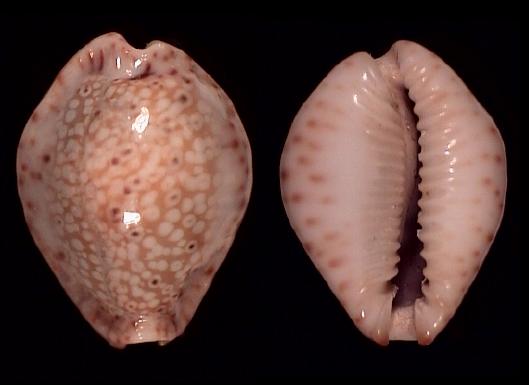 Thailand. Specimens from the eastern distribution limit
tend to be rather small and pale.
Thailand. Specimens from the eastern distribution limit
tend to be rather small and pale.
There are callused
forms as this one, but you can get regular elongate shells as
well.
The general shape is not really an issue
in separating geographical forms in the species of Erosaria
(as everybody with a good collection of lamarckii
will know).
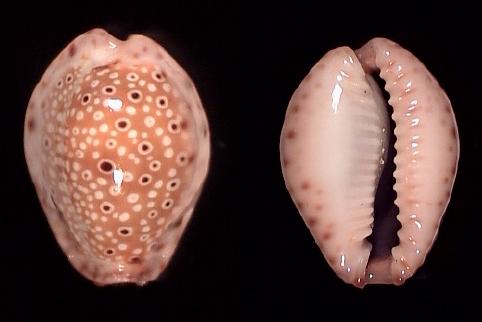
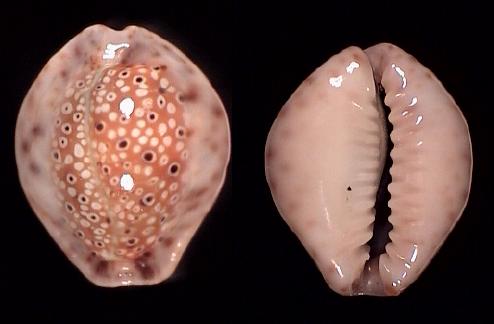 These two cuties are typical Maldive shells. Unfortunately,
little material is available from there these days.
These two cuties are typical Maldive shells. Unfortunately,
little material is available from there these days.
Maldive
shells are smaller and tend to be more callused.
In the following, I will show some unusual variations,
mostly from Sri Lanka.
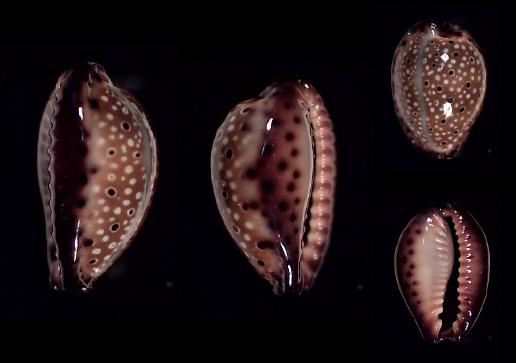
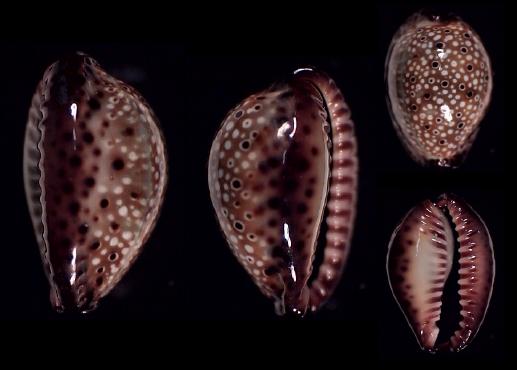 The southern coast of Sri Lanka is inhabited by small,
dark specimens.
The southern coast of Sri Lanka is inhabited by small,
dark specimens.
The place where these really unusual
shells are from is rather hard to access as strong waves
break ashore from the open ocean.
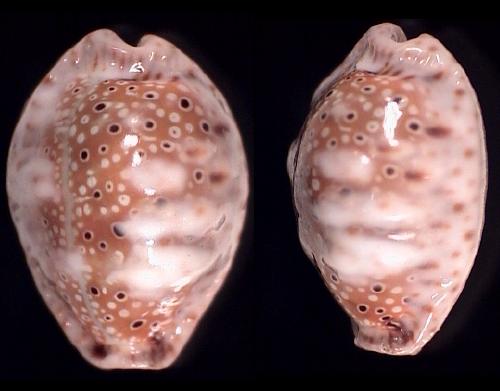
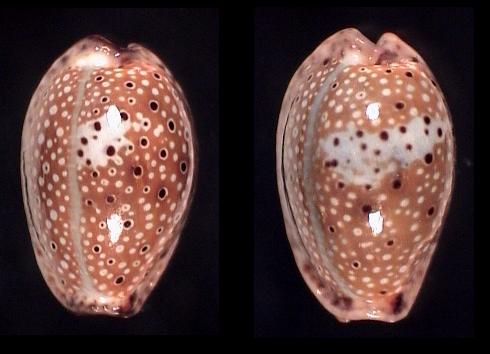 Shells with a white blotch
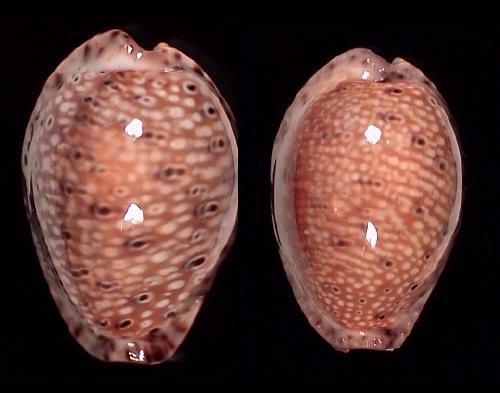 earthquake pattern
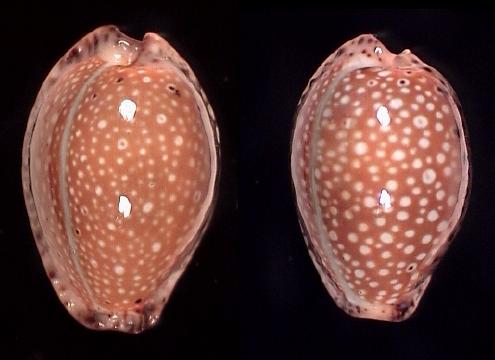 almost no ocellated spots
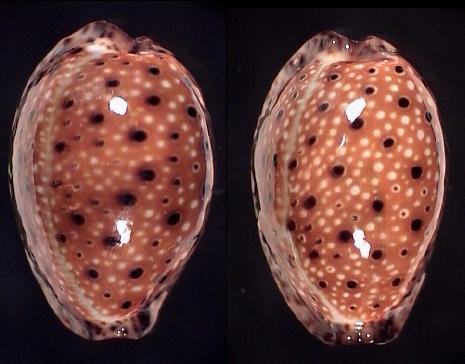 very large ocellated spots
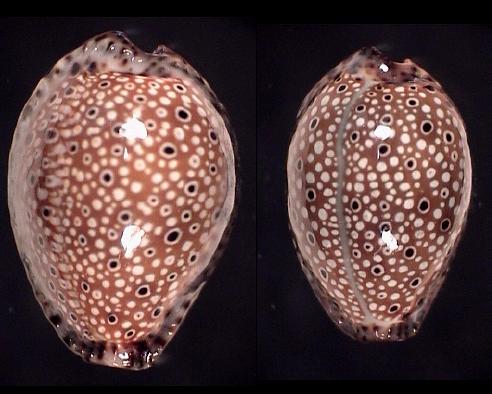 contrasting
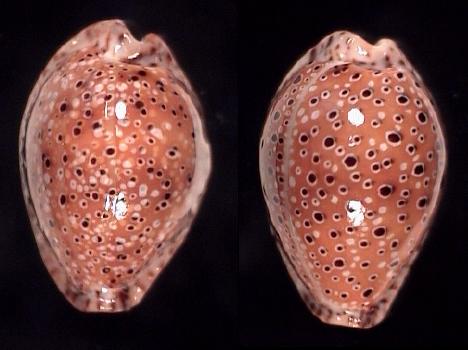 many ocellated spots
 tuberculose
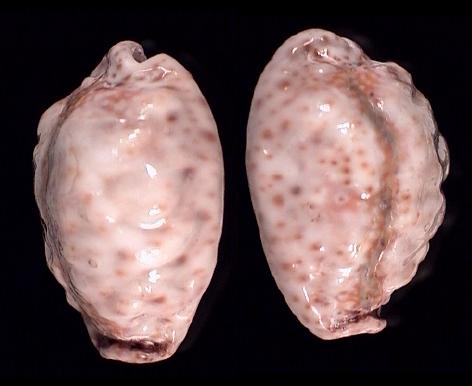 superquasimodoi
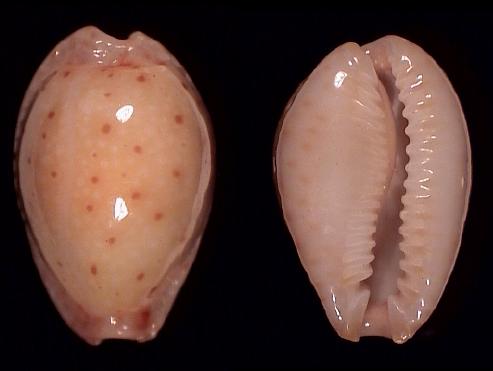
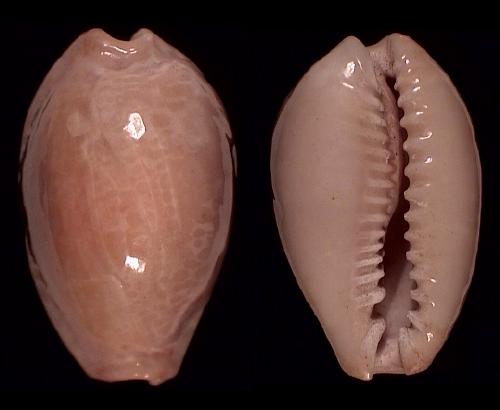
Finally, here is the famous subfossil form which has
been propagated "new species" or "the true thomasi",
or more intelligently "mystery cowry".
Such shells were found in the excavations for
the railroad track at Dikwella, Sri Lanka.
Nice
specimens are quite rare.
www.cowries.info
© Felix Lorenz 18.02.2004