A preliminary revision of the living
Notocypraea
by Felix Lorenz
A preliminary revision of the living
Notocypraea
by Felix Lorenz
The species of the genus of Notocypraea from the southern
half of Australia are a confusing groups of cowries. Many authors
have avoided dealing with that group and most collectors have
simply "given up". Other authors have tried to manage
the diversity of its members by introducing a large number of
names. Many of these are based on single specimens and the descriptions
are not accompanied by sufficient illustrations. Preliminary
revisions made by other authors have either increased or reduced
the account of taxa, more recent revisions have introduced the
methods of DNA barcoding. Another approach included the features
of radulae, however, to evaluate the importance of radula features
in this genus would rewuire studies dealing with the general
variability of radulae within populations, which in the case
of cowries has only been done in very few genera (e.g. Zoila
and Monetaria).
The present-day taxonomy and systematic arrangement of the
genus is based on conchological features and in few cases, DNA
features helped to clarify the status of species (in the case
of pulicaria, dissecta and subcarnea). The DNA analysis, helpful
in the study of genera and subfamilies, has added little that
would support the species and subspecies evaluation in the other
species. The opposite is the case, some species appear to be
split in subspecies not supported by shell features (e.g. angustata),
whereas apparently good subspecies (or species) are not different
from their allies (e.g. occidentalis and piperita).
In the Pleistocene age, at the end of the last ice age, approx.
10.000 years ago, the ocean levels rose and vast areas of Australian
coastline became oceanfloor. These new habitats presented a battlefield
of different species competing for food sources, hiding places,
ect. Random variability within each immigrant population and
natural selection has lead to the formation and manifestation
of new features, varieties and finally, species, subspecies,
and a large number of variations in the shallow water. The situation
in the Notocypraea is comparable to that of the genus
Zoila. The archaic ancestral populations from which the
shallow water immigrants originated may have looked pretty much
the same as those forms we can find in greater depths today.
In the deep water, the ecological conditions have hardly changed
at the same time, the populations could remain more stable and
retain more archaic features.
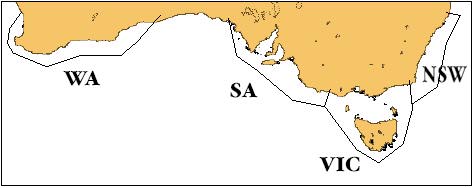
The species of Notocypraea mostly have wide ranges along the
Australian coast, but their occurrences may be scattered. Four
provinces seem to exist in which different species or subspecies
are found: Western Australian Province (WA), South Australian
Province (SA), Victoria and Tasmania (Vic), New South Wales (NSW).
Little is known about the occurrence of Notocypraea from the
Great Australian Bight.
The main problem in the conchological characterization of
taxa is the enormous variability in every conchological feature,
along with the rather frequent occurrence of conchological intermediates,
which may be hybrids between nearly all taxa. After the comparison
of five thousand specimens of Notocypraea I have found these
features to be more important than others: general shape, structure
of the fossula, character of the dorsal banding and pattern,
size and density of marginal spots. The following species, subspecies
and forms seem constant and consistent enough for a consideration:
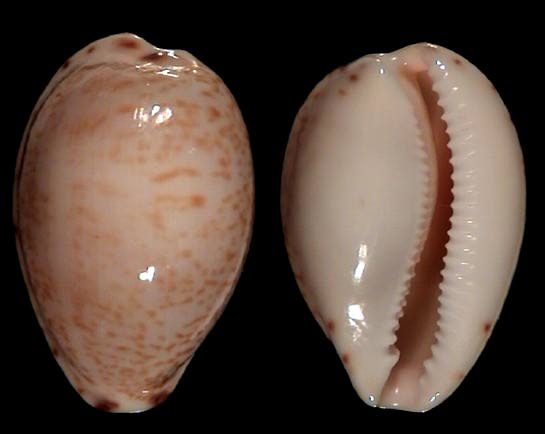
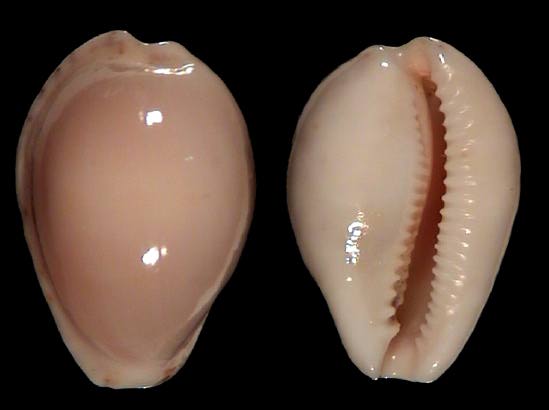
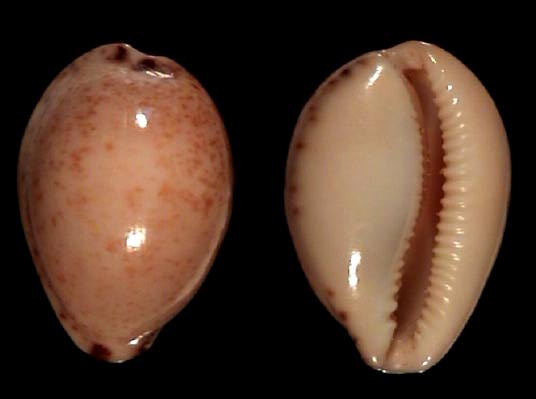
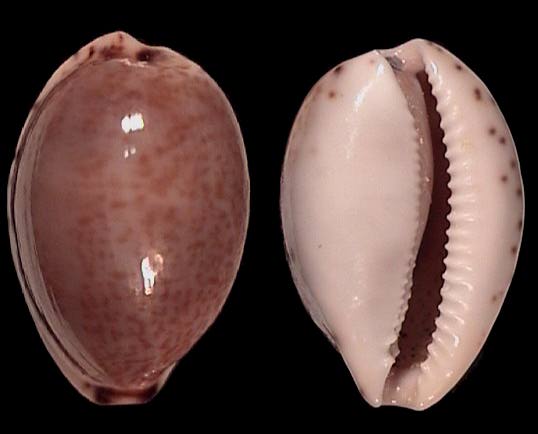
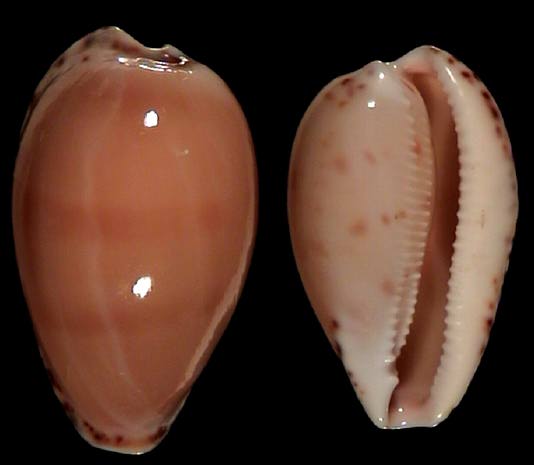
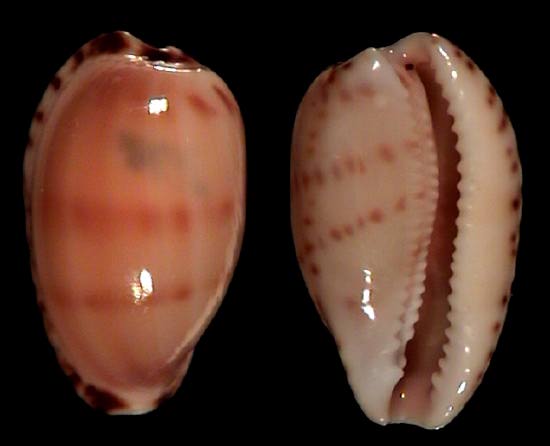
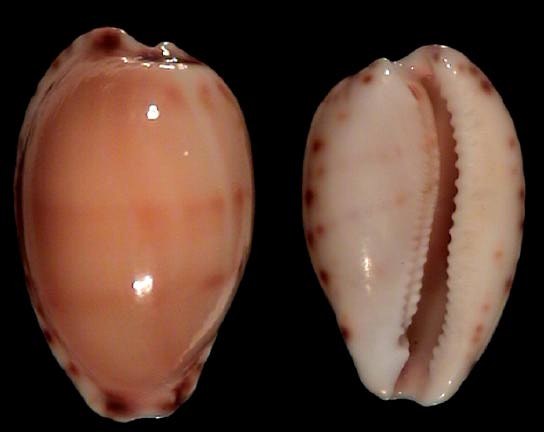
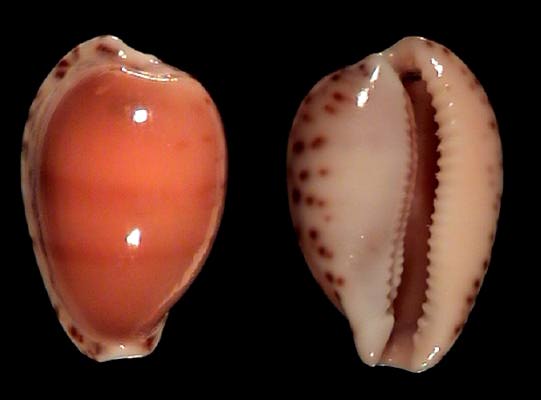
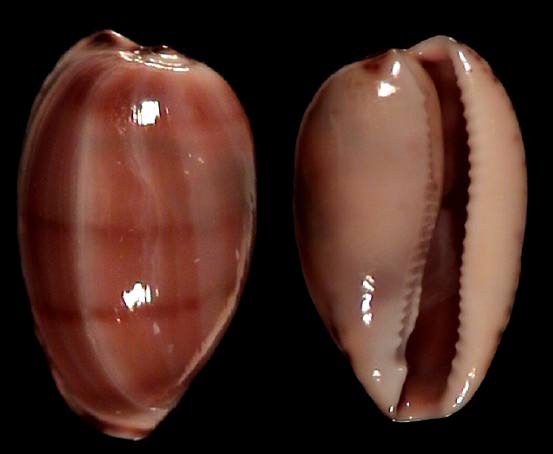
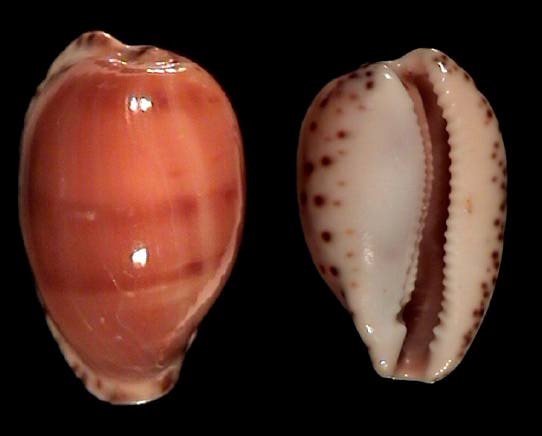
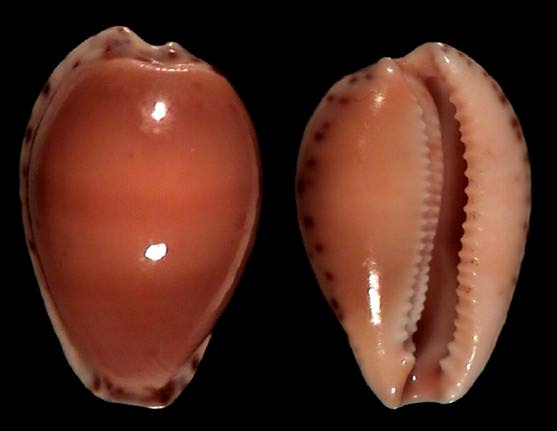
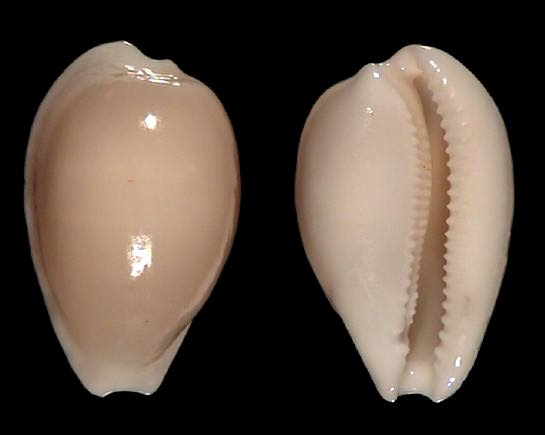
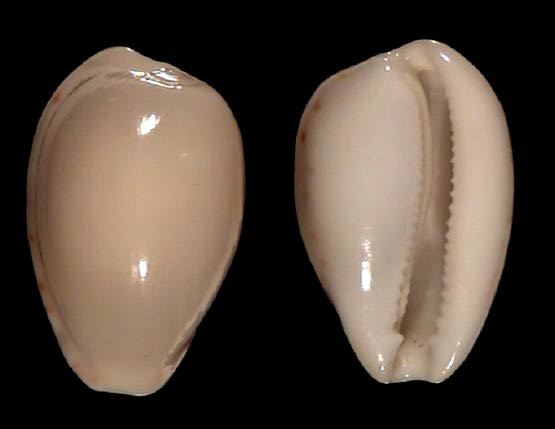
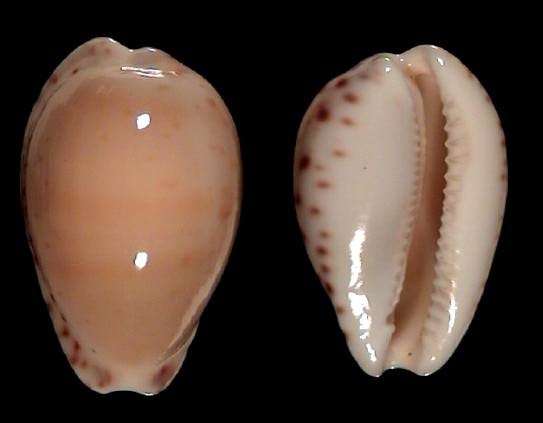
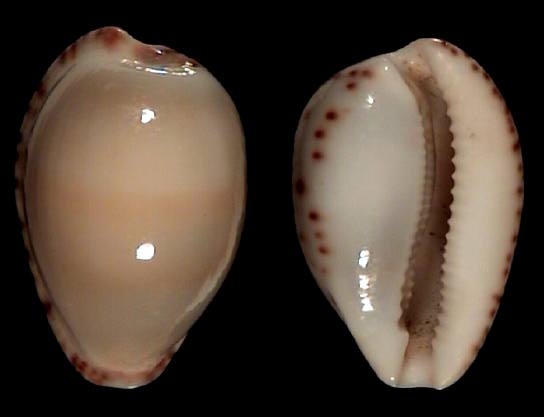
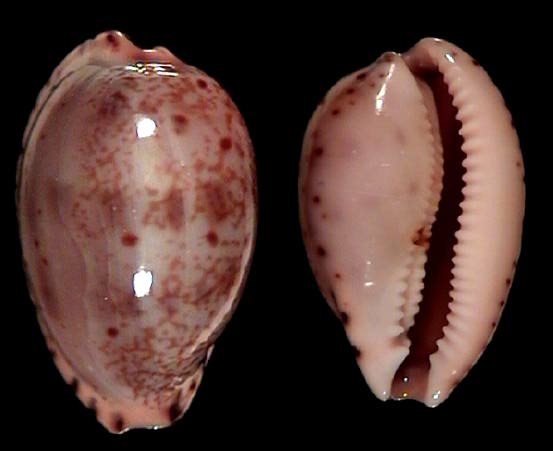
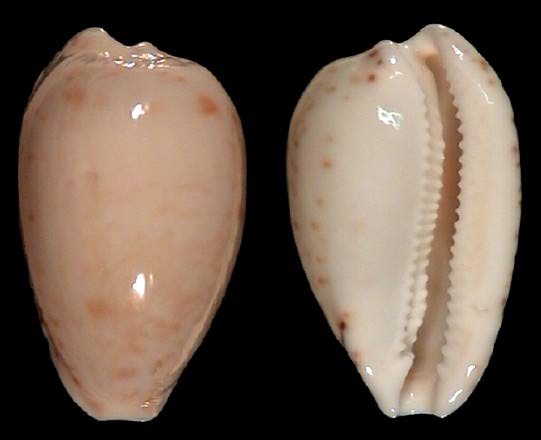
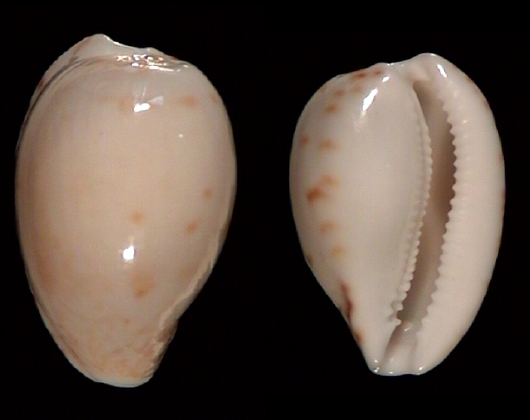
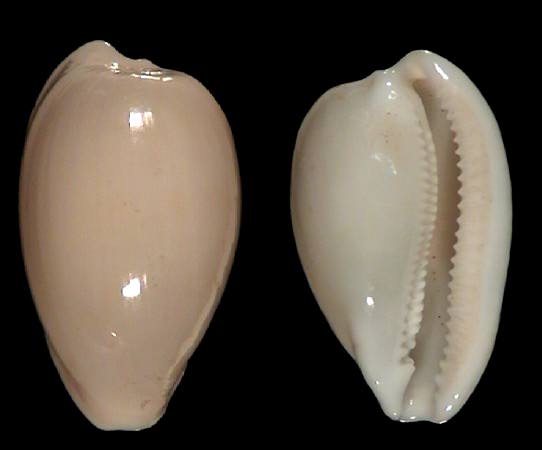
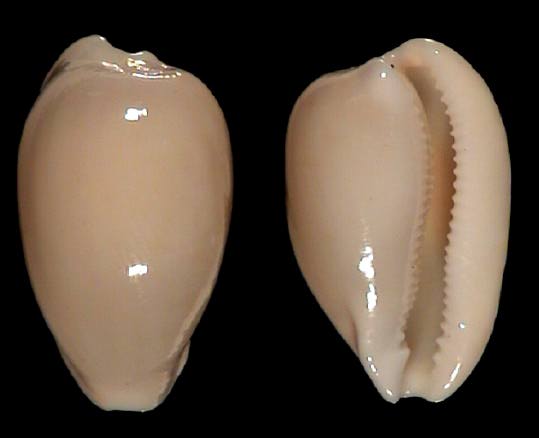
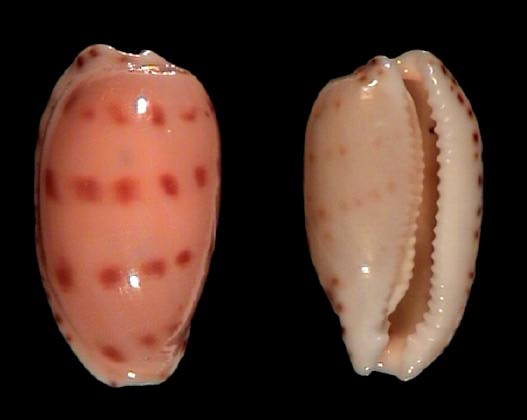
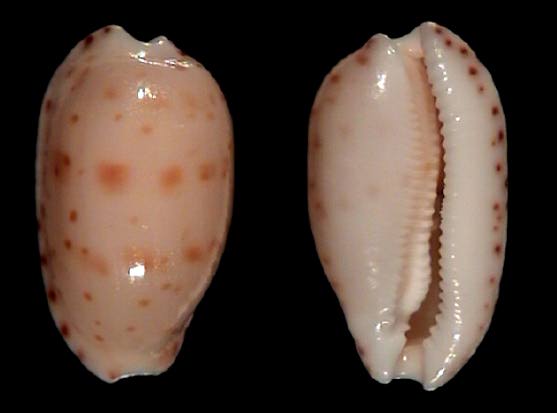
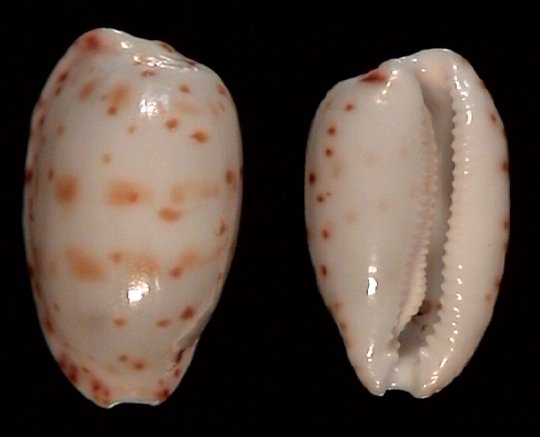
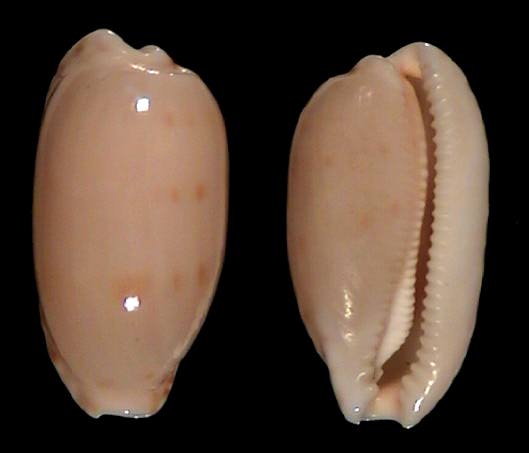
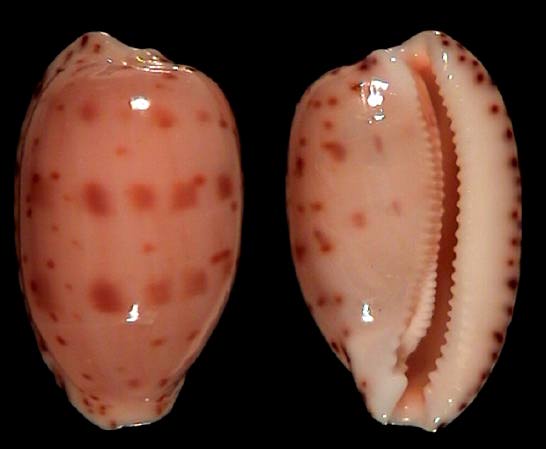
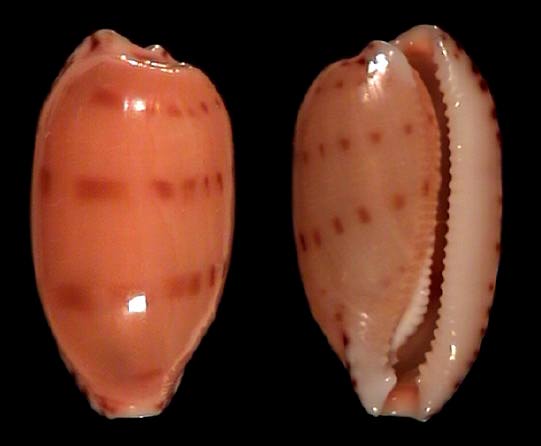
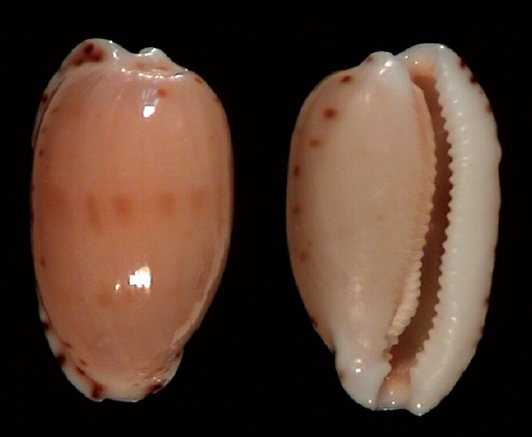
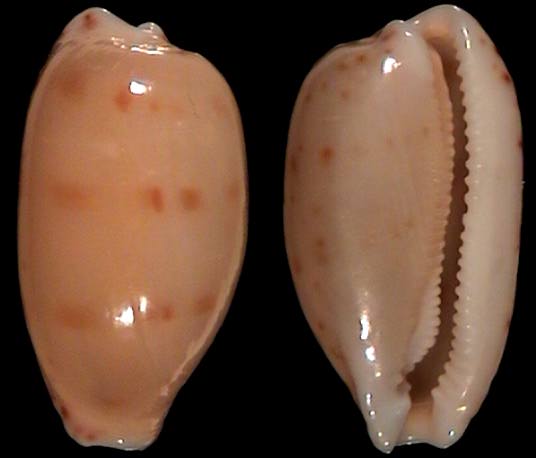
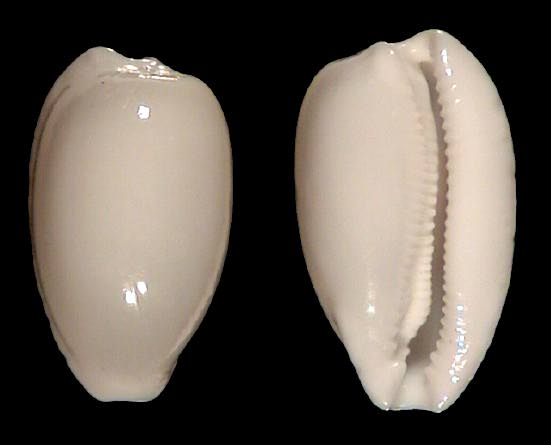
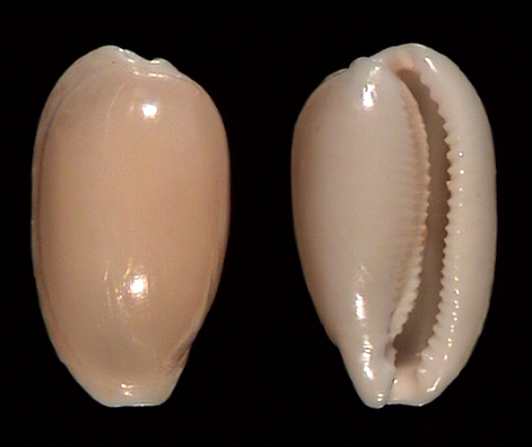
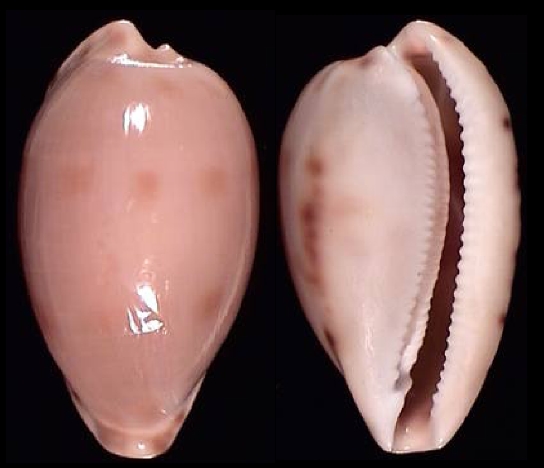
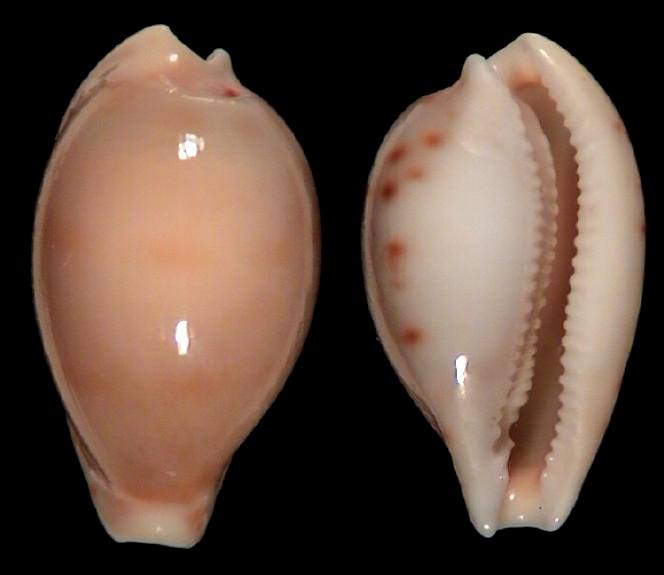
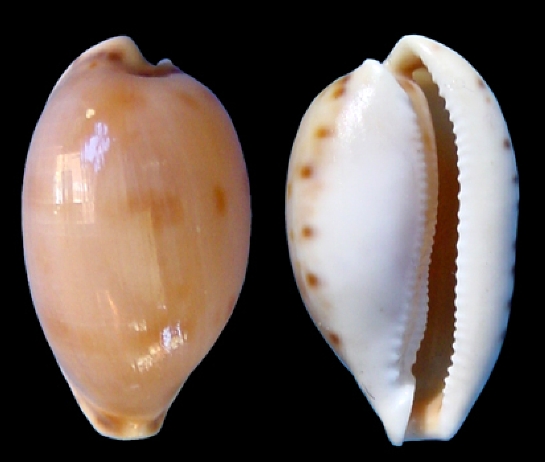
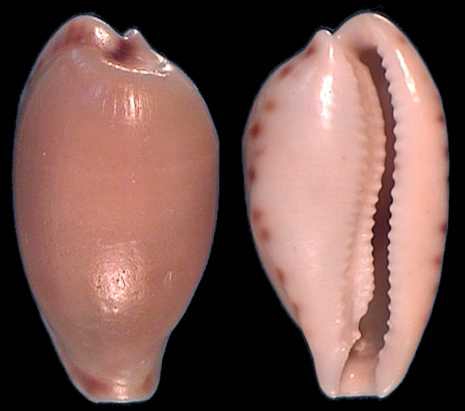
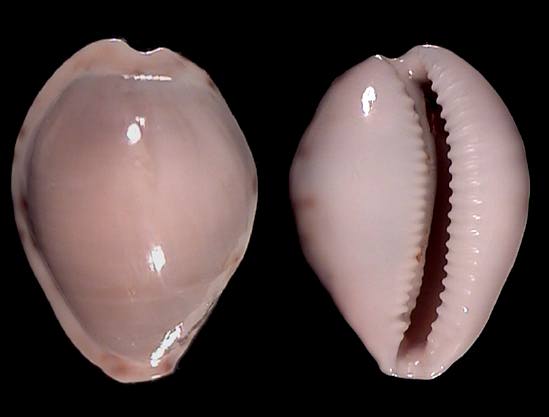
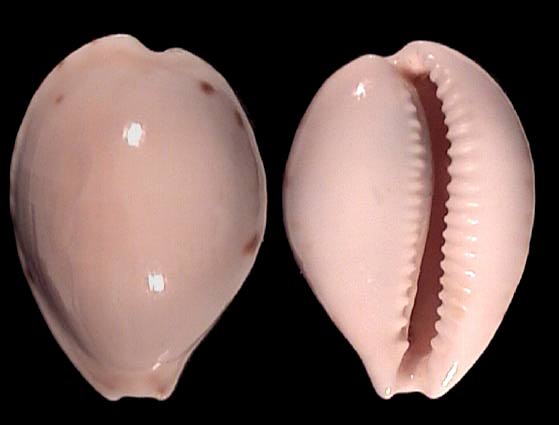
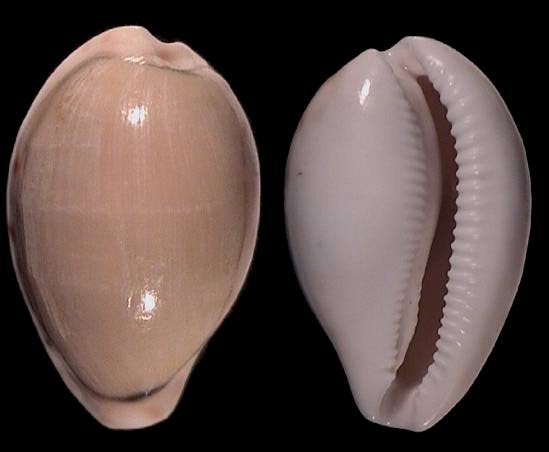
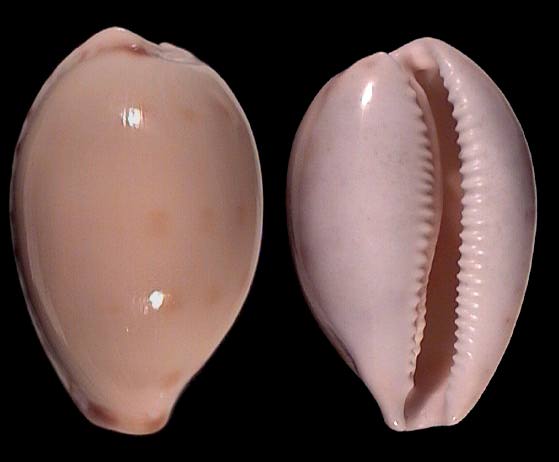
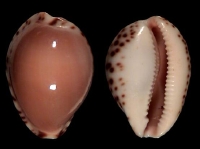
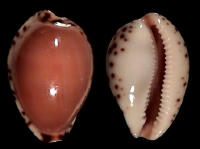
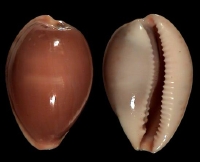
angustata: no subspecies or
forma-names. Synonym: castanea, verconis.
Oval depressed, flat fossula, dorsum mostly unbanded, white
to dark brown color, no pattern. Marginal spots small and dense.
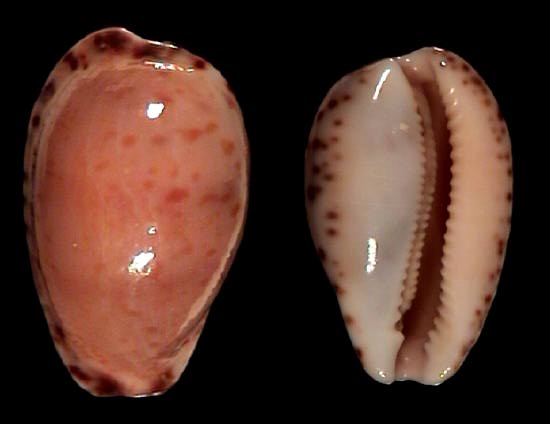
The labrum is declivous anteriorly. Shells from SA are usually
smaller, with larger and less dense marginal spots compared to
those from Vic. Shells from Tasmania vary greatly in size and
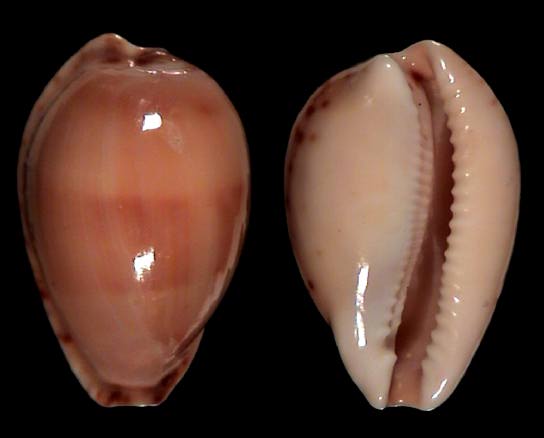
shape, some are black when freshly collected. There is a rare
form with a faint dorsal band, perhaps a result of interbreeding
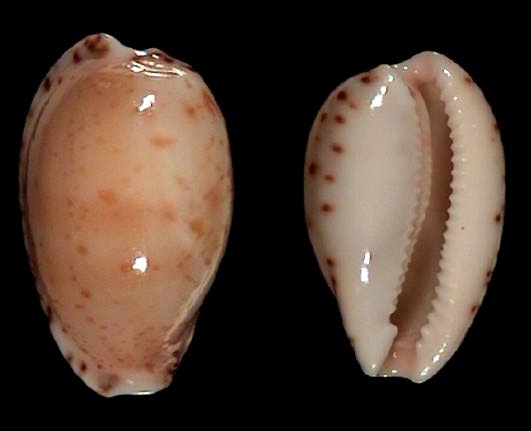
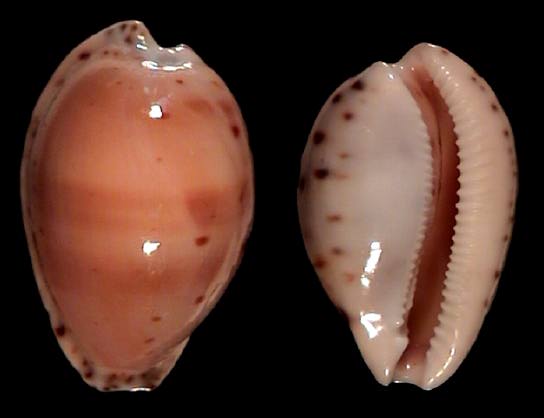
with comptonii. Varieties from deeper water, mainly found in
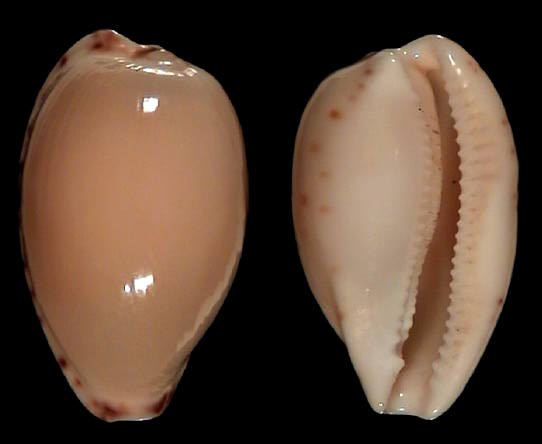
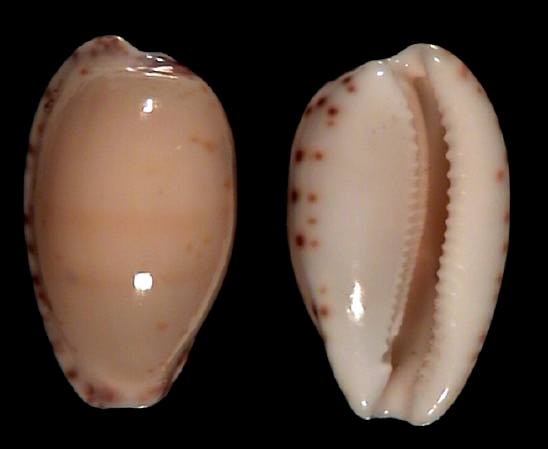
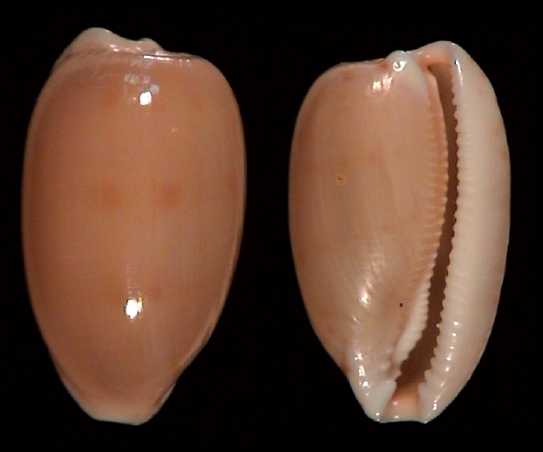
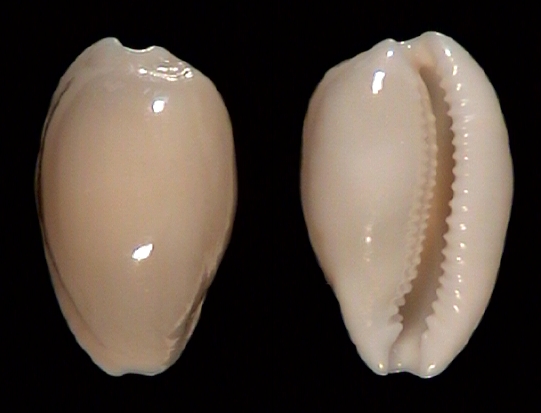
the Bass Strait area (Vic) have less marginal spots and sometimes
a very pale, almost whitish dorsum. The names emblema, molleri
and subcarnea were used for such shells in the past, however,
all these names belong to what is now recognized as subcarnea,
a valid species mainly found along the coast of Tasmania. Molecular
data separates the population from the western limit of distribution as
subspecies (verconis) but conchologically, the populations seem inseparable.
 |
 |
 |
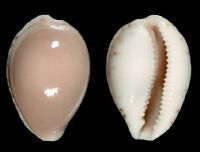 |
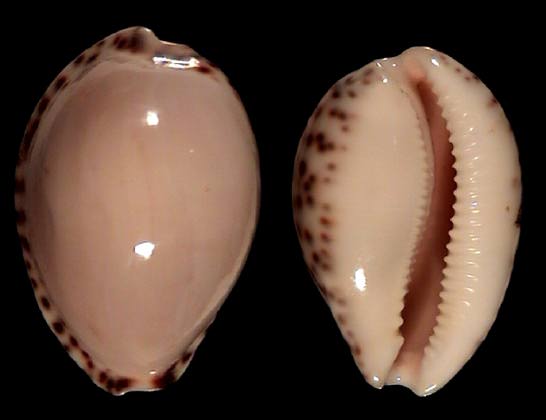
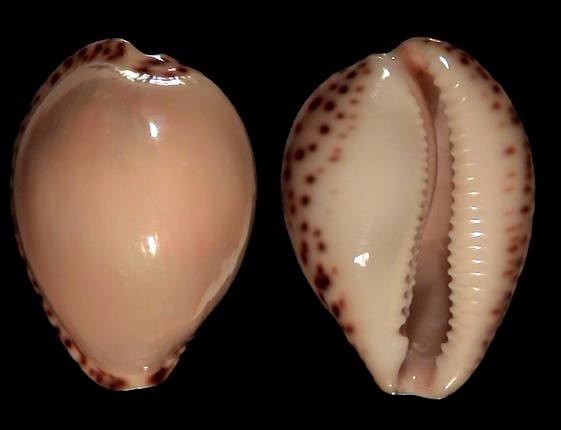
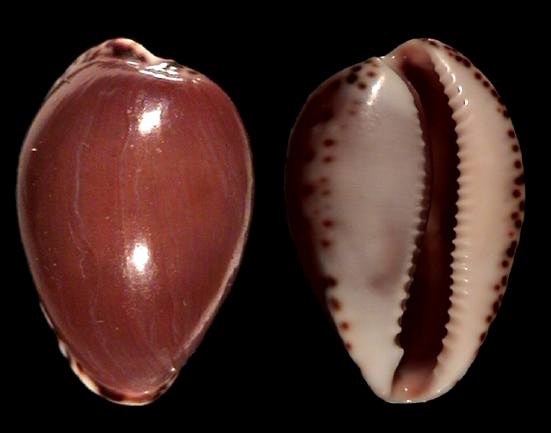
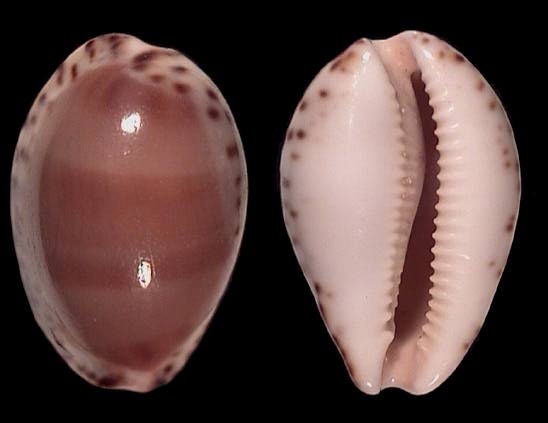
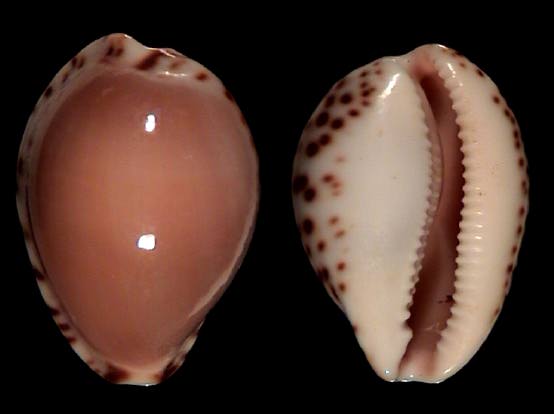
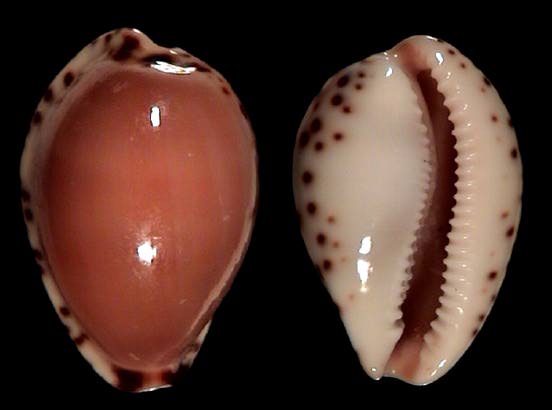
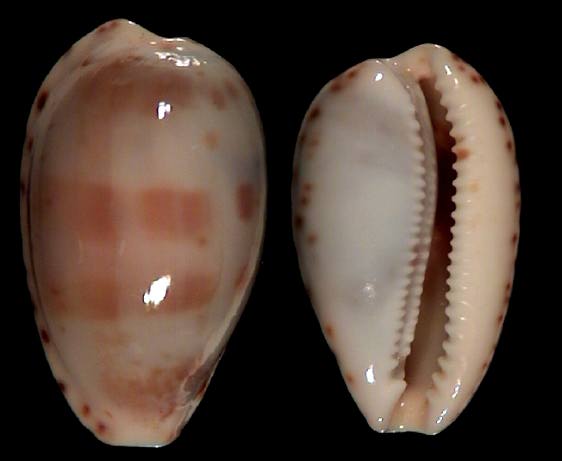
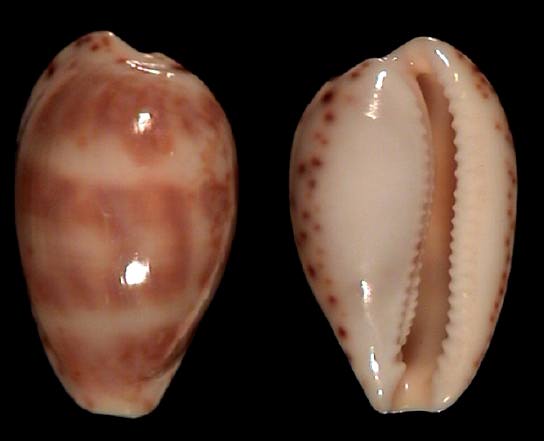
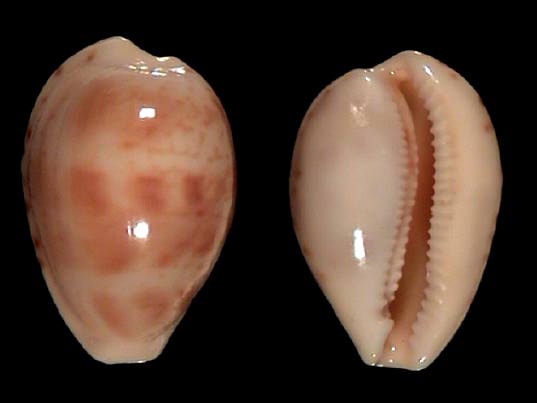
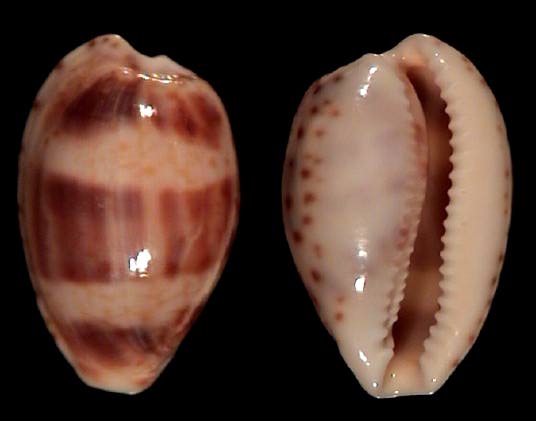
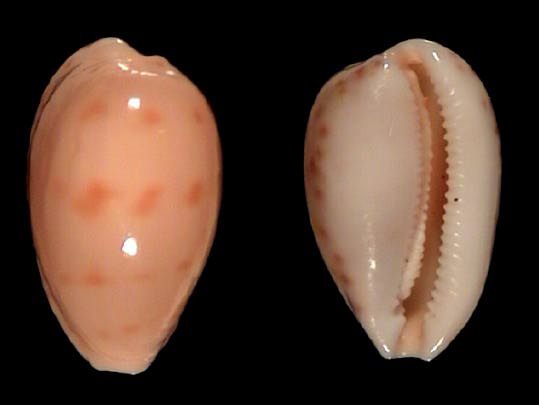
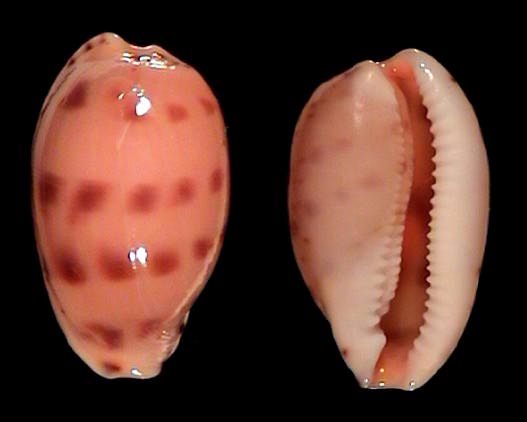
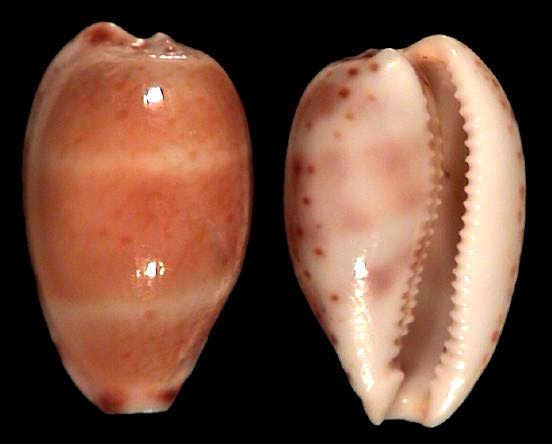
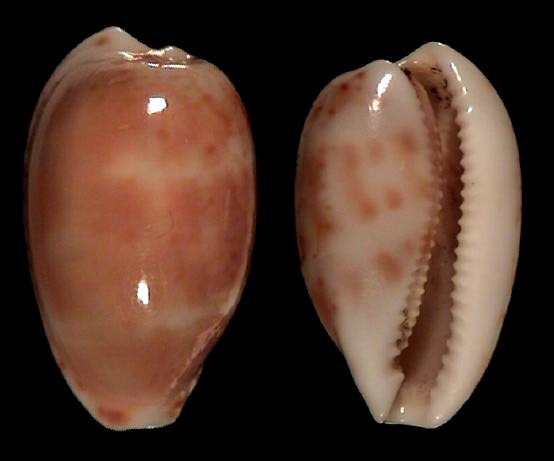
| angustata, western form, SA |
angustata, western form, SA |
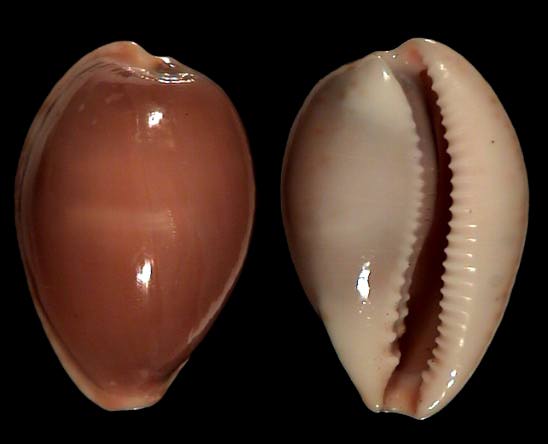
angustata, var. with reduced spots, Vic |
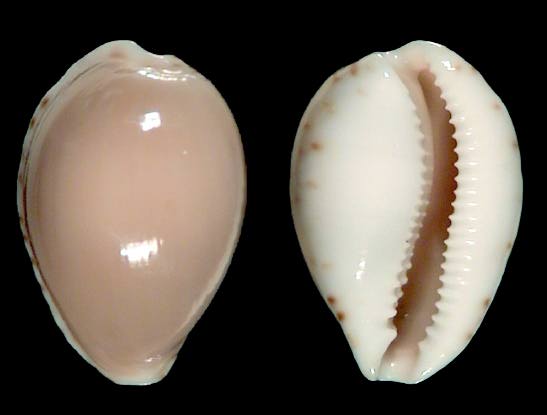
angustata, pale form, Bass Strait, Vic |
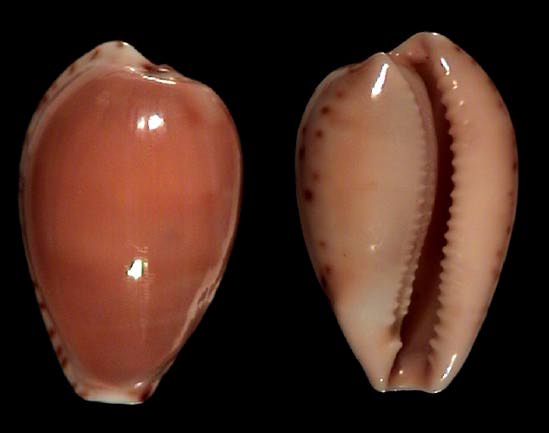
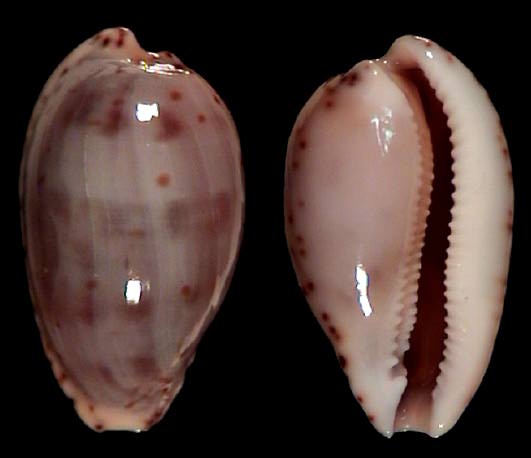
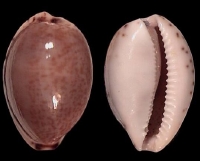
declivis: one subspecies: dennyorum
Oval, depressed, flat fossula, dorsum unbanded or faintly
banded with a compact transverse band, dorsum covered with minute
spots, marginal spots sparse and small. Occasionally albinistic.
Found in SA and Vic.
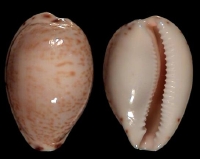 |
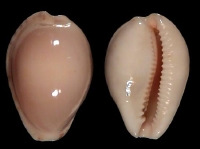 |
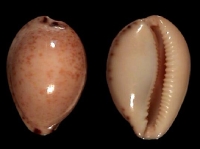 |
 |
| declivis, typical, Vic |
declivis, albinistic, Vic |
declivis dennyorum, Tasmania |
declivis dennyorum, variation from Tasmania |
declivis dennyorum: no forma names.
Southern Tasmanian specimens have more numerous marginal spots, a darker dorsum, are more solid and
shorter than those from other areas. Molecular data supports the status as separate subspecies.
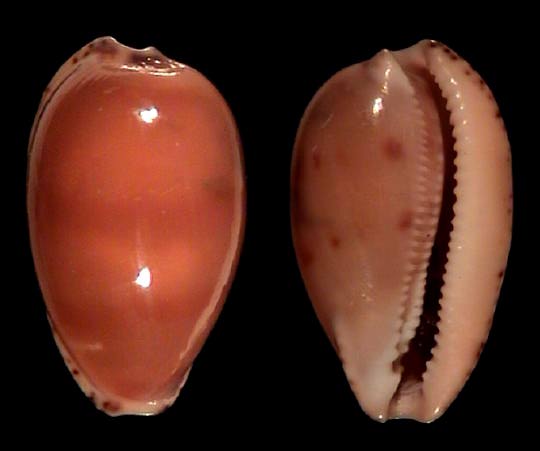
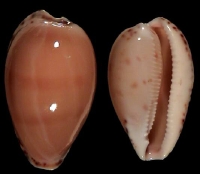
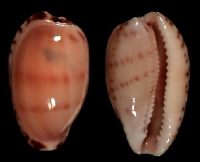
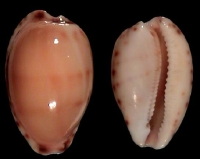
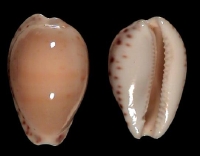
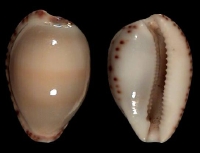
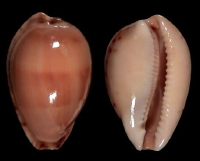
comptonii: no subspecies. Forma
names: casta, mayi, ereginae, griffithi, Synonym: trenberthae.
Elongate oval to pyriform. Fossula mostly slightly projecting.
Dorsum with a darker transverse zone with is darker along its
borders, most shells appear to have two narrow transverse bands
which are not interrupted towards the labral side. Dorsum often
finely spotted, rarely netted. Marginal spots small and dense,
mostly reaching onto base. The labrum is declivous anteriorly.
A very variable species found in WA, SA and Vic, but no subspecies
can be recognized based on geography. Therefore, the names formerly
listed as subspecies of comptonii are now regarded as mere individual
forms (mayi, casta, griffithi = formerly trenberthae). Specimens from SA and Vic may
have a dark brown base (variety griffithi), there is also a
wide range of purely white, pale orange to faintly spotted forms
found within populations from SA and Victoria (except Tasmania)
Many names exist to use on such shells and dealers have been
very inventive in the past, yet the only correct name to use
is casta. The callused and large variety mayi is found mainly
in Vic, with a yellow to orange shell and sparse or absent dorsal
spotting. Narrow specimens of that form from deeper water are
also known as wilkinsi. Nearly all forms of comptonii seem to
occur alongside in certain areas. The deeper water ereginae is known from the Albany/Esperance area (80-120 m) and has a stronger developed fossula and narrow aperture.
 |
 |
 |
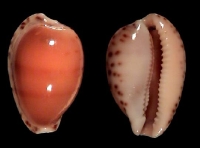 |
| comptonii, typical, WA |
comptonii, typical, WA |
comptonii, typical, WA |
comptonii, typical, WA |
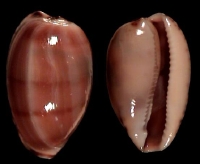 |
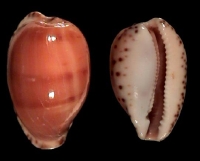 |
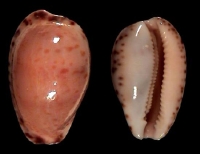 |
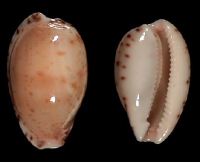 |
| comptonii, typical, SA |
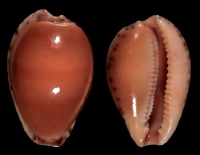
comptonii, typical, Tasmania |
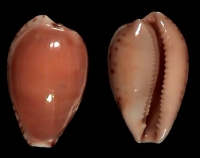
comptonii, typical, SA |
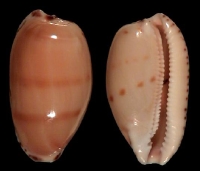
comptonii, typical, Vic |
 |
 |
 |
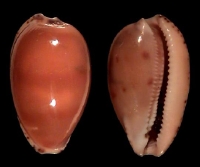 |
| comptonii var. griffithi, SA |
comptonii var. griffithi,
SA |
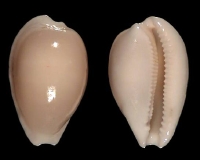
comptonii var. ereginae, deep water, Esperance WA |
comptonii var. ereginae, deep water, Esperance
WA |
 |
 |
 |
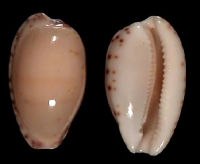 |
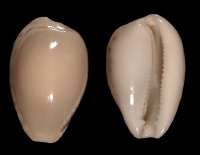
| comptonii var. casta, Vic |
comptonii var. casta, faint spots,
Vic |
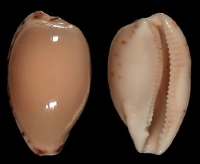
comptonii intermediate casta / mayi,
SA |
comptonii intermediate casta
/ mayi, SA |
 |
 |
 |
 |
| comptonii var. mayi, SA |
comptonii var. mayi, Vic |
comptonii var. mayi, Tasmania |
comptonii var. mayi, Tasmania |
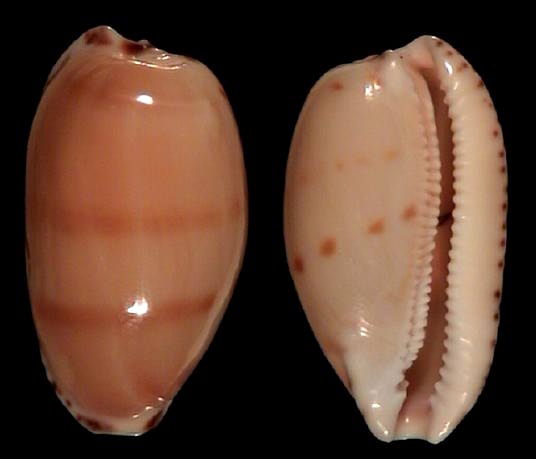
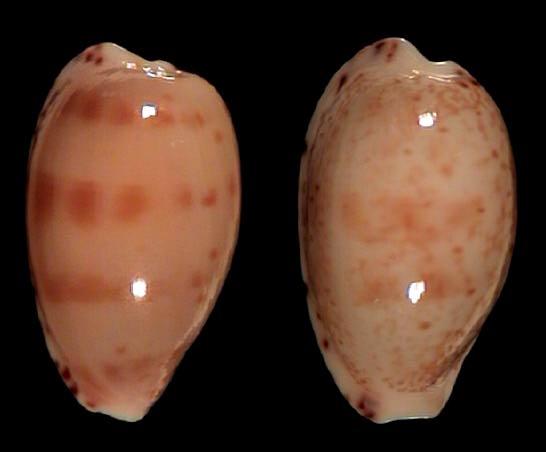
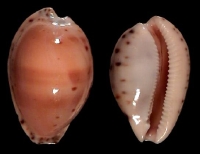
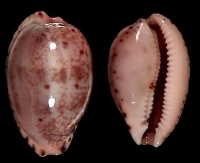
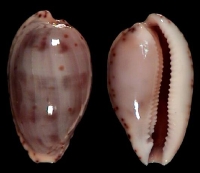
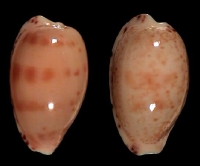
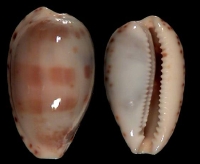
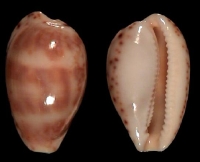
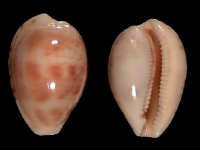
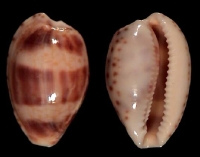
piperita: one subspecies: occidentalis.
Forma name: bicolor, wilkinsi. Synonyms: reticulifera, leucochroa
Elongate oval to pyriform. Fossula mostly slightly projecting.
Dorsum with a darker, usually interrupted transverse zone or
two to four interrupted bands. Dorsum often finely netted, often
along with larger spots. Marginal spots small, mostly not reaching
onto base.
A very variable species found in WA, SA and Vic. Albinistic
specimens do not seem to occur in piperita from SA and Vic. Specimens
with conspicuous dorsal banding are called var. bicolor, another
name formerly in use was dissecta, which is actually the cowry
formerly called hartsmithi (see below).
 |
 |
 |
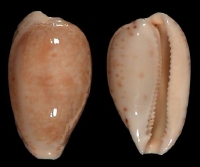 |
| piperita, typical, Esperance, WA |
piperita, typical, Esperance, WA |
piperita, typical, Albany, WA |
piperita, typical, Albany,
WA |
 |
 |
 |
 |
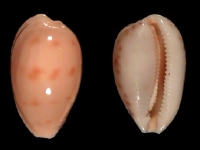
| piperita typical, SA |
piperita var. bicolor, SA |
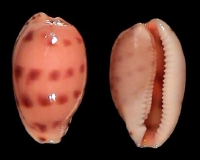
piperita var. bicolor, SA |
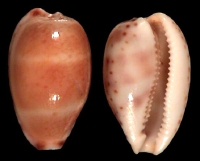
piperita var. bicolor, Vic |
 |
 |
 |
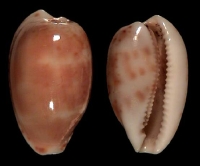 |
| piperita, deep water, Esperance,
WA |
piperita, deep water, Esperance,
WA |
piperita variation, Cape Recherche,
WA |
piperita variation, Cape
Recherche, WA |
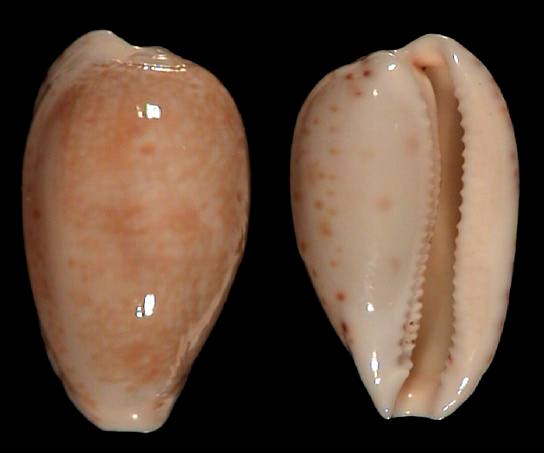
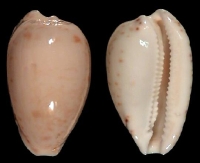
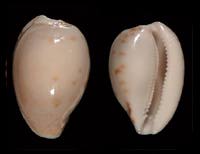
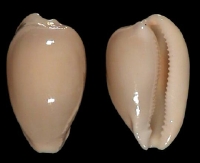
piperita occidentalis: Synonym: euclia
More pyriform. Aperture rather narrow, fossula more developed.
Pale cream to white, mostly with narrow interrupted bands, sometimes
very sparse pattern. From the western coast of WA, Cape Leeuwin
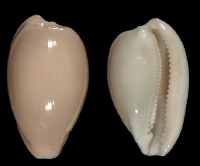
area. Sometimes albinistic, the name eulica was probably based on such shells.
Formerly considered a valid species, but similar shells are
found among typical piperita from other areas so that this taxon
should be considered a western subspecies, at most.
 |
 |
 |
 |
| piperita occidentalis, typical, WA |
piperita occidentalis, typical,
WA |
piperita occidentalis, albinistic,
WA |
piperita occidentalis, albinistic,
WA |
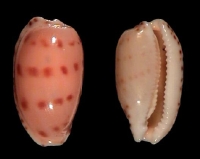
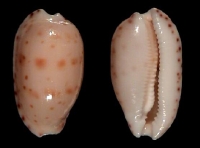
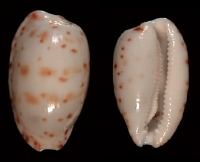
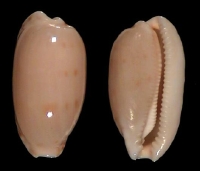
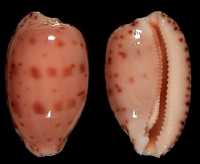
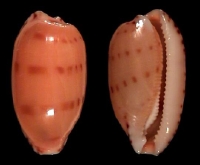
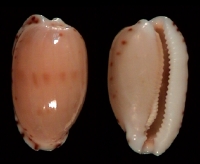
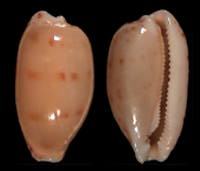
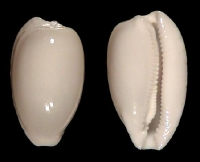
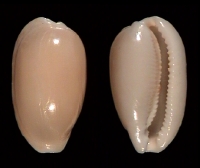
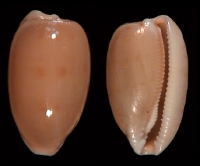
pulicaria: no subspecies. Synonym: candida
Narrow cylindrical, slightly depressed. Fossula distinctly
projecting. Dorsum with four narrow interrupted bands, mostly
with sparse spots. Marginal spots small and dense. Rarely albinistic
(var. euclia). Restricted to WA. A deep water (80-150 m) variation
from the Esperance area is more inflated, and a shorter fossula.
The name euclia is also misused for dwarf albinistic piperita
from the Cape Recherche area. Interestingly, the holotype of
pulicaria is distinctly spotted dorsally, but lacks the four
transverse bands.
 |
 |
 |
 |
| pulicaria, typical, WA |
pulicaria, typical, WA |
pulicaria, typical, WA |
pulicaria, pale, nearly unbanded,
WA |
 |
 |
 |
 |
| pulicaria, deep water, Esperance, WA |
pulicaria, deep water, Esperance,
WA |
pulicaria, deep water, Esperance,
WA |
pulicaria, deep water, Esperance,
WA |
 |
 |
 |
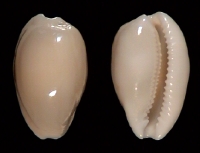 |
| pulicaria var. candida, Cape Recherche
WA |
pulicaria var. candida, Cape
Recherche WA |
pulicaria, Esperance, WA |
pip. occidentalis resembling euclia, WA |
dissecta: no subspecies or forms,
synonym: hartsmithi
Pyriform, mostly rostrate. Fossula slightly to strongly projecting.
Dorsum with four indistinct narrow, interrupted bands and no
other pattern. Marginal spots large and dense. The prominent
fossula along with the large marginal spots make this species
unmistakable.
In an important paper published in the Records of the Australian
Museum in 1931, Tom Iredale described several subspecies and
forms of Eastern Australian cowries. Among them is Notocypraea
dissecta from 90 m depth off Twofold Bay, just south of
Eden, New South Wales. The illustrations of the holotype are
poor, but one feature of the 21 mm shell is visible: large lateral
spots. Its geography and this feature had given me the suspicion
that dissecta might be an earlier name for the elusive
Notocypraea hartsmithi Schilder from New South Wales.
At last, I managed to trace the dissecta type with the kind help
of Dr. Alison Miller and Dr. M. G. Allen of the Australian Museum,
who submitted photographs. The large, sparse marginal spotting,
slender shape, umbilicate spire, rostrate extremities and the
projecting fossula, the fine dentition and the faint middorsal
banding agree and it is apparent that hartsmithi and dissecta
are conspecific. Therefore Notocypraea dissecta Iredale
1931 must be given priority over Notocypraea hartsmithi
Schilder 1967. That name was described on the basis of a single
beachworn specimen collected at Wyargine, Sydney. (Original Reference:
Notadusta hartsmithi F. A. Schilder (1967) Arch. Moll.,
Vol. 96, p. 3941.). F.A. Schilder gave a detailed and accurate
analysis of the specimen, along with details of the characteristic
fossula. A second specimen was later found on the same spot,
largely confirming Schilder's first diagnosis. This specimen
is not available to me for study. After these two findings, it
became quiet around hartsmithi and dissecta. Both names
were virtually forgotten, and listed as synonyms of comptonii,
and the name dissecta was also in use for piperita
with distinct banding and reduced dorsal pattern.
When I met Lance Moore in his shop at "the Rocks" in
the downtown of Sydney in 1982, he gave me a batch of beachworn
Notocypraeas of all blends, with the remark: see what
you can find out on these. Back in Germany I realized that one
specimen was quite different from all the others. It contained
a label stating "Hacking River", which is an area near
the Sydney harbour, and i had a deja-vu. Some research in my
piles of xeroxed cowry-literature finally produced what I had
been looking for - the description of the "Sydney-Cowry"
hartsmithi. Comparing the poor photo with my shell I had
no doubt that I was looking at a hartsmithi. For the next
years, I kept searching through all collections and selections
of Notocypraeas I could locate, with a couple of "almost-
hartsmithi-like" shells showing up, but none was actually
the "real thing".
When the work on the "Guide to Worldwide Cowries" began,
my hartsmithi remained the only specimen we had at hand.
It took a long time to convince my late friend Alex Hubert that
even on the basis of this one shell it was necessary to list
hartsmithi as valid - in the end he surrendered with more
than just reservations... Of course, the rarity of hartsmithi
made a lot of people point at me with criticism, I agree it must
have appeared a bit forward to draw conclusions from just one
shell and a poor xeroxed b/w photo.
During the decades of a split Germany, Schilder's collection
with the holotype of hartsmithi was hidden away in chests
and boxes in the Museum of East Berlin, inaccessible to us. After
the fall of the Berlin wall the holotype finally could be located
in what was left of the Schilder-collection. It was photographed
for me by Dirk Fehse of Berlin in 1997. Little later, a livecollected
hartsmithi appeared in an old Australian collection: much
smaller, paler, and from further south (Bass Strait area), but
conchologically typical. Now I am able to show another, very
typical specimen corresponding exactly with the holotype and
my first specimen. It was collected on a beach south of Sydney
and is in moderately good condition.
Since then, at least a dozen more specimens of N. dissecta
(hartsmithi) were collected, from fishtraps off New South Wales,
and by a divers at 15-25 m, in different areas in New South Wales.
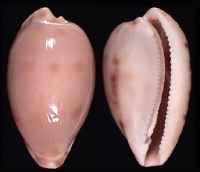 |
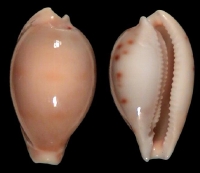 |
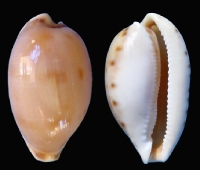 |
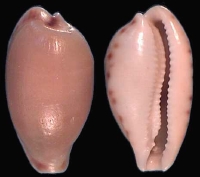 |
| dissecta, typical, NSW |
dissecta, deep water, NSW |
dissecta, typical, NSW coll. Hawke |
dissecta, typical, NSW |
subcarnea: no subspecies or
forms, Synonyms: albata, emblema, molleri
Oval, depressed to inflated, usually large. Flat fossula,
ribbed posterior columella. Dorsum whitish to cream, sometimes
with very faint narrow interrupted bands. The labrum is gently
curved anteriorly, and not declivous as in comptonii and angustata.
Recently, studies of the holotype of subcarnea revealed
that this name has been misinterpreted as a variety of angustata,
which differs by having smaller and denser marginal spots and
a posterior columellar ridge instead of ribbing. A comprehensive
study was published recently in the Visaya-magazine. It is a
valid species supported also by DNA differences. It seems restricted
to Tasmania and the Bass Strait.
In a review of the cowries from Tasmania, Beddome (1897) compares
numerous variations of Notocypraea collected in Tasmanian
waters. He differentiates between comptonii, piperita,
declivis and angustata. He assigns four main variations
to latter species: angustata typical, var. subcarnea
(which he refers to as a taxon suggested by Ancey), var. albata,
and var. mayi (which today is assigned to comptonii).
In his hand-drawn plates he illustrates these in an easily recognizable
way. Hugh Morrison and Simone Pfützner supplied a set of
livecollected Notocypraea from the South of Hobart, Tasmania,
as well as a large collection of shells gathered on 7 Mile Beach,
Port Stanley, Northwestern Tasmania over a period of many years.
Among that material, I noticed a strange cowry that recalled
me of a shell I had studied in the British Museum in summer 1985:
the holotype of subcarnea. That shell (reg. No. 1900.11.14.26)
confirms my Tasmanian series as being the true subcarnea.
From a single livecollected shell taken by Hugh Morrison at 6
m in the southeast of Tasmania, along with declivis and
angustata, a piece of dried animal was recovered and sent
to Dr. Christopher Meyer for DNA analysis. He managed to retrieve
enough material to sample the specimen and informed me that it
did not correspond at all with any of the classic Notocypraea-species
but seems closest related to Notocypraea dissecta
(formerly hartsmithi, see above) from New South Wales,
which had just been included in the database (Meyer 2004). Finally,
I found another, apparently live taken, specimen trawled at
unknown depth in the north of Tasmania - in my own collection,
wedged inbetween boxes in a drawer of "odds and ends".
Notocypraea subcarnea Beddome has a large (21-32
mm), depressed shell with a moderately strong callus along both
sides, the spire is covered with callus and deeply umbilicate
in juvenile shells. Some specimens are fairly elongate and drop-shaped.
A feature of some shells is a transverse ribbing of the shell-surface,
already noted by Beddome. The base is convex, the short extremities
are callused dorsally. The labrum is convex, its outer margin
is angular and bent up towards the dorsum. The dentition is very
fine, extending slightly onto the labrum and the base. The fossula
is fairly well developed, showing three to six denticles. The
aperture is wide and strongly curved throughout. The posterior
end of the columellar side is distinctly ribbed. The anterior
terminal ridge is very short and declivous. The dorsum is pale
yellow-cream, without secondary pattern but mostly with four
rather indistinct and narrow interrupted brown bands. The marginal
spots are large, sparse, rather pale and mostly situated towards
the dorsal part of the margins. The basal aspect rarely shows
any spots. The extremities are conspicuously tinted darker. The
animal seems to be bright red judging from the remnants found
in the dived specimen.
Notocypraea subcarnea differs from angustata
by the posterior end of the columellar side being ribbed instead
of smooth. N. subcarnea is more depressed and paler, the
banding differs by being narrow and interrupted whereas in the
rare specimens of angustata that show a banding that is
broad and uninterrupted. The anterior terminal ridge of angustata
is longer and rather straight, the aperture is less curved. The
extremities of angustata are shorter and less callused.
The most easy to determine feature separating subcarnea
from angustata and all but one species of the genus is
the sparser and much larger spotting of subcarnea. That
feature is shared only with Notocypraea dissecta
which also has a similar dorsal banding, but which is a narrow,
elegantly rostrate species with a stronger fossula. It is interesting
to note that the formation of the marginal spotting of most Notocypraea
supports the genetic relationships. Those species which differ
from having coarser and sparse spotting (dissecta and
subcarnea) are also closest related and more remote from
the rest which all have very fine and dense marginal spots (declivis,
comptonii, piperita, angustata and pulicaria).
These conchologcial features are consistent within the series
studied. A comprehensive revision of the genus, including comprehensive
statistical analysis, is in preparation.
The relative rarity of subcarnea has probably supported
the fact that it was overlooked for so long. It seems endemic
to the shores of Tasmania. Its name has instead been misused
for all kinds of pale variations found in Notocypraea,
e.g. the white shelled form of comptonii (variation or
subspecies casta), or pale specimens of angustata
from deeper waters. Incidentally, Beddome's albata (introduced
after subcarnea in the same 1897-paper) is also based
on a specimen of subcarnea and therefore becomes a synonym
of that species.
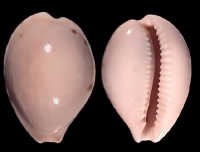
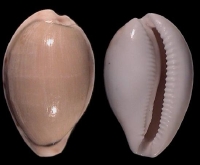
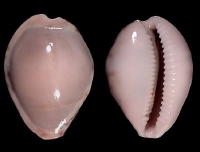 |
 |
 |
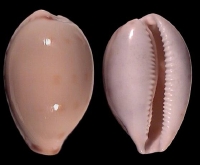 |
| subcarnea, typical form, Tasmania |
subcarnea, typical form, Bass Strait,
Vic |
subcarnea, large form, Tasmania |
subcarnea, large form, Tasmania |
In the Conchologists of America Vol.35 No. 2, Don Cram reports
the re-discovery of Notocypraea emblema. He illustrates the holotype,
which clearly shows all the conchological features of subcarnea,
including the characteristic large marginal spots and the ribbing
of the posterior columellar canal. The shell is slightly distorted,
hence the labrum does not look very characteristic but is untypically
curvy. In his most interesting article he illustrates radulae
of different species of Notocypraea, including that of the holotype
of emblema (hence the first illustration of the subcarnea-radula).
He discusses a cowry he calls Notocypraea sp. x cf. emblema on
page 16 fig. 2 and 3. These illustrations in my opinion show
N. comptonii var. casta with faint labral spots. The fossula
region, the small size and density of the marginal spots, the
declivous labrum and the smooth formation of a posterior columellar
ridge bordering the canal reveal that these shells are not the
same species as the shell shown in fig. 1 on that page, whose
ribbed posterior columellar canal, the rather evenly curved instead
of declivous labrum and larger sparse marginal spots identify
it as subcarnea. The radula for comptonii is not shown to compare
with the shells labelled N. sp. x cf. emblema, but in Bradner
& Kay's Catalogue of Cowry Radulae fig. 210 there are good
illustrations which reveal that Cram's shells have radulae most
similar to those of comptonii.
Aug. 2007, reviewed 2021