The many faces of Muracypraea mus -
a personal view on Mouse-Cowries
Perhaps I should have known that any change made to the usage of names in our "Guide" needs a comment and an explanation. I am thankful to Mr. Moshe Erlendur Okon for pointing out a subject I should have given some detailed explanation. Here is what he wrote on the Conch-L:
Shalom to all,In January, I posted the following to Conch-L. There were no responses, and so try again I shall.I am wondering about the
status of the different Mouse Cowries. In the Guide to Worldwide Cowries by Lorenz and Hubert two subspecies are mentioned: mus mus and mus bicornis. Regarding the taxon (?) donmoorei they write: "In view of the immense variability of all cochological features within this group it has become common usage to call all the large, mostly tuberculate mus by the name donmoorei, which is, however, not allowed according to the laws of nomenclatural priority. There can be no doubt that the specimen described and illustrated by Sowerby in his Thesaurus Conchyliorum as Cypraea mus var. bicornis belongs to this complex and therefore represents the valid name, replacing the widely used donmoorei." So it is clear that donmoorei is regarded here as a senior synonym of bicornis. On Dr. Lorenz' updated checklist for Cypraeidae the genus Siphocypraea is replaced by Muracypraea, but again, with no mention of donmoorei.However, on his Cowrie Sales Catalogue, Dr. Lorenz lists a "mus donmoorei - the true form, dense, course dentition". So is there a clear cochological difference between the two after all? And if the answer is 'yes', is donmoorei a form of mus or of bicornis, a subspecies of mus or a separate species? To complicate the mus mess, I have a specimen taken at low tide on eel grass which is tuberculate and therefor bicornis. However according to the Guide bicornis is restricted to deeper water. Sincerely, Moshe ErlendurLast year I met Prof. Dr. Edward Petuch in Florida and had the chance to examine some material, including a donmoorei-paratype and a specimen of the elusive tristensis which I had not been able to study till then. I have actually not changed my personal standpoint on treating donmoorei, birconis and tristensis as being basically mus.
As I am aware of some sort of revision being in preparation by another authority, I shall only shortly give an update to my personal classification, and explain why I used both, donmoorei and bicornis in my sales catalogue.
But vefore, I wish to point out again at what I have written at the end of my Zoila book, as this might explain a bit my way of proceeding in the usage of names:
"Personally, I doubt that at this stage anyone will manage to offer an infallible, universally accepted systematics for all the different scenarios of speciation observed in the Cypraeidae, especially when it comes to evaluating lower level taxa. The question whether a taxon is a valid species, or a subspecies of another, is overemphasized in presentday debates, in my opinion. At times in which the registration of biodiversity can hardly keep pace with the destruction of worldwide biotopes, giving names along with precise descriptions and good illustrations for separable populations and demes is the task of a modern taxonomist. To ensure precise communication among amateurs and professionals in the field of malacology, it is advisable to work with a differential rather than integrating, retrogressive taxonomy. In other words, different shells should have separate names so that we can talk about them."
The second thing I need to point out again is that my web-checklist and what is written here is not a publication and therefore provisional. Please dont nail me down on what I put up here. It is for your information and your entertainment, and as subjects of discussion, but often far from being my last word on a subject. As you will all know I am wrong in many places, and I am always happy to change my mind as soon as I am able to learn more.
The generic question. The genus Siphocypraea was introduced for the fossil S. problematica. In the Pliocene, this group of cowries lived in the Okeechobee-Sea, an ancient lagoon system now forming the Floridian peninsula. This sea gradually became a brackish swamp, the cowries and all other molluscan fauna had to adapt rapidly and formed innumerable forms, about eight or so conchologically separable species-groups, which Prof. Edward Petuch proposes to split into more than 60 palaeospecies and four or so subgenera. In any case, the lineage of Siphocypraea has nothing to do with mus, except that these apparently had have a common ancestor. The most similar fossils from South America resembling mus are placed in the genus Muracypraea - I tend to use this as generic name for the mus of today's time, too. Work needs to be done in this case, still.
Splitting up the mus?! Alex Hubert convinced me that the illustrations of bicornis looked a lot like those Columbian donmoorei that were found, that was the end of this name for the Guide... Noone can tell now where the bicornis-type came from. It is this same problem about many of the synonyms of mus that they could have either been used on a donmoorei-like shell, or a Venezuelan mus which is extremely variable. For the time being I tend to use the name donmoorei again because it was clearly defined for shells from deeper Columbian waters, with one feature that is actually working well: the white interior of the shell. Even the tuberculate (mostly) deeper water mus have dark interiors, but there are intermediate stages, too. But that tells us little about the biological status, which in the case of donmoorei was indeed discussed by Petuch. His argument that the Columbian donmoorei feeds on sponges is speaking in favour of a separate species against the herbivorous mus from Amuay Bay. But what about the intergrades between the typical mus from Venezuela and donmoorei-like shells from Columbia, I mean those heavy-shelled mus with tubercles that may also occur in shallow water at Amuay Bay (as Mr. Okon correctly mentions)?? Simply, I dont know. It is hardly to say now whether bicornis was such a shell or a deep water Columbian donmoorei. Conchologically, the differences are very slight and individual shells may be inseparable. As for the usage of names, my proposal is the following:
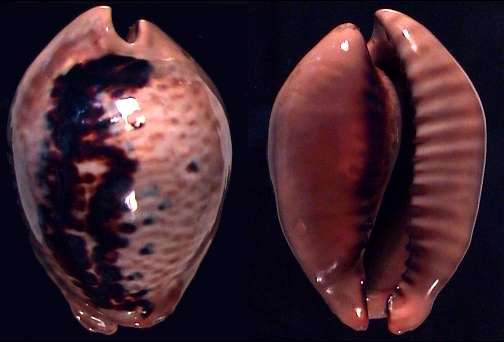
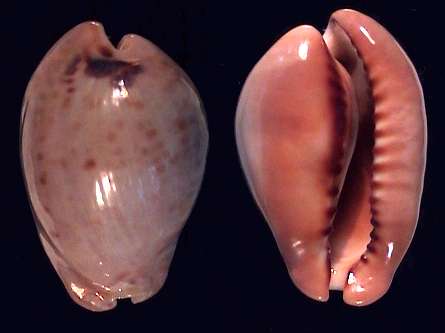
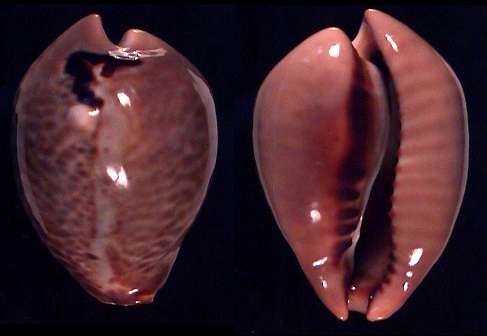
mus mus, typical, with faint tubercle
mus mus, large, heavy shell
mus mus, typical lightweight shell
1. mus mus
Range: Venezuela, especially Amuay Bay
Habitat: Shallow water (1-2 m) to at least 30 m. On eelgrass beds.
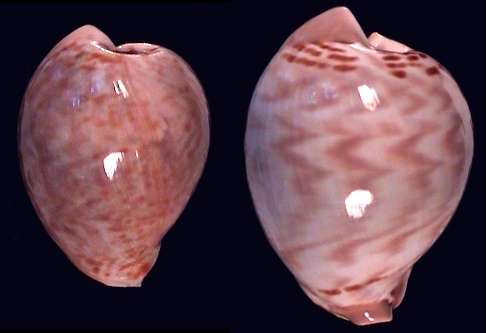
Shell features: Rather small, light weight. Rarely with a small tubercle. Greenish ground colour. Juvenile with dense zigzac-bands. Interior purple-brown. Columellar teeth absent midway, a distinct black blotch along the aperture in this region. The anterior extremity is mostly rather short.
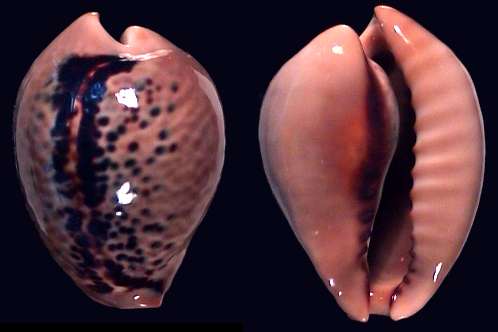
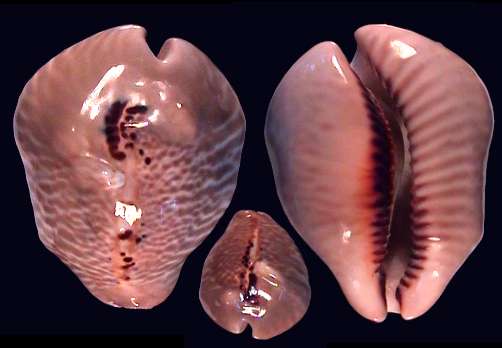
mus bicornis, Venezuela, specimen resembling donmoorei
mus bicornis, typical specimen. Note the paler interior of the shell
mus bicornis, note the fading columellar teeth
2. mus bicornis
Range: Venezuela, also Amuay Bay
Habitat: Shallow water (1-2 m) to at least 30 m. On eelgrass beds.
Shell features: Usually larger, more heavy, with more or less distinct dorsal tubercles. Juvenile with dense zigzac-bands. Interior much paler, whitish-brown zones on whitish. Columellar teeth fading midway, yet more distinct than in typical mus, same confluent black blotch along the aperture in the midsection. The anterior extremity is produced, spoonlike.
Juvenile specimens, left: mus, right: donmoorei
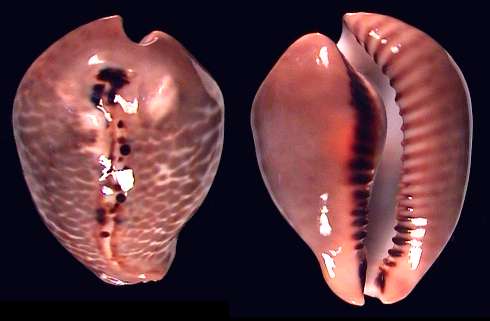
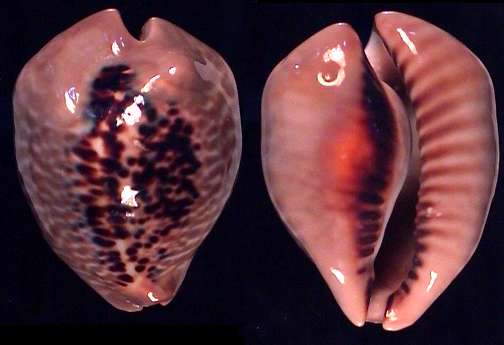
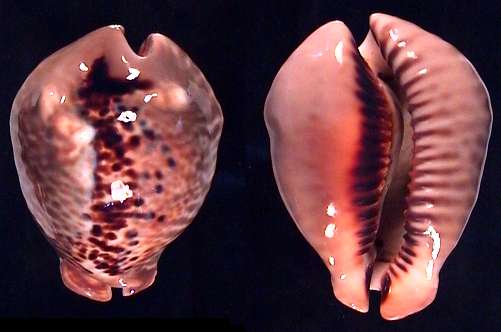
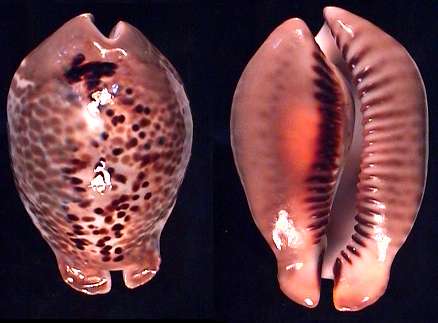
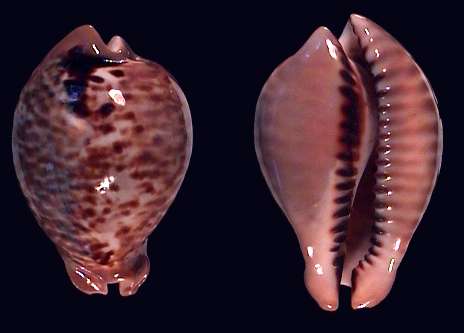
mus donmoorei. The columellar teeth are distinct throughout, the interior is white
mus donmoorei, specimen with spoonlike anterior extremity
mus donmoorei, specimens with short anterior extremity3. mus bicornis var. donmoorei
Range: Columbia, offshore
Habitat: At least 30 m and deeper. Feeds on sponges.
Shell features: Rather large, very heavy. Juvenile with wide, distinct zigzac-bands. Interior white. Dorsum mostly tuberculate, but smooth forms are also found. Columellar teeth distinct, dense and long throughout, no confluent black blotch along the aperture, but a bright orange blotch (occasionally in m. tuberculata, too). The anterior extremity is either produced, spoonlike, or short.
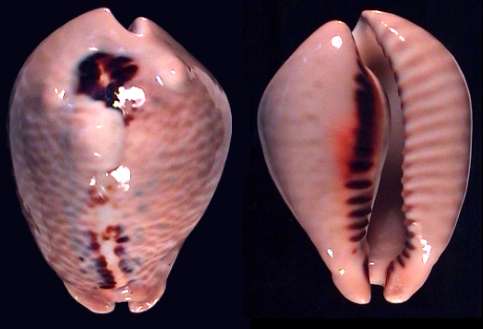
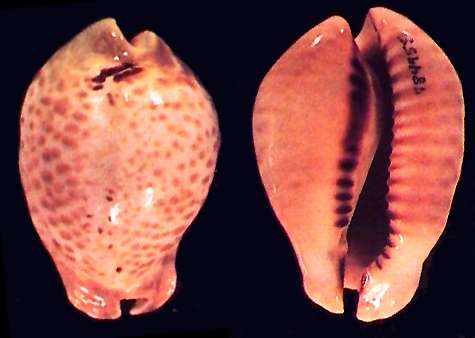
mus tristensis, paratype
mus tristensis (?), locality unknown
mus tristensis, large and heavy variation4. mus bicornis var. tristensis
Range: western Columbia, offshore
Habitat: Over 100 m and deeper. Feeds on sponges.
Shell features: Medium sized, pyriform, inflated. Interior pinkish-white to purplish. Columellar teeth may be fading, but can be strong in larger, heavy shells, wide aperture. No orange blotch on base. The shell's background is very light in colour. The anterior extremity is produced and forms spoonlike extensions (this is an important feature). The larger shells rarely trawled in western Columbia also belong to tristensis according to Petuch (pers. comm 2001)
Uploaded 2001, names reviewed 2021

 mus
mus, typical, with faint tubercle
mus
mus, typical, with faint tubercle