The following was uploaded in April 2004. A lot of it is still valid (2021), but a more updated treatise is given in Vol. 1 of G3.
Molecular systematics of Cowries -
genetic analysis as a tool for generic and family-assignment
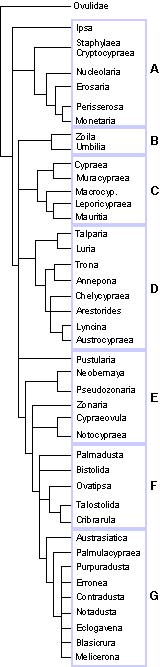
In "Biological Journal of the Linnean Society 2003, 79:401-459" Dr. Christopher Meyer of the Florida Museum of Natural History has published a comprehensive study on the phylogeny of Cowries based on molecular sequence data from mitochondrial genes. He describes three new genera and presents the data derived from the analysis of more than 1200 specimens of 210 cowry-taxa (recognized species or subspecies). Many of the descriptions I published in "New Worldwide Cowries" are partly based on the studies of Dr. Meyer to which I had ready access prior to their publication. For more information about Dr. Meyer and his project visit the site of the Cowry Genetic Database Project of the FMNH. In the following I will try to summarize those findings from the genetic analysis that are most important for our understanding of the family. You will miss some genera (e.g. Barycypraea, Propustularia/ =Proadusta) because these have been analyzed after this study was published. In any event, I will keep you updated.
At first glance we can see that Ipsa childreni is very isolate. This species is one of the most ancient in the family. Cryptocypraea is a new genus for dillwyni which is not as related to the smaller Erosarias as the shell may suggest. It is closer to Staphylaea than Nucleolaria. That is a bit of a surprise when looking only at shells. The mantles of dillwyni and nucleus are very similar, in fact. Perisserosa is the genus Meyer resurrected for guttata. The genus Monetaria includes caputserpentis, which makes sense also because there are hybrids with moneta. It is interesting that guttata is closer related to Monetaria than to the rest of Erosaria (= Naria)
Zoila and Umbilia are fairly close relatives - well, the fossils and their geography suggest this. No great surprises in the Cypraeinae (groups C-D), just that you may notice that according to the DNA analysis, Annepona mariae is the closest living relative to Trona stercoraria!! Hardly to believe when looking at their shells.
Another small surprise is the position the DNA analysis places Pustularia. Apparently that group has developed a long time ago and underwent dramatic conchological modifications. Cypraeovula and Notocypraea are sister-groups, well supported by DNA analysis. So Ovatipsa (chinensis and coloba) is indeed close to Talostolida and Cribrarula. We should have listened to the Schilders more, they had already known it... Note that Blasicrura ends up in a different section. So the relationship to teres-like species to pallidula-like species is not as big as we thought. Austrasiatica comprises hirasei, sakuraii, langfordi and deforgesi. I described it back in 1989 but Alex and I were reluctant to use it against Nesiocypraea with no more data at hand than shells. Palmulacypraea is a new genus that comprises katsuae, boucheti and musumea Contradusta is a new genus Meyer described to give credit to the fact that walkeri and bregeriana are genetically way different from Erronea where everyone else had placed them. Eclogavena comprises coxeni, quadrimaculata, luchuana and dayritiana. These are all quite different genetically from Blasicrura interrupta, pallidula and summersi. Finally I am surprised to see Melicerona (felina and listeri) revived in a place where I would not have expected them, far away from Erronea. Generally it is possible to say that most of the generic assignments made on the basis of shells by Schilder & Schilder and Lorenz & Hubert are strongly supported by the DNA analysis. The method is far from being the definite clue to all the questions that still remain pending, but it has answered a lot already. The results of Dr. Meyer's work so far reveal two facts:
1) the systematics of the Cowries based on the study of shells is strongly supported by the DNA-Data (about 90% agreement). However, the subdivision of the family Cypraeidae into four subfamilies was partly relevated. This does not mean that we all have to change our data-files and collection tags, though. We can say that basically, the B-group is what we used to call Bernayinae, C-D is the Cypraeinae, E-G are the traditional Cypraeovulinae, while A is Erosariinae. A few species and genera have dropped out of the old system to be oddly placed somewhere noone would expect them (mariae with stercoraria, dillwyni near Staphylaea, Pustularia near the Zonarias). The vast mayority of the generic assignments based on shells is confirmed by the DNA-analysis.
2) THE SPLITTERS WERE RIGHT!!!
In the near future I will report further on the revolutionary insights on species and subspecies that the monumental work of Dr. Meyer has revealed.