
This
was last edited in 2002 and reflects the status at the time. Things
have become considerably more complex since, so regard the following as what it is, a blast from the past, grossly outdated.
One of the most problematic groups in the family Cypraeidae is certainly the Leporicypraea mappa - complex whose large and colourful shells have attracted both, collectors and taxonomists to a high extent, with the result that its taxonomic and systematic situation is in a mess. In the first edition of A Guide to Worldwide Cowries" there were several mistakes concerning the assignment of names, and also in the interpretation of some of the Pacific taxa. In the second edition we have finally clarified the situation, at least on the taxonomical standpoint whereas the systematic arrangement is still unsatisfacorily superficial. This revision offered here on the internet shall give an overview to the taxa and all unnamed but distinct populations known to me. Perhaps somebody will find appropriate names for them, some of the ones I am using here have no taxonomic value, maked with *
The systematic position of most so-called subspecies is probably that of valid species. One indication for this is the sympatric occurrence e.g. of geographica and rosea in East Africa, Madagascar and the Mascarenes, of viridis and rewa in the Central Pacific and mappa and geographica in Indonesia. Another indication is offered by genetic studies according to which the mappa-complex consists of as many as seven species (Chris Meyers, pers. comm.). Here I am making an attempt to find a reasonable compromise between splitting up the group and keeping it in an overviewable scale. The result from the conchological and zoogeographical comparison leads to three distinguishable groups (here listed as species), with two subspecies and several geographically confined forms. Individual colour variations have not been listed.
1. Leporicypraea geographica geographica (forma: minima)
1 a. Leporicypraea geographica rewa
2. Leporicypraea mappa mappa
2 a. Leporicypraea mappa viridis (formae: eluceta, guamensis*, montrouzieri)
2 b. Leporicypraea mappa rosea
2 c. Leporicypraea mappa aliwalensis
1. Leporicypraea geographica geographica Schilder & Schilder 1933
The type of geographica was claimed to originate from Indonesia. It is difficult today to assign the name to either the well known large shelled East African specimens or the smaller eastern populations known from Phuket Is. and the Andaman Sea. The main conchological characteristics of geographica are the somewhat irregular, almost blurred dorsal netting, the large marginal spots and the absence of a basal blotch. The shells are oval rather than cylindrical, the margins are irregularly pitted. These features are also found in the rare rewa from western Polynesia, which should therefore be assigned to geographica rather than to any other forms or subspecies of mappa. More pictures are here.
minima Raybaudi 1985: Maldives, Thailand, Indonesia; Smaller, less callous.
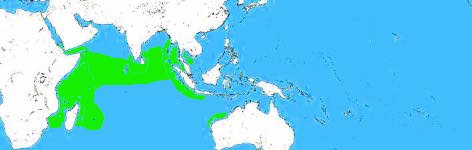
Distribution of L. g. geographica
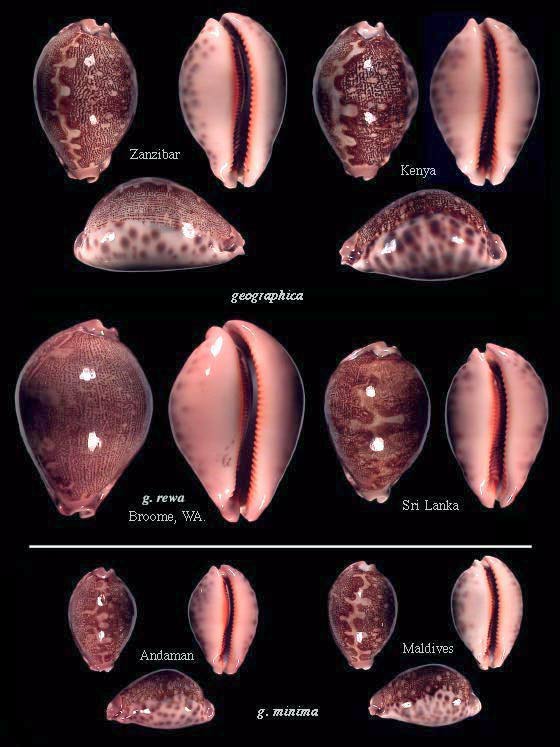
Leporicypraea g. geographica and its dwarf eastern variation L. geographica var. minima. According to genetic studies, the Western Australian shells belong to g. rewa rather than geographica geographica.
1 a. Leporicypraea geographica rewa (Steadman & Cotton 1943)
This rare taxon from western Polynesia differs from the western geographica mainly by its enormous weight and the more callous margins. The aperture is very narrow. Unlike any Pacific mappa, rewa never shows a basal blotch and has irregular, pitted margins. The dorsal line is mostly indistinct. It is found in Western Australia, the South China Sea to Tonga, Fiji and Samoa.
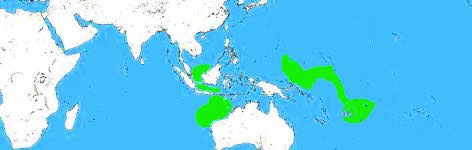
Distribution of L. g. rewa
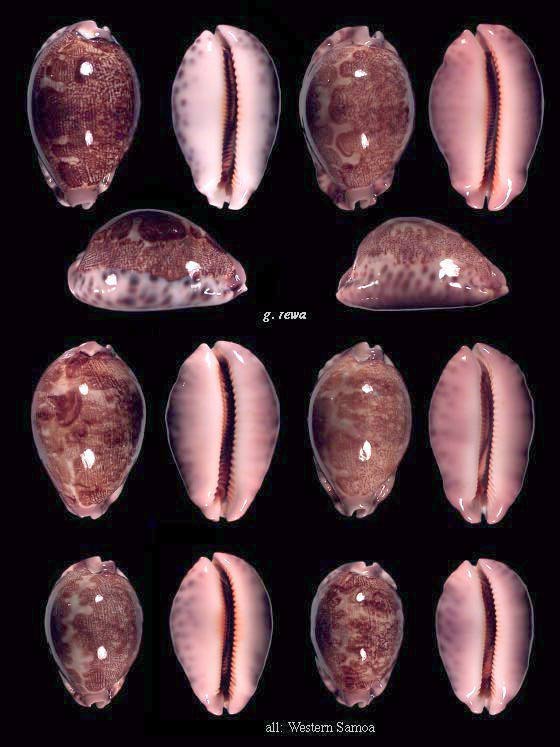
L. geographica rewa, typical specimens
2. Leporicypraea mappa mappa (Linnè 1758)
The holotype of mappa was illustrated by Rumphius and clearly shows the western Pacific subspecies known from the Philippines and parts of Indonesia. It is large, inflated, with a tendency towards a cylindrical shape. The base shows a faint blotch, the teeth are pale brown. The margins are hardly callous, with numerous small spots. The dorsal netting is regular and distant, forming round lacunae and the characterstic serpentine-dorsal line situatued towards the labral side of the dorsum. Reddish specimens are called panerythra.
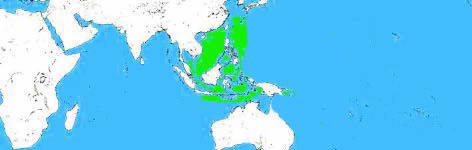
Distirbution of Leporicypraea mappa mappa
2 a. Leporicypraea mappa viridis (Kenyon 1902)
There was quite a confusion about this name and probably there still is, well I am using this name here again for the western Pacific subspecies, admitting my earlier mistake. Conchologically, some viridis may be nearly indistinguishable from mappa mappa, but there are several distinct populations in Micronesia and Melanesia that represent no problem in distinction. The assignment of the New Caledonian shells to this subspecies as done by Alex Hubert and me in the second edition of the "Guide" is admittedly provisional, it is backed, however, by genetic findings.
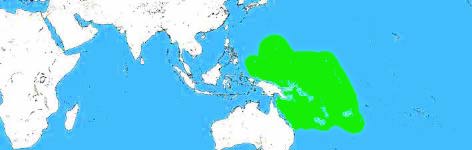
There are several important geographic variations (or even subspecies?) in the Pacific:
eluceta Lorenz & Hubert 2000: Marshall Is. and Truk; Inflated, very heavy, oval. Basal blotch often absent. Bright whitish to orange base. Teeth pale orange. Larger marginal spots. The dorsal line usually is situated on the middle of the dorsum.
guamensis (new): Guam and other Island of the Marianas; Small. Very slender, slightly cylindrical. Basal blotch distinct, often present on both sides of the base. Lateral spots very fine and numerous. The dorsal line shows wide curves and is situated towards the labral side.
montrouzieri (Dautzenberg 1903): New Caledonia; Large, more elongate than western shells. The basal blotch distinct, the aperture rather wide. Lightweight. In deeper water off New Caleonia, a heavy shelled variation occurs which resembles the eastern admirabilis.
viridis from the Solomons and Australia are rather similar to the Philippine mappa mappa, the main differences being the more oval shape, more callous margins and the more produced anterior extremity.
All typical southwestern Pacific viridis have a more or less distinct basal blotch, a rather wide aperture, and dense, crowded marginal spots. The dorsal pattern always form regular circular lacunae. Serious consideration to subdivide eluceta as subspecies fails on account of the rarity of this beautiful form whose spectrum of variations is so far difficult to evaluate.
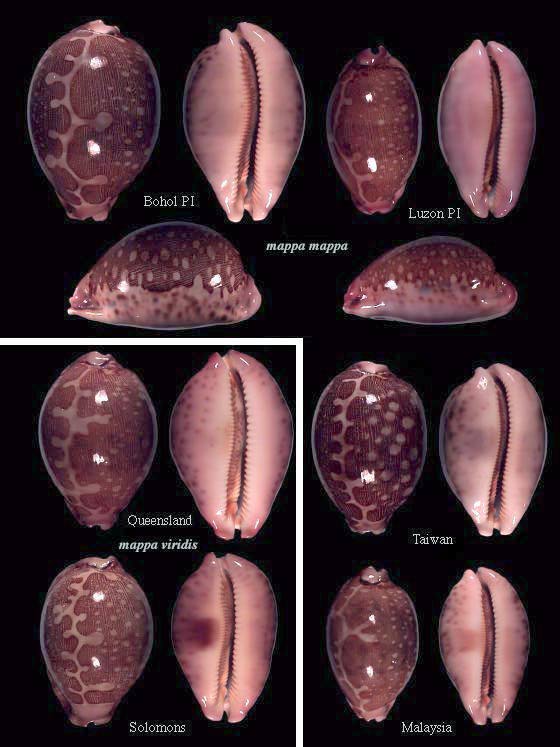
L. mappa mappa and its typical variations
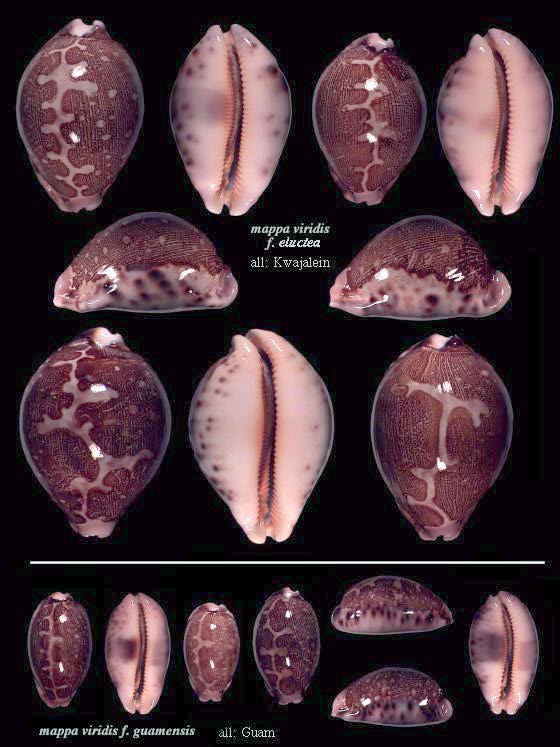
The varieties L. mappa viridis var. eluceta and m. v. var. guamensis
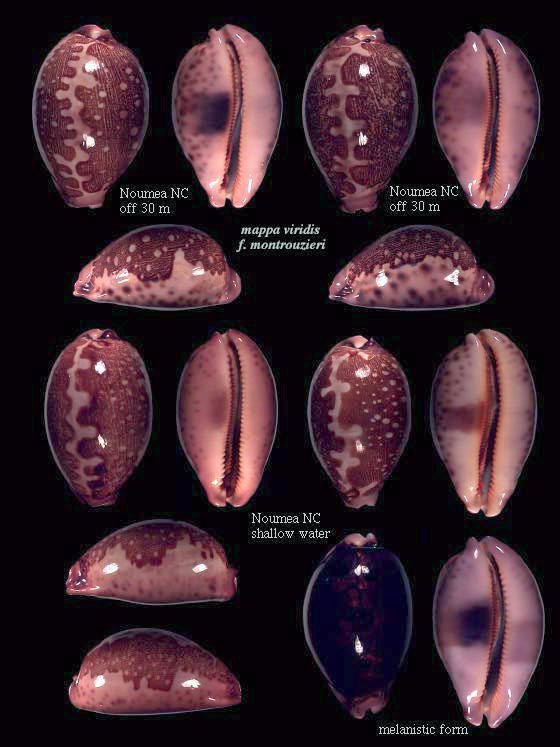
The New Caledonian L. mappa viridis var. montrouzieri
2 b. Leporicypraea mappa admirabilis Lorenz 2002
This is the unmistakable heavy-shelled eastern Polynesian subspecies formerly lumped with viridis.
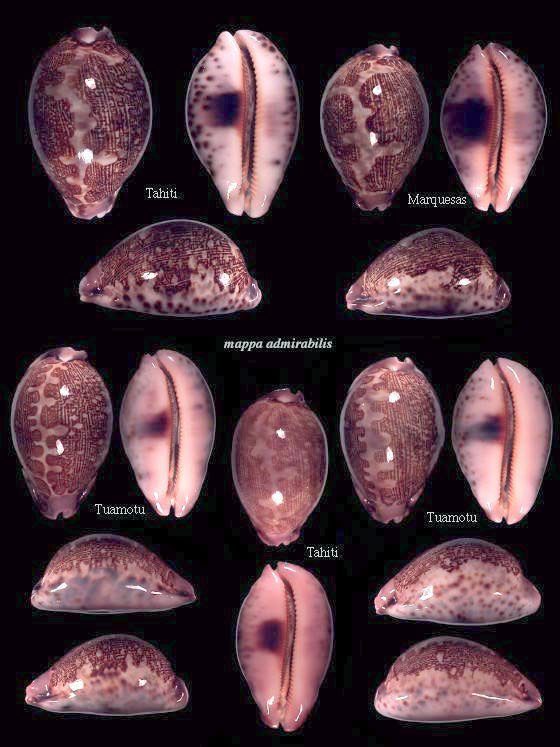
Leporicypraea mappa admirabilis from different Polynesian localities
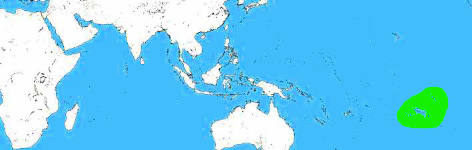
Distribution of mappa admirabilis
2 c. Leporicypraea mappa rosea (Gray 1824)
The occurrence of m. rosea alongside geographica without interbreeding has been a taxonomical stir for a while, leading me to believe they were examples for sympatric subspecies, or separate species - an interpretation more likely to be the case, but perhaps a bit anarchistic at the time I first expressed it back in the late eighties. Still all I can say is that I do not know which interpretation is correct, as I am not a map cowry - I guess these guy know better than we do. What we can see is that rosea shares the basal blotch with mappa and appears more closely related to this rather than geographica. Rosea is characterized by the reduced number of regular round lacunae, the finer, dense and regular marginal spots, the more cylindrical, somewhat depressed shape and the more blurred, denser dorsal netting. The typical rosea is from Mauritius and La Reunion, which has a bright purple basal blotching and bright orange teeth. The populations from the mainland of East Africa, the Comoros, Madagascar and the Sala y Malha Bank tend to be larger and more distinctly cylindrical, the basal colour being less bright, whereas the teeth in all rosea are bright orange (compared to mappa). More pictures are here.
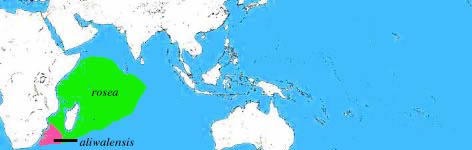
Distribution of L. mappa rosea and L. mappa aliwalensis
2 c. Leporicypraea mappa aliwalensis Lorenz 2002
This southern subspecies is closest related to m. rosea. Natal; Elongate, very dark basally. Dorsal netting dark, dense and coarser.
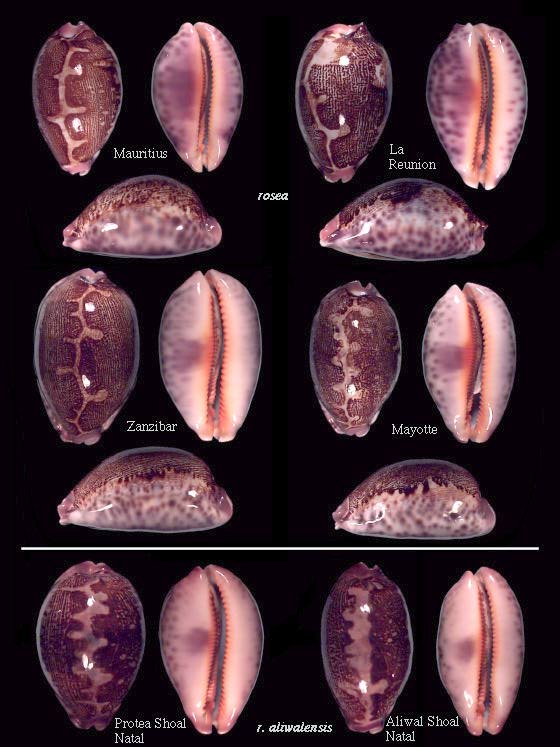
Leporicypraea mappa rosea and its South African variation L. mappa aliwalensis