
Nesiocypraea lisetae, maricola, and look-alikes
Nesiocypraea lisetae is a
widespread, yet rare, deep-water species whose
conchological features are easily overlooked (beause of its small
size), but obvious enough when looked at under magnification. One would
think that a shell is carefully examined when it comes to deciding
whether it could possibly be a rarity like lisetae, but the opposite
seems to be the case. On every shell-auction on the web, on lists of
shell dealers (even some whose names I actually have heared before) and
of course on shell-shows, a lot of look-alikes are offered as lisetae,
but a quick glance tells you they are not. In the following I will show
you where to look.
But first, let us admire the beauty and variability of Nesiocypraea lisetae. The species was originally described by Kilburn 1975, from Natal, South Africa. One year later, Cate described Nesiocypraea maricola from the Philippines. Both names were given to what is now considered subspecies of the same species. The name maricola is stands for shells from the Pacific. These tend to have more distinctly pointed tips than their South African relatives. The MNHN Paris has dredged small specimens from New Caledonia, Vanuatu, Fiji and the Austral Islands in eastern Polynesia. These shells are even more rostrate than their western Pacific allies. Nesiocypraea lisetae is mostly found ex pisce in South Africa, but shells have been dredged as well, usually at depths ranging from 70 to 150 m. In the Philippines, it was found by dredging and in tangle nets, off 100 to 200 m. The Japanese shells are found by dredging at 200 m, in New Caledonia and the Austral Islands, shells were found from 100 to 1000 m depth. This makes N. lisetae one of the deepest living species in the Cypraeidae. Generally, lisetae is inflated, with sharply pointed extremities and a narrow aperture, closely resembling the species of Pustularia. The dorsum is usually pink to pale cream, ornamented with a slightly darker blotch. There are discrete spots mostly along the margins. The aperture is curved behind, and the posterior tip on columellar (left) side is as long or even longer than the labral one. The teeth are short, and connected with a callus-bridge on both sides, especially labrally. This feature is uniquely found in lisetae and distinguishes it easily from any species of Pustularia. 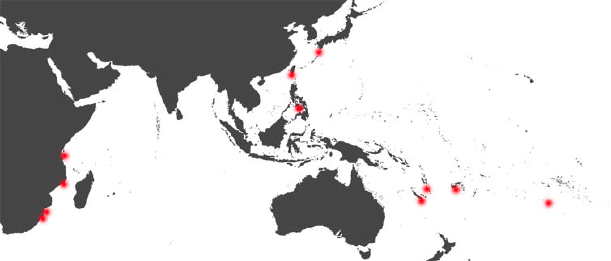 The distribution of Nesiocypraea lisetae (red dots mark ascertained sites where the species has been collected) 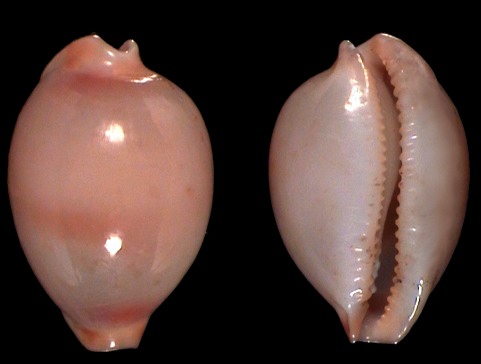 Nesiocypraea lisetae, 14 mm, from Natal, South Africa. the extremities are rounded posteriorly. 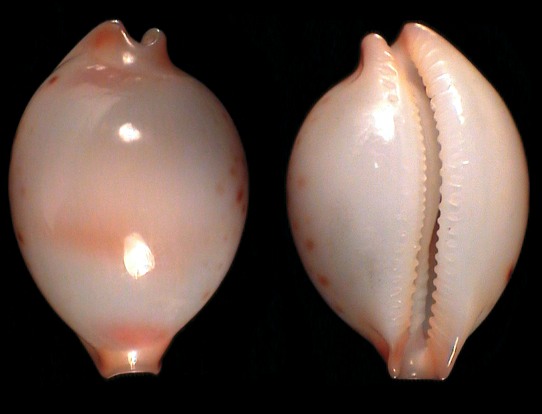 Nesiocypraea lisetae, 15 mm, Natal, South Africa 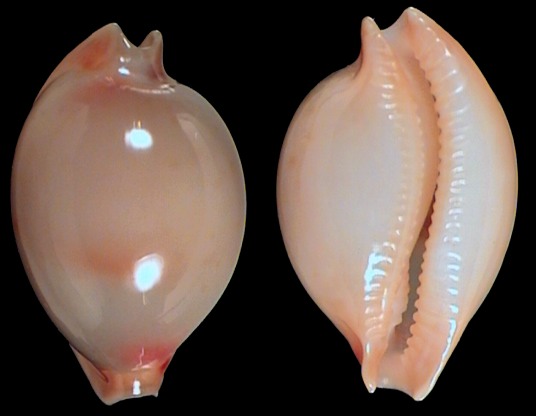 Nesiocypraea lisetae, 16 mm, Mozambique. Locality unconfirmed 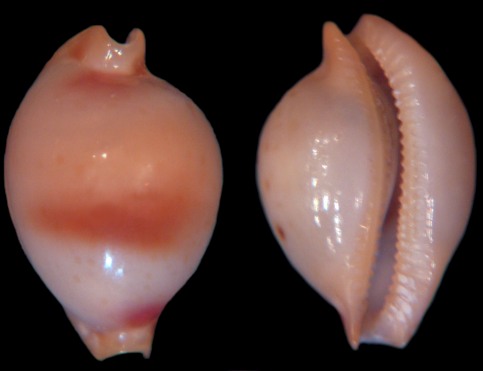 Nesiocypraea lisetae, 15 mm, Japan 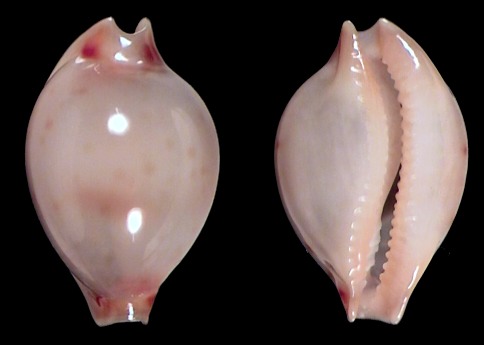 Nesiocypraea lisetae maricola, 12 mm, from the Philippines 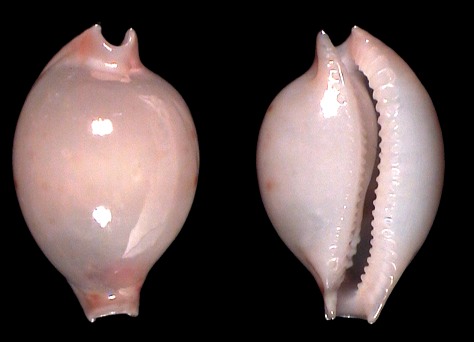 Nesiocypraea lisetae maricola, 13 mm, from the Philippines 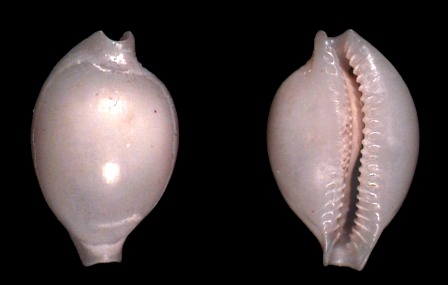 Nesiocypraea lisetae maricola, 10 mm, from Rurutu (Austral Is.) 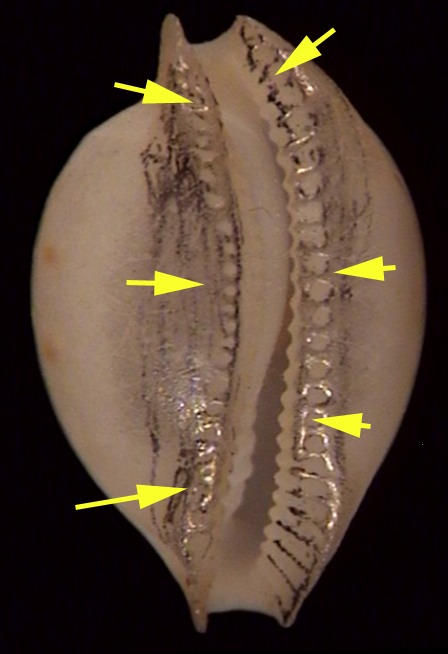 In this specimen of
Nesiocypraea lisetae maricola from the Philippines the teeth have
been stained with a pencil. Note that there is a distinct ridge
connecting them. It is especially obvious in the posterior part of the
columellar side. If you compare this region with the look-alikes (see
below) you will see the difference instantly.
Lisetae look-alikes 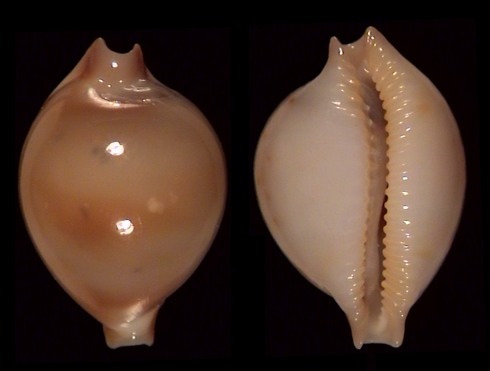 The subadult of Pustularia bistrinotata are most commonly confused with lisetae. Note that the teeth are not connected by a callus-ridge. 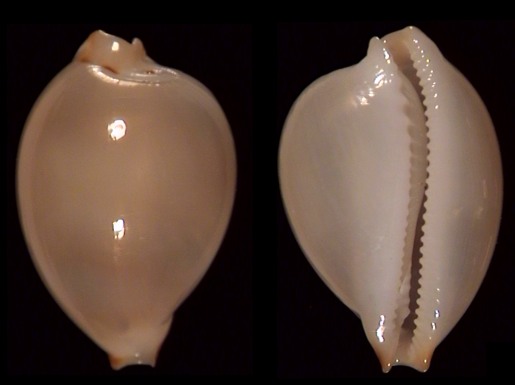 The subadult of Pustularia cicercula can be superficially similar to lisetae. Note that the teeth are not connected by a callus-ridge, they are not even extending at all. 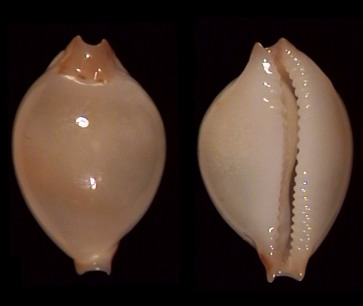 This subadult of Pustularia cicercula is quite similar in shape to lisetae. Note that again the teeth are not connected by a callus-ridge, and the aperture is rather straight. 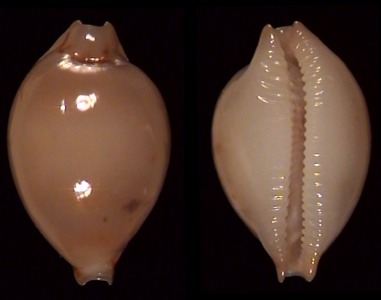 This subadult of Pustularia margarita is also similar in shape to lisetae. Note that again the teeth are not connected by a callus-ridge - very obvious posteriorly on columellar side - and the aperture is rather straight. 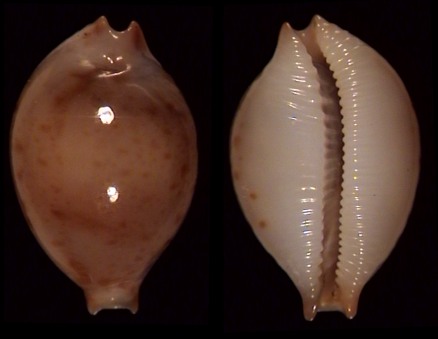 This exceptional specimen of P. margarita has a curved aperture and rather short extremities. However, once again the teeth are obviously those of a Pustularia. 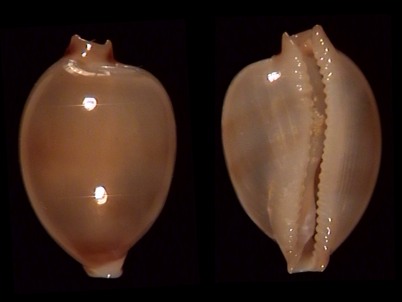 For the sake of completeness, a juvenile Pustularia globulus which looks a bit weird, so people that never saw a real lisetae might get fooled by such a thing as well. 1) there will be owners and sellers of the look-alikes that will try to argue they got the "real thing" for cheap, and others that will bombard me with photos of ... look alikes. 2) still a lot of people will go for that bargain specimen on eBay... 3) there will be more of those shells than true lisetae in the years to come. A dealer in faked diamond rings can only survive if there are enough people who want to believe that the ring is real. Belief has no place in the world of science, so it is entirely the individual's choice which way the wind blows. |
first uploaded 2009, updated 2021