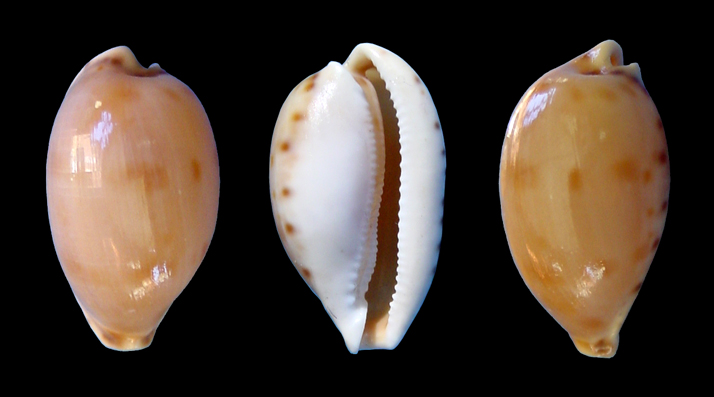
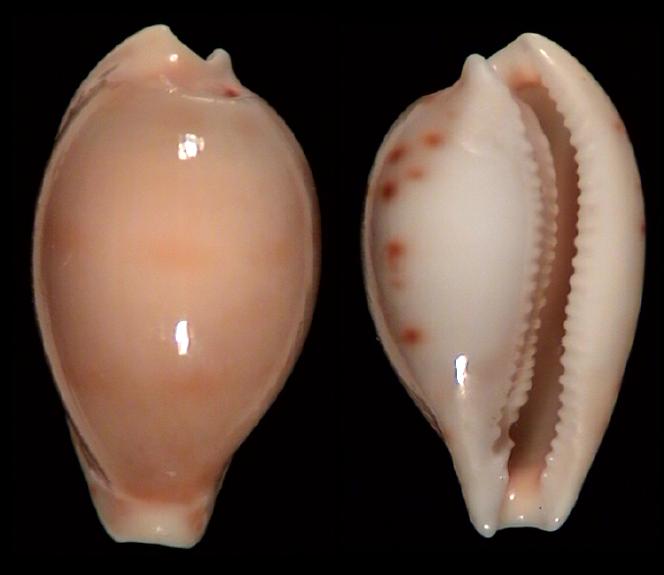
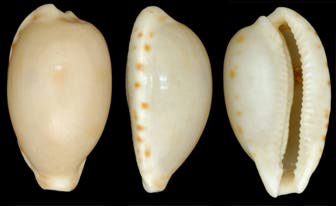
Notocypraea hartsmithi (Schilder 1967) - at last!
The mysterious hartsmithi was described on the basis of a single beachworn specimen collected at Wyargine, Sydney. (Original Reference: Notadusta hartsmithi F. A. Schilder (1967) Arch. Moll., Vol. 96, p. 3941.). F.A. Schilder gave a detailed and accurate analysis of the specimen, along with details of the characteristic fossula. A second specimen was later found on the same spot, largely confirming Schilder's first diagnosis. This specimen is not available to me for study. After these two findings, it became quiet around hartsmithi and for more than two decades it was virtually forgotten, and listed as a synonym of comptonii.
When I met Lance Moore in his shop at "the Rocks" in the downtown of Sydney in 1982, he gave me a batch of beachworn Notocypraeas of all blends, with the remark: see what you can find out on these.
Back in Germany I realized that one specimen was quite different from all the others. It contained a label stating "Hacking River", which is an area near the Sydney harbour, and i had a deja-vu. Some research in my piles of xeroxed cowry-literature finally produced what I had been looking for - the description of the "Sydney-Cowry" hartsmithi. Comparing the poor photo with my shell I had no doubt that I was looking at a hartsmithi. For the next years, I kept searching through all collections and selections of Notocypraeas I could locate, with a couple of "almost- hartsmithi-like" shells showing up, but none was actually the "real thing".
When the work on the "Guide to Worldwide Cowries" began, my hartsmithi remained the only specimen we had at hand. It took a long time to convince my late friend Alex Hubert that even on the basis of this one shell it was necessary to list hartsmithi as valid - in the end he surrendered with more than just reservations...
Of course, the rarity of hartsmithi made a lot of people point at me with criticism, I agree it must have appeared a bit forward to draw conclusions from just one shell and a poor xeroxed b/w photo.
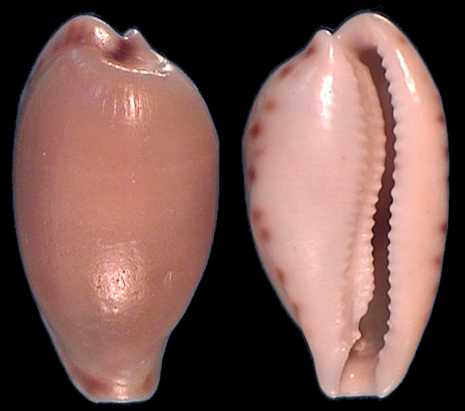
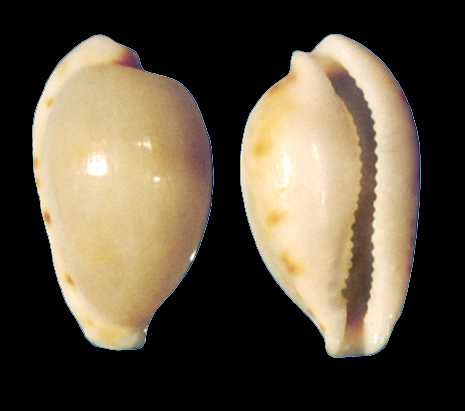
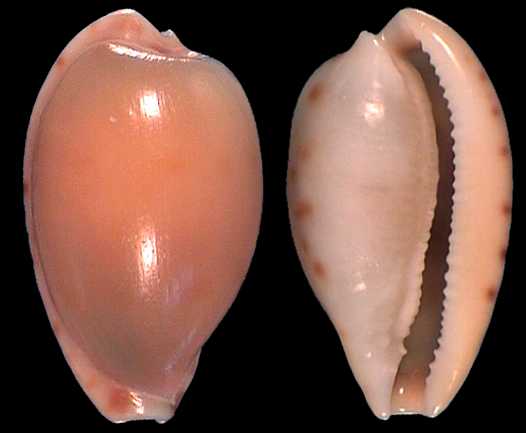
During the decades of a split Germany, Schilder's collection with the holotype of hartsmithi was hidden away in chests and boxes in the Museum of East Berlin, inaccessible to us. After the fall of the Berlin wall the holotype finally could be located in what was left of the Schilder-collection. It was photographed for me by Dirk Fehse of Berlin in 1997. Little later, a livecollected hartsmithi appeared in an old Australian collection: much smaller, paler, and from further south (Bass Strait area), but conchologically typical. Now I am able to show another, very typical specimen corresponding exactly with the holotype and my first specimen. It was collected on a beach south of Sydney and is in moderately good condition.Five years ago, two specimens of N. hartsmithi were collected from a fishtrap off New South Wales, and finally, last year two specimens were found on a sand/kelp reef shelf at 22 m by a diver at Malua Bay, New South Wales. These fresh specimens do not look a lot different from the dead taken ones, apart from being darker and highly glossy.
With a sufficient number of specimens at hand, a precise description of Notocypraea hartsmithi can be given:
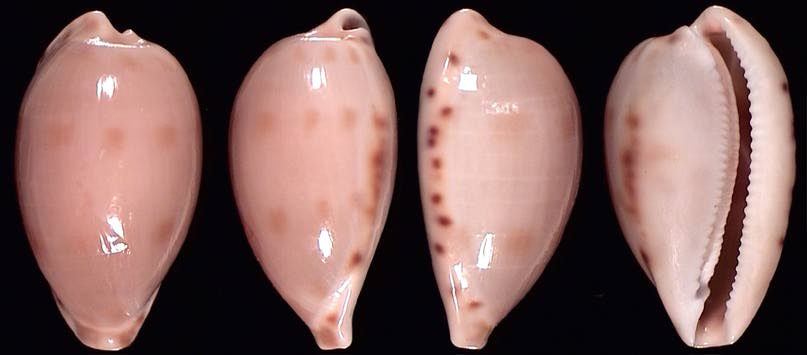
Elegantly pyriform, with slightly rostrate extremities. Spire umbilicate, small, and hidden by callus. Margins hardly callused. Teeth very fine, hardly extending labrally. On columellar side, the teeth are rather long and somewhat extending towards the base and far into the shell. The columella is gently sloping and forms a spoonlike fossula which is densely denticulate. This fossula resembles that of N. pulicaria rather than another species of the genus. There are four narrow interrupted middorsal bands. The tips are stained with darker. The large marginal spots on both sides of the shell are characteristic. There is no secondary dorsal pattern. The dorsal ground colour varies from cream to brownish-pink.
Size range: 16 - 26 mm
Distribution: From Sydney, NSW to Bass Strait, Victoria. The habitat ranges from 22 m to approx. 100 m.
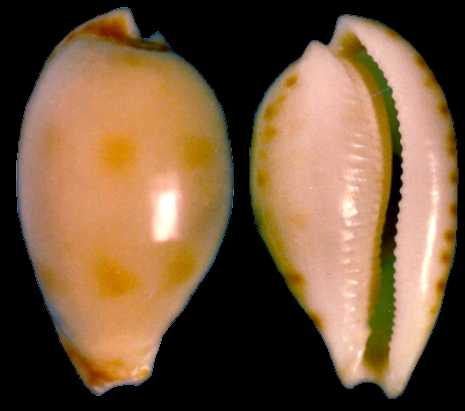
1) Holotype: 24 mmWyargine, Sydney, coll. East Berlin Museum
2) 20 mm Hacking River, Sydney, coll. CLSF
3) 16,5 mm Bass Strait area, coll. Deprez
4) 21 mm Nowra, New South Wales, coll. CLSF
5) 24 mm, Malua Bay, New South Wales, livecollected at 22 m.
6) Sydney, New South Wales, livecollected at 12 m. Coll. Angus Hawke 7) Terrigal, New South Wales, in crayfish pot off 140 m.
F. A. Schilder described hartsmithi under the genus Notadusta, assuming that it is closer to the N. katsuae/musumea group. Wohever, in these the columellar region is differently formed, the fossula is not as prominent. By systematical placement, hartsmithi in my opinion belongs to the South Australian group of smaller direct-edevlopers and not to the widespread Pacific deep water species with have a free swimming Veliger stadium (musumea and katsuae range from Japan, the Philippines, New Caledonia to Fiji). The specimens of hartsmithi I have studied resemble some fossil representatives of the ancient genus Notoluponia, in which the columellar teeth are comparable in their charater of extending towards the base. For the time being I propose to place hartsmithi in the living Notocypraea with a question mark, as done in the "Guide". In any case it is an outstanding valid species still to be studied further. Hopefully, this short essay may draw more attention to this shell and the beaches it comes from.
And this is why the real name for this species is Notocypraea dissecta:
In an important paper published in the Records of the Australian Museum in 1931, Tom Iredale described several subspecies and forms of Eastern Australian cowries. Among them is Notocypraea dissecta from 90 m depth off Twofold Bay, just south of Eden, New South Wales. The illustrations of the holotype are poor, but one feature of the 21 mm shell is visible: large lateral spots. Its geography and this feature had given me the suspicion that dissecta might be an earlier name for the elusive Notocypraea hartsmithi Schilder from New South Wales. At last, I managed to trace the dissecta type with the kind help of Dr. Alison Miller and Dr. M. G. Allen of the Australian Museum, who submitted photographs. The large, sparse marginal spotting, slender shape, umbilicate spire, rostrate extremities and the projecting fossula, the fine dentition and the faint middorsal banding agree and it is apparent that hartsmithi and dissecta are conspecific. Therefore Notocypraea dissecta Iredale 1931 must be given priority over Notocypraea hartsmithi Schilder 1967.
Notocypraea dissecta holotype coll. Australian Museum No. 57770