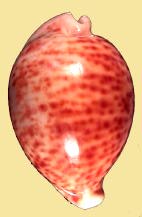
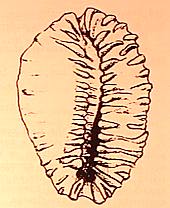
Pleistocene Cypraeacea from the vicinity of Hurghada, Egypt
Published in Schriften zur Malakozoologie, Cismar, 5:19-41, pl. 6-10 (1992), here is a small update and some new illustrations.
Abstract:
Several species of Cypraeacea from the Pleistocene of Hurghada, Egypt are discussed in comparison with their living representatives. Four new taxa of Pleistocene Cypraea are introduced.
Introduction:
During a longer stay at the Magawish Village 16 kms south of Hurghada, Egypt, I was able to collect a large number of fossil Cypraea, as well as living representatives, often of the same or similar species. Due to the dry climate in this region the fossil shells are all in exceptionally good condition, often retaining traces of colouration. The abundance of some of the fossil species allows a comparison also of features subject to ecological modification. Four spots in the vicinity of the Magawish Village were visited, and several formations were found to contain fossil cowries.
The Localities:
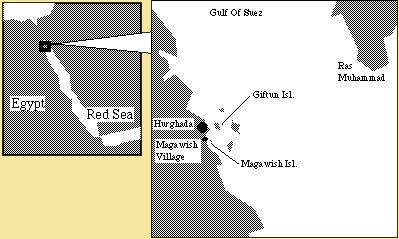
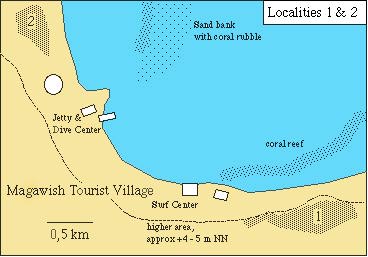
The map shows four areas in which collections have been made. Locality 1 and 2 were visited most frequently and also proved to contain the biggest variety of species. These areas are characterized by fossil coral rubble and solid blocks of limestome and corals. Inbetween this conglomerate, the shells could be taken out without any tools or a knife. There is a steep wall rising from approximately one hundred metres of the beach to 5 to 6 metres height. Above there is flat sandy, slightly wavy land without traces of vegetation, forming the Arabian Desert running about ten kilometres at same height, then rising up, with a chain of rocks and later the red shimmering mountain chain (up to 2600 m high, running all along the western Coast from the Gulf of Suez to the Nubian Desert in Sudan) whose refection gave the Red Sea its name.
Fig. 1: Collecting area
The limestone formations that run all along the coasts of the Red Sea in the northern areas are suspected to be geologically young (1-4 Million years in average). At times when the level of the Red Sea was much higher, extensive coral reefs grew along the coastline. These reefs got exposed and dried out when the sea level sank. Nowadays similar reefs frame the coastline, about half a kilometre away from the fossil reefs. On top of the walls rising from the beach-level there are many fossil shells of good condition. These are suspected to be of youngest age, they are also those most easy to separate from the substrate they stick to. Their aperture is filled with lose sand but no hardened limestone. On the bottom of the walls there is harder limestone conglomerate from which to take shells undamaged is difficult and is barely possible without tools.
Fig. 2: Locality 1 and 2
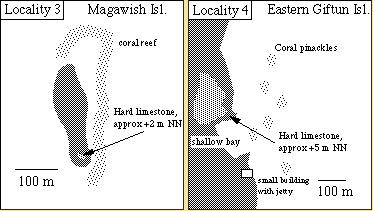
In these layers the apparently older shells have been found, their apertures are filled with hardened limestone and their pattern has vanished. These were also the shells most aberrant compared to the living material. Locality 3 and 4 are hardened limestone walls at the adjacent islands Giftun and Magawish. Latter was visited only once and proved poor in fossils. Giftun Island however showed a rich variety quite different from that of locality 1 and 2. In the record of species and their localities I have differentiated the levels in which the shells were found, so shells from the uppermost area of the walls are suspected to be of younger age than shells from lower deposits.
Fig. 3: Locality 3 and 4
Material:
More than twohundred specimens of fossil Cypraeacea were collected. Only complete shells or fragments showing the complete basal aspect have been taken into account. For specimens closely resembling the living representatives from the same area the valid name of the latter has been adopted, also for specimens resembling a living species or subspecies not found in the area or the Red Sea at all, with the addition Variety A, Variety B,...etc. For specimens showing features not seen in any living relative a new name to characterize the apparently extinct species or subspecies has been introduced.
Note:
Several species now common in the Hurghada area have not been found fossil. These have been listed separately in the summary of species.
In the meantime, a large number of new specimens have been reported to me, on top of all a collection of subfossilized shells assembled by Mr. Marc Grigis of Ninove, Belgium. These specimens are of much better condition than those I have collected, I suspect that their age is comparatively younger than that of the specimens collected at the locs. 1-4. The locality is Hurghada, approx. 3 km away from the beach. The exact site is not known to me and in the following is listed as loc. 5.
Bistolida erythraeensis Sowerby 1837 The fossil B. erythraeensis from loc. 1 are identical with living representatives. At Hurghada as well as in many other northern localities B. erythraeensis occurs in a callous, rhomboidal variety with a convex base, no black staining of the dental interstices (seen in southern specimens) and callous, dark extremities. The marginal calluses are always produced and bent up, rather angular, giving the shell a depressed appearence. Contrary to southern populations which prefer deeper water, the Hurghada- B. erythraeensis lives in very shallow water, under rocks in muddy areas.
Not formerly recorded from Pleistocene deposits. Two slightly chipped specimens were found on the same locality where also B. E. cepaformis Lorenz 1992 was collected, but in a still younger layer. Localities: 1; 5;
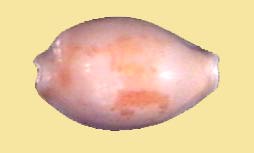
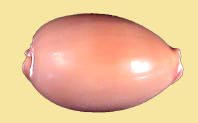
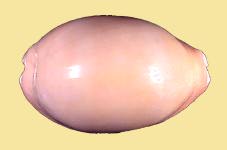
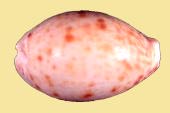
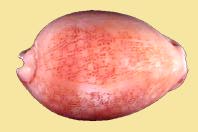
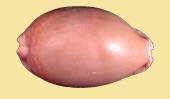
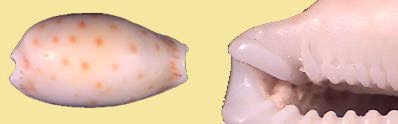
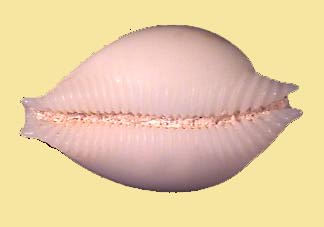
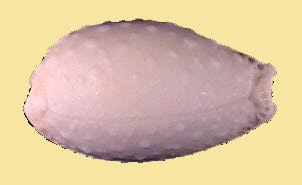
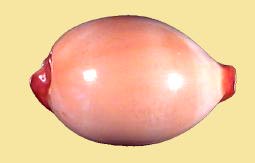
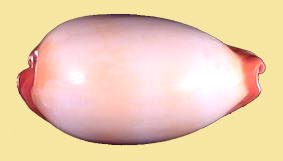
Bistolida erythraeensis cepaformis Lorenz 1992 The holotype of this new taxon was first thought to be a species of Pustularia: The extremities are elegantly rostrated, slightly curved. The shell is rather globular, the teeth fine and extending. Another shell was then found in the same locality in a younger formation on locality 1 which is less inflated and more similar to Bistolida erythraeensis. The new subspecies which has been found along with fossil B. erythraeensis (typical) is characterized by its rostrated extremities, rather curved aperture, sorther teeth which extend only slightly towards the base and labrum but do not cross it as in typical erythraeensis, and the rounded, callous margins which are bent up and rather angular in callous B. erythraeensis from the same area. The onion- shape (cepa = lat. onion) due to the rostrated, thin extremities is characteristic. The dorsum is irregularily blotched as in typical B. erythraeensis (UV-light) but the marginal spotting is very faint and scarce, while that of typical B. erythraeensis is fine and dense.
Bistolida erythraeensis cepaformis is only known from the Pleistocene limestone deposits of Magawish Village (Loc. 1) Localities: 1;
Cribrarula cribraria var A Linne 1758 A broad, callous specimen of C. cribraria resembling the East Australian c. melwardi in shape. The specimen otherwise shows all features found in C. cribraria, including traces of the dorsal netting.
A single shell from the top of the cliff at Locality 1. This Indo-pacific species lives in many parts of the Red Sea, I have not seen specimens from as far north as Hurghada, however. Localities: 1; 5; Note of 2021: It is now known under tha name C. cribraria "perstata" and is still found in scattered places in the Indian Ocean and the Red Sea.
Cribrarula cribraria var B Linne 1758 A narrow, cylindrical specimen of C. cribraria resembling the northwestern Pacific variety of the species (C. cribraria) and not at all the living East African and Red Sea race C. comma. There is faint marginal pitting. The dorsal netting is well preserved and visible under UV-light. Note of 2021: This variation is still found in the general area, and today is known under the name C. abaliena erypersica Meyer & Lorenz 2017.
Along with the shell of C. Cribraria var. A from the top of the cliff at Locality 1. Localities: 1; 5;
Cypraea pantherina Solander 1786 A large (82 mm), inflated specimens of exusta was collected on Loc. 5 by Marc Grigis. This specimen agrees with living representatives from adjacent areas.
Localities: 5;
Erosaria nebrites Melvill 1888 This species is the most common in the upper layers (younger) of locality 1 and 2. The species is extremely variable in size and shape. Most specimens are so well preserved that the blotches on the margins are visible even in normal light, UV light will show the fine dorsal spotting, and sometimes, the basal streaking as it is seen in living specimens which are as commonly found in the vicinity of Hurghada today. One remarkable feature was however observed in the fossil shells compared to the living specimens so far investigated: In many specimens the marginal blotches (which are supposed not to reach the base or the edges of the shell in E. nebrites) are split into two smaller blotches, of which one is situated below the marginal edge, and the other above. In the related E. erosa from the Indo Pacific the same marginal blotches occur, however situated directly on the marginal edges, or below, so that they are visible ventrally as well. It is suspected that E. nebrites has directly and continuously developed from E. erosa (which has still existed in the Red Sea in the Pleistocene of Port Sudan). The position of the marginal blotches in living specimens of E. nebrites and E. erosa represent a constant and reliable feature for distinction. Plate 3 shows the transition from E. erosa (fig. f) to E. nebrites (fig. g (fossil) h)
In all younger layers of loc. 1 and 2 E. nebrites was found in abundance. At Giftun, only one large (35 mm) specimen, at Magawish Isl. none was found. E. nebrites was found in Pleistocene deposits of Suez and Nefiof, Sinai. Living populations are found all over the Red Sea, Somalia, and scattered records from at Zanzibar, Ceylon. Localities: 1; 2; 4; 5;
Erosaria nebrites labrospinosa Lorenz 1992 This new race is characterized by processes of the labral teeth reaching the marginal edge, forming spines and tubercles. In well preserved specimens even on columellar side such tubercles and ridges can be seen. The holotype from the oldest layers of locality 2 is a well preserved shell with fine dorsal spotting and a characteristic blotch on the left margin dorsally. There is no blotch on columellar side in the holotype but in all paratypes there are two blotches. These seem less restricted to the dorsal area as in typical E. nebrites but also cover parts of the margins, hence visible on basal view as well under UV light. The teeth of the type (15 labr., 14 col. teeth) extend and branch out towards the margin, turning into tubercles and ridges whilst extending almost onto dorsum. On columellar side the teeth are very strong, thickened, elevated posteriorly but not extending far onto base. Towards the margin on columellar side however there are numerous distinct ridges and tubercles, giving the shell a very corrugated outline, even from dorsal view. Some of the Paratypes are less extreme due to erosion. This race is very outstanding and seems to represent a sort of side- branch of the evolution of E. nebrites out of E. erosa from the Indo-Pacific. Despite the large number of nebrites, no n. labrospinosa was found amongst the material supplied by Marc Grigis from Loc. 5. Note of 2021: following the suggestion made by Eduard Heiman, the name labrospinosa is now used for specimens of nebrites with produced teeth.
Erosaria nebrites labrospinosa has been found in the very low (old) layers in all four localities, (where typical E. nebrites were not found) never in abundance. Localities: 1; 2; 3; 4;
Erosaria turdus Lamarck 1810 Several specimens of this species have been found, variable in shape but otherwise comparable with E. turdus from southern parts of the Red Sea. The E. turdus found living in the Hurghada area now is narrower and more fragile than the fossil specimens.
E. turdus has been reported from the Pleistocene of Suakin, Sudan, Suez and Nefiof, Sinai. A single specimen was found in a subfossil deposit at Dar- es-Salaam. In East Africa, only a small population of E. turdus occurs at Mozambique Island. The living E. turdus is common in the Red Sea, Arabia and northeastern Somalia. Localities: 1; 2; 3; 4; 5;
Erronea (Ovatipsa) caurica quinquefasciata Schilder 1938 Four specimens of this race were found, two in very good condition. Both are exceptionally large and cylindrical, otherwise showing all the characteristics of the living race from the same area. It is interesting to note that despite the large number of specimens collected from some species, only four E. caurica were found. Today, the E. caurica quinquefasciata is the most abundant cowry species on the reefs around Hurghada, followed by E. nebrites.
This species was formerly reported from the Pleistocene of Suez and Port Sudan. It occurs commonly in all areas of the Red Sea. Localities: 1; 2; 3; 5;
Erronea (Purpuradusta) gracilis var A Gaskoin 1849 Several complete shell and fragemts of E. gracilis were found at loc 1. These show traces of the spotting and banding under UV light. Similar to living specimens of E. gracilis from the Red Sea (var. notata) the posterior end is partly covered by callus.
Erronea gracilis is occasionally found living in the area of Hurghada, but is very common in southern parts of the Red Sea. (Indo- Pacific). This is the first record of the species from the Pleistocene of the Red Sea region. Localities: 1; 5;
Erronea (Purpuradusta) gracilis var B Gaskoin 1849 Four very small, rostrated specimens of E. gracilis were found at loc. 2. These show a discrete middorsal blotch under UV light.
Living specimens of E. gracilis normally exceed the size of 12 mm by far. The rostrated extremities and fragil appearance suggest that var. B is a degenerated form. Localities: 2; 5;
Luria (Basilitrona) isabella Linne 1758 Several specimens of this species were found in almost all localities and formations. The size and shape varies as well as the degree of callousity. Some specimens appear exceptionally rostrated.
Isabella has been collected from the Pleistocene of Suez, Port Sudan, and even the Pliocene of Tanzania. In the Red Sea it occurs commonly. At Hurghada it is found in small (20 mm) and larger modifications. Localities: 1; 2; 3; 4; 5;
Luria (Basilitrona) pulchra Gray 1824 Several very well preserved specimens conchologically identical with the living L. pulchra were found at very old layers. One shell was found inside limestone too hard to cut, in the oldest exposed layers at loc. 4. here most specimens were found. All fossil L. pulchra still retain traces of the dark terminal blotches.
L. pulchra was reported from the Pleistocene of Port Sudan and the Pliocene of East Africa (ssp. gregoryi Cox 1930) It is found living only in the Red Sea, very rarely in the Hurghada area. Localities: 2; 4; 5;
Lyncina carneola var. A(leviathan) (Sch. & Sch. 1937) A single, well preserved specimen fitting the living L. leviathan has been found. This species is very common throughout the Red Sea. Its shell is very similar to the sympatric L. carneola but apart from larger size has a slightly stepped and often tuberculate labral margin which is not separated from dorsum by a bluish frame. In the fossil shell features such as colouration are absent, there is also no tuberculation to the labral margin so that the specimen is provisionally added to the L. carneola- complex.
Lyncina leviathan is common throughout the Indo-Pacific and the Red Sea. From the Pleistocene it has been found at Dar-es-Salaam, Tanzania. Localities: 1; 2; 3; 4; 5;
Lyncina carneola var. B Linne 1758 Several smaller specimens resembling Pacific L. carneola were found. These are narrow and elongate, with a strongly thickened hind top on columellar side.
This variation was found only at locality 1, I have not seen living specimens from the Red Sea with a similar narrow shape. Localities: 1; 5;
Lyncina carneola var. C Linne 1758 Two broken shells of a larger type of L. carneola were found, similar to a giant variation still found living in the northern parts of the Red Sea. The margins and extremities are rounded, apparently these shells are carneola and not L. leviathan.
Only two incomplete shells were found in older layers at loc. 1 Localities: 1; 5;
Lyncina carneola var. D (crassa) Gmelin 1791 This is the variation of L. carneola that was most commonly found in all deposits, and still is found living along the coasts of the Red Sea. The variation crassa is characerized by heavy marginal calluses giving the shell a somewhat rhomboidal, depressed appearance.
Most good specimens were found in younger deposits of loc. 4 Localities: 1; 2; 3; 4; 5;
Lyncina lynx Linne 1758 Asingle callous but otherwise typical specimen was found resembling those living in adjacent areas.
Localities: 5;
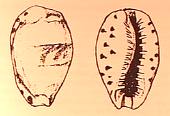
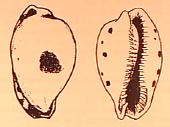
Mauritia (Arabica) arabica var. A Linne 1758 The cylindrical shape and plateau-shaped dorsum betray that this variety is not the well defined M. arabica grayana (Pl. 1 fig. e) found in this part of the Red Sea now. Typical M. arabica immanis (Pl. 1 fig 1a shows the outline of a specimen from Yeddah) are not found in this northern part of the Red Sea. Apparently, the variability of M. arabica in the area around Hurghada was far greater in the Pleistocene than now, possibly the time inbetween was just enough of the M. a. grayana- type to maintain against other M. arabica- races to form a very distinct race (or species to some authors) here, while in southern areas of the Red Sea both, M. arabica immanis and M. a. grayana still occur alongside, often very difficult (if at all) to separate from each other. This is an interesting example how a polymorphous species such as M. arabica, after migrating into the northern Red Sea, has survived only by developing into the humped M. a. grayana ( perhaps due to convergence more similar in shape to M. histrio from East Africa).
Typical M. arabica have been reported from the Pleistocene of Suez, living M. arabica (ssp. immanis) seem to occur only as far north as Yeddah. Localities: 1; 2; 5;
Mauritia (Arabica) arabica var. B ? grayana Schilder 1930 This is the variety which approaches the living M. arabica grayana. It has a slightly oval instead of cylindrical shape, very fine teeth and a slightly humped instead of plateau-shaped dorsum. Similar specimens to this variety have been found in Pleistocene deposits at Nefiof, Sinai.
This variety of M. arabica has been reported from the Pleistocene of Nefiof, Sinai and Port Sudan. The typical M. arabica grayana is found in the Red Sea, Somalia and Oman. Localities: 1; 2; 4; 5;
Mauritia (Arabica) arabica var. C Linne 1758 This variety has the shape of Pacific M. arabica arabica. It is cylindrical, with a flat base and rather blunt extremities. The dorsum is not humped but forms a plateau. Smaller specimens of living M. arabica grayana are slightly humped dorsally. The variation C is apparently extinct in in this part of the Red Sea
The dwarf form of M. arabica has only been found in older (lower) Pleistocene deposits at locality 1 Localities: 1; 5;
Monetaria annulus Linne 1758 Three very eroded shells were found in a very young part of the fossil reef at locality 2. In this area many well preserved specimens of E. nebrites were found, retaining the original nacre and faint pattern.
Monetaria annulus occurs in all parts of the Red Sea. It has been reported from the Pleistocene of Suez, Dar-es-salaam and many Western Pacific areas. Localities: 2; 5;
Monetaria moneta Linne 1758 Only a few large, tuberculate specimens with elevated teeth were found. This species is not found living in this northern part of the Red Sea.
Despite two fragments of smaller specimens from loc. 1 and 2, only few shells have been found in the older formations at loc. 4. The species has not been reported from the Pleistocene of the Red Sea but has been found in deposits of Tanzania, South africa, the Philippines and Java. The living species is found in the entire Indo Pacific. Localities: 1; 2; 4; 5;
Nucleolaria nucleus Linne 1758 One very well preserved specimen, and one fragment of the base were found, identical with the living representatives of this species.
From the Pleistocene this species has been reported from Port Sudan. It is found frequently in all areas of the Red Sea including Hurghada, and the Indo-Pacific. Localities: 1; 5;
Palmadusta lentiginosa Gray 1825 A complete shell retaining the dorsal and marginal pattern, and a fragment of a base have been found at loc. 1. The smaller, complete shell measures 20 x 12,5 x 10 mm, and has 13 short teeth on either lip. It is interesting to see this species from the northern Red Sea.
Two specimens were found in the Pleistocene of Magawish, Hurghada. This is the first record from the northern Red Sea area for this species. The distribution of the living P. lentiginosa ranges from the southern half of the Red Sea, the Persian Gulf to Thailand. Localities: 1; 5;
Paulonaria macandrewi Sowerby 1870 The unique shell from loc. 1 is pyriform, elongate, with 15 well produced, slightly extending labral and 13 short columellar teeth. These are strongly thickened anteriorly. (Pl. 2 fig. f), connected by a slightly shallower ridge not fusing the teeth completely. The dorsum is spotted with large, distant circular spots which are more distinct under UV-light, which also uncovers a dense and regular spotting that reaches far onto base. The fossula is rather flat, showing two faint denticles. There is no marginal pitting, although the shell is fully adult as can be seen from a produced callousity on each extremity. The shell closely resembles P. macandrewi which is found living at Hurghada and throughout the Red Sea. This species has slightly finer, less distant teeth, which are slightly extending on columellar side. The margins in typical P. macandrewi are distinctly pitted, at least towards the extremities, there is no development of a tubercle anteriorly. Several large (15-19 mm) specimens were found by Marc grigis at loc. 5. In one of these, the anterior columellar teeth are fused.
This peculiar variety is known from a single shell from the Pleistocene of Magawish Village, Hurghada. The living Paulonaria macandrewi ranges from the Red Sea to Muscat, Oman. Localities: 1; 5;
Pustularia cicercula Linne 1758 A single, slightly eroded and chipped specimen still retaining the characteristic dorsal pustulation and the spire blotch (UV light) has been found at loc. 1. It agrees with the living specimens of Pustularia cicercula now common in southern parts of the Red Sea.
The single specimen was found in a younger deposit facing the Surf Centre at Magawish Village (loc. 1) The species has been found in the Pliocene of Dar es Salaam, Tanzania. The living species is found throughout the Indo- Pacific. Localities: 1; 5;
Pustularia globulus brevirostris Sch. & Sch. 1938 A single, well preserved specimen retaining traces of the original spotting. The midway-columellar teeth are connected by a callous ridge, which is characterizing for this subspecies. The aperture is straight. There are 23 labral and 21 columellar teeth.The specimen was found in the top of the cliff facing the Surf Centre at Magawish Village, in the younger deposits.
Now occurs only in the southern Part of the Red Sea. (East Africa, Mauritius). In Dar-es-Salaam since Pleistocene. Localities: 1; 5;
Pustularia marerubra Lorenz 2009 There are two species of Pustularia in the Pleistocene deposits, P. cicercula giftunensis Lorenz 1992, and P. marerubra. The dentition of P. marerubra is finer than in living P. globulus brevirostris. The aperture is curved behind, the midway-columellar teeth well separated. There are 28 labral and 26 columellar teeth, which extend onto the middle of labrum and base. The extremities are rather short. The dorsal spotting is similar to g. brevirostris.
Known from the Pleistocene of Giftun Island and loc. 5. Localities: 4; 5; The living specimens of Pustularia marerubra from the Red Sea seem to be conspecific with the fossils, they differ considerably from brevirostris of the Indian Ocean, also in coloration.
Staphylaea limacina Lamarck 1810 Two fragments of the base and labrum were found, good enough to verify the species.
This is the first record of S. limacina from the northern part of the Red Sea. As far as I know, there is no positive record of this species, fossil or living, for the Red Sea at all. Localities: 1; 5;
Talparia exusta Sowerby 1832 A large (70 mm), inflated specimen of exusta was collected on Loc. 5 by Marc Grigis. This specimen agrees with living representatives from adjacent areas.
Localities: 5;
Talparia talpa Linne 1758 A small number of typical specimens were found resembling those living in adjacent areas.
Localities: 5;