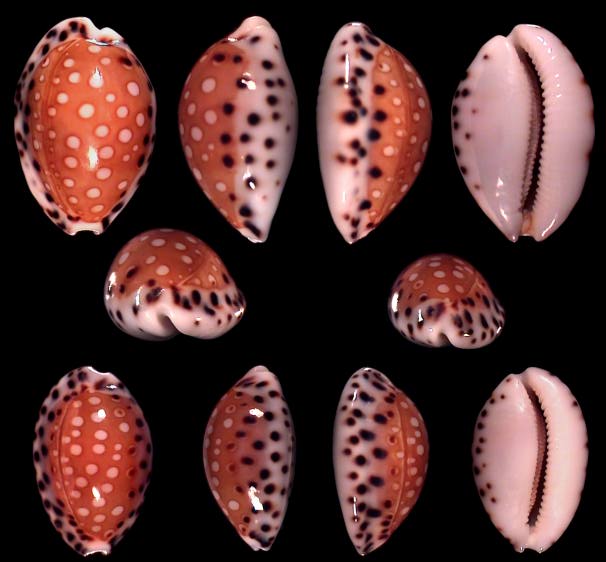
Extract from the description published in La Conchiglia.
A new species of Cribrarula (Gastropoda: Cypraeidae) from Easter Island
by FELIX LORENZ & BRET K. RAINES
A spectacular new species of Cypraeidae belonging to the Cribrarula cumingii-complex was recently found by MICHAEL GARCIA while diving at a depth of 30 m along the west coast of Easter Island. It is the fourth cowry species endemic to Easter Island and is here named in honour of its discoverer:
Cribrarula garciai sp. nov.
Material: Two adult specimens, collected alive. Animals were preserved inside the shells and could be examined by the first author. Holotype: 26,4 mm legth; 17,4 mm width; 13,7 mm height; 25 labral teeth; 24 columellar teeth (coll. LACM). Paratype 1: 22,3 mm length, 14,3 mm width; 10,8 mm height; 24 labral teeth; 23 columellar teeth (coll. LORENZ). For the statistical comparsion: 92 specimens of C. cumingii cumingii (SOWERBY 1832), 36 C. cumingii compta (PEASE 1860) and 84 C. cumingii astaryi.
Description:
The shell of the holotype is oval, with blunt extremities. Extremely
callous at extremities and along the margins. Spire small and
depressed, fully covered with callus. Base convex, very thick.
Aperture narrow and of equal width throughout, gently curved
to the left in the posterior third. Labral teeth (25) indistinctly
extending towards the middle of the labrum, columellar teeth
(24) not extending onto base but reaching deep into the shell
to form a distinctly denticulate columellar peristome. The fossula-area
is not separated from the peristome and equally denticulate.
The terminal ridge is thickened and rather long. The base, the
marginal callus surrounding the shell, the extremities and the
dorsal lacunae are plain white. The dorsum is covered with a
bright orange-brown coat forming regular round lacunae of variable
size. There is an indistinct dorsal line running across the dorsum
along the labral side. The margins are densely covered with very
large black spots reaching onto base and also onto dorsum, where
they form a row of slightly elevated black spots. The smaller
paratype specimen agrees with the holotype in these features.
The animal characteristics are unrecorded, the radula is unknown.
Habitat and distribution:
The two specimens known so far were found alongside on the roof
of a cave in 30 m depth near Hanga Roa, Easter Island.
Discussion:
The new species can be compared to the Polynesian group of smaller,
laterally spotted taxa of the genus Cribrarula, generally
assigned to a single species, Cribrarula cumingii. There
are three different subspecies and a number of ecological varieties,
some of which were given separate names: The nominate form, Cribrarula
cumingii cumingii from Tahiti is known from smaller shelled
form ranging between 12 and 16 mm, and a larger form exceeding
20 mm. Intermediate sized shells are less frequent. The larger
form is generally known as cleopatra SCHILDER & SCHILDER
1938. The holotype of cumingii, however, measures 27 mm
and the larger form is therefore the typical cumingii
(see LORENZ 2000). The smaller form has not been given a separate
name. Large shelled specimens are usually found in shallow lagoon
waters, whereas the turbid habitats of the lagoon edge are inhabited
by smaller shelled individuals. The Tahitian cumingii cumingii
is characterized by its slender shape without conspicuous marginal
callus, by a fine dentition extending onto the labrum, a narrow
aperture and a conspicuous fossula showing numerous denticles.
The smaller cumingii compta seems to be restricted to Tuamotu. It is more inflated, with rostrated extremities. The labral teeth are more numerous than in typical cumingii and do not extend onto the lip. On columellar side there is a callus ridge bordering the aperture. The margins are hardly callous and sparsely spotted. The status of compta as subspecies or even valid species is still under study, very little is known about its habitat and the animal characteristics. The consistent conchological differences of the Tuamotu shells from the Tahiti ones were discovered only recently (LORENZ & HUBERT 2000).
The third subspecies of c. cumingii is restricted to the Marquesas Islands: Cribrarula cumingii astaryi. Most authors have accepted astaryi as valid species at first, but this step was questioned by LORENZ & HUBERT (1993, 2000). Repeated findings of shells hardly assignable to either c. cumingii or c. astaryi in the Marquesas seem to support the status of a geographical subspecies (unpublished observation). The actual status of c. astaryi remains an open question. The main conchological features separating c. astaryi from c. cumingii are a somewhat broader shell, a wider aperture and less numerous fossula denticles. There are two ecological extremes, with a wide spectrum of intermediate forms: the typical c. astaryi is small shelled (12-14 mm), rather slender and hardly callous on columellar side. The variety lefaiti MARTIN & POPPE 1989 is defined as being larger (16-20 mm) and more callous. However, also small shelled individuals occasionally have strong callus, and large shells may be slender, without any callus. We consider lefaiti an ecological or individual form without taxonomic importance. Cribrarula garciai nov. sp. can safely be assigned in the vicinity of the cumingii-like species on account of its relatively fine dentition, the narrow aperture and the finely denticulate fossula-area.
Separating C. garciai nov. sp. from other species in the genus represents no problem: it differs from C. gaskoinii (REEVE 1846) from Hawaii by the finer dentition, the finely denticulate fossula and the large, sparse marginal spots which are especially dense and fine in gaskoinii. The dorsal lacunae are also must larger and sparser than in the Hawaiian species. The Melanesian C. catholicorum SCHILDER & SCHILDER 1938 may be similar in the development of strong marginal callus, but in this species the teeth are coarser and the fossula is steep, with only four to seven coarse denticles. The marginal spots are fine and inconspicuous. The western Polynesian C. taitae BURGESS 1993 is hardly callous, with a coarse dentition resembling C. catholicorum. The recently described C. pellisserpentis LORENZ 1999 from Madagascar may be similar in size, the callousity of the margins and the size of the marginal spots. This species, however, has a wide aperture, comparatively coarse teeth and a short, coarsely denticulate fossula.
Acknowledgements:
We wish to express our sincere appreciation to the honorable
MAYOR EDMUNDS PAOA for granting the junior author permission
to continue his research of Easter Island mollusca. We also
like to thank MICHEL GARCIA, NICOLAS HAOA and the EASTER ISLAND
FOUNDATION for their continued support.
Literature:
BURGESS, C. M. (1993): A new species of Cypraea from
Samoa in the C. cribraria complex.
The Veliger 36, p. 174177
LORENZ, F. (2001): A morphometriy analysis of the cowry Cribrarula cumingii (Gastropoda: Cypraeidae) with a revision of its synonyms. La Conchiglia 294295, p. 7781
LORENZ, F. & HUBERT, A. (2000): A Guide to Worldwide Cowries: Second revised edition. Conchbooks, Hackenheim, 590 pages, 116 colour plates
SCHILDER, F. A. and SCHILDER, M. (1938) "Prodrome of
a Monograph on Living Cypraeidae"
Proceedings of the Malacological Society London 23, p. 119231
SCHILDER, F. A. and SCHILDER, M. (1952) "Ph. Dautzenberg's
Collection of Cypræidæ"
Mémoires Institut Royal des Sciences Naturelles de Belgique
(2. ser.) 45, p. 1243 and Plate IIV