
A new subspecies of Cribrarula cribraria from Sri Lanka
Published in: Schriften zur Malakozoologie, 10:1-3
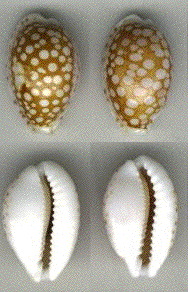
Cribrarula cribraria ganteri, n. ssp. (left: Holotype, right: Paratype 1)
Description:
Oval, very callous, slightly depressed shell with slightly produced extremities. The labral margin is steplike and indistinctly pitted. Base very callous, convex. There is a slight depression on columellar side towards the anterior end, giving the shell a slightly distorted outline in dorsal view. The aperture is equally narrow throughout. The labral teeth ectend regularly onto the middle of the labrum, on columellar side they are short and somewhat finer. The fossula is rather produced, showing four distinct denticles, the peristome is distinctly ribbed. Ribs and denticles are prolongations of the teeth.
The dorsal ground colour is pale olive, covered by a reddish brown coat forming large, regular lacunae. The dorsal line is irregular, rather wide towards the extremities. The white margins are very callous on both sides, distinctly spotted with brown. The marginal callus is bent up on columellar side. The spots form slight depressions.
In the paratypes the above described features vary only slightly, the characteristic brown spotting along both sides of the shell can be rather dense and conspicuous, in very callous specimens it may be obscured partly by callus. In some specimens the spotting is produced also towards the middle of the base, in most specimens at least some spotting is visible on basal view. Some specimens have a distinct doral line. The marginal depression towards the anterior on columellar side is another characteristic and relatively constant feature which in some very callous specimens becomes less conspicuous while in others it is even exaggerated. In two additional subadult specimens the marginal spotting is already formed on both sides. In a very callous specimen there are only faint traces of spots underneath the milky white callus.
Material: (length x width x height (mm) (labral : columellar teeth))
Holotype: 24,5 x 15,8 x 12,2 (17:16) coll. HNC, Cismar No.
Paratype 1: 24,5 x 15,0 x 11,4 (14:16) coll. F. Lorenz, jun.
Paratype 2: 25,4 x 15,7 x 12,0 (16:15) coll. F. Lorenz, jun.
Paratype 3: 26,5 x 16,8 x 12,5 (16:17) coll. F. Lorenz, jun.
Paratype 4: 26,1 x 15,9 x 11,9 (16:19) coll. F. Lorenz, jun.
Paratype 5: 25,5 x 16,1 x 12,5 (16:16) coll. F. Lorenz, jun.
Paratype 6: 25,4 x 15,4 x 11,2 (17:17) coll. F. Lorenz, jun.
Paratype 7: 28,7 x 17,4 x 13,2 (16:16) coll. F. Lorenz, jun.
Locus typicus:
All specimens known so far seem to come from a strip of beach at Mount Lavinia, 10 kms south of Colombo, Sri Lanka. There is a fringing barrier reef offshore the sandy beach which might be the habitat. Amongst the type series there are both, livecollected and fresh beached shells, the existence of the latter suggests that the habitat cannot be too far offshore.
Discussion:
The dense and distinct marginal spotting formed on both sides of the shell is a characteristic feature in the new taxon never seen to similar extent in Cribraria cribraria and its various subspecies. Occasional specimens of C. cribraria comma Perry 1811 from East Africa and C. cribraria var. zadela Iredale 1939 from the Philippines may have traces of spots along the dorsal part of the labral margin. However, in no variant of C. cribraria known so far the spotting is visible also from basal view, neither is there conspicuous spotting all along the columellar side of the shell. In all other spotted specimens of C. cribraria the spots form slight elevations but no depressions as in C. c. ganteri ssp. nov.
The new taxon is assigned to Cribrarula cribraria only on provisorical basis, as features such as the distinct marginal step and the formation of the extremities are similar to eastern Indian Ocean and western Pacific specimens of C. cribraria cribraria. The callous margins and general outline closely resemble the eastern Australian C. cribraria melwardi Iredale 1930, which never shows marginal spotting, however.
The locus typicus of the new subspecies does not bear typical populations of C. cribraria cribraria Linne 1758, but specimens of C. cribraria cribraria typical for this region in the Indian Ocean have been found nearby, whereas related spotted specimens do not occur anywhere else near the type-locality. If this state of present knowledge can be supported further, we may consider C. cribraria ganteri ssp. nov. a very restricted endemic taxon.
Dense marginal spotting is typical in species such as Cribraria gaskoinii Reeve 1846, C. esontropia Duclos 1833 and C. catholicorum Schilder & Schilder 1938, all of which are smaller in average, and easily distinguished by their different shapes. The considerable size, the formation of the margins and the dental structure implies closest relationship to C. cribraria rather than any other species in the genus. Especially C. esontropia deserves further consideration as this species is very variable in shape and has proved to be far more widespread than previously thought. Most authors concorded in considering C. esontropia an endemic species to the Mascarene Islands. Only recently its presence in Madagaskar, the Persian Gulf and the southeast African coast was confirmed. In this species, however, the labrum is not steplike, there is no marginal depression anteriorly on the columellar margin and the dentition is less produced.
References:
F. Lorenz, jun. & A. Hubert (1993): A Guide to Worldwide Cowries Christa Hemman Verlag, Wiesbaden, p. 176 ff., Pl. 69-70
D.P. Sharabati (1981): Saudi Arabian Seashells Doreen Phillips Sharabati, p. 99
C. M. Burgess (1985): Cowries of the World Seacomber Publications, Cape Town, p. 241