|
by Felix Lorenz
Material
Two lots of live-collected shells were obtained recently from
commercial shell dealers. One lot of twelve specimens is from
Borongan, Samar, and the other lot of 40 specimens reached the
author without locality data except >Philippines<. Both
lots were mixed with larger quantities of cicercula, margarita
and globulus, as well as typical bistrinotata bistrinotata,
suggesting that the origin is indeed the Philippines. Since both
lots of shells show identical shell features, it is assumed that
they were collected in the same area. It is astonishing that
despite the vast exploitation of the Philippines Islands, even
today shells appear which have never before been illustrated
or studied. The new taxon is described here in honor of Dr. Marco
Chiapponi of Lecco, who has contributed for a long time to the
study of the interesting genus Pustularia.
Pustularia chiapponii n. sp.
Description
Greatly inflated, globular. The extremities are distinctly rostrated
but barely margined. The spire is large, somewhat projecting,
completely covered by a thick callus. Dorsum and margins are
densely granulose; those granules are less distinct towards the
middle of the dorsum. There is a deep dorsal groove running longitudinally
across the shell, forming a Y-shaped depression bordering the
posterior extremity. The posterior terminal callosity is well
developed. The aperture is narrow and conspicuously curved to
the left in the posterior third.
The teeth on both sides are fine, rather weak, but well defined
throughout their way across both labrum and base and far onto
the margins on both sides where they meet the dorsal pustules.
The posterior labral margin is crossed by the teeth, which thus
are visible as spiny processes in the dorsal view. The entire
shell is pale yellow, there are no traces of basal blotches,
nor is there any staining of the teeth. The yellow color is slightly
paler only towards the aperture. There are three barely perceptible
darker patches dorsally, which may be interpreted as blotches.
These are, however, not separated by the dorsal groove. There
are no traces of smaller marginal or dorsal spots.
The paratypes correspond exactly with the holotype, none of the
features described above are subject to perceptible variation.
Designated types
Length x width x height (mm), (labral teeth: columellar teeth),
depository
Holotype: 19.1 x 12.6 x 11.4 (24 : 22) coll. HDN Cismar
Paratype 1: 19.1 x 12.6 x 11.6 (24 : 18) coll. Chiapponi
Paratype 2: 16.4 x 10.4 x 9.4 (25 : 18) coll. Chiapponi
Paratype 3: 17.7 x 11.5 x 10.2 (24 : 18) coll. Lorenz
Paratype 4: 19.4 x 12.3 x 11.0 (22 : 18) coll. Lorenz
Paratype 5: 18.7 x 11.5 x 10.3 (25 : 19) coll. Lorenz
Paratype 6: 19.7 x 12.3 x 11.0 (25 : 19) coll. Chiapponi
Paratype 7: 17.9 x 11.1 x 9.9 (24 : 18) coll. Chiapponi
Type locality
The only ascertained locality of the new species is Borongan,
Eastern Samar Island, Philippines. The habitat is unknown but
suspected to be rather shallow water.
Discussion
Pustularia chiapponii belongs to the group of pustulose
species without a spire blotch. The only similar species, therefore,
is P. bistrinotata from which it differs by the following
features: complete absence of basal blotches in all specimens
known. There are some specimens of bistrinotata, especially
of its Melanesian subspecies mediocris, in which the basal
blotches are reduced, incomplete, or even absent. In mediocris,
the percentage of specimens without basal blotches is 40% for
Solomon populations and 25 % for New Caledonian populations.
In 60% of the Solomon specimens and 75% of the New Caledonian
specimens, there are at least apparent remnants of basal blotches.
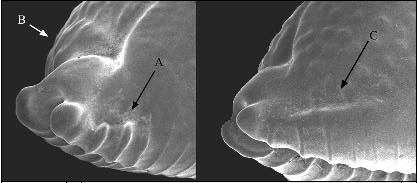
Fig. 1: The characteristic posterior extremity of a Pustularia.
Left: P. chiapponii n. sp., right: P. bistrinotata.
(SEM photos) In chiapponii, the teeth are long, extending far across
the base and the labrum, they are never interrupted by a callus-bridge,
and in no specimen are they shorter mid-way on either side. In
none of the populations of bistrinotata are there teeth
of comparable length. Furthermore, the teeth meet with the dorsal
granules, which are often connected.
In P. bistrinotata, the pustules are usually separate
and distinct from each other (Fig. 2). The posterior labral teeth
cross the terminal margin (Fig. 1, left). This feature is seen
only in exceptional specimens of bistrinotata. All populations
of bistrinotata show a brown spotting of the margins as
well as the dorsum. Smaller spotting is not developed in chiapponii
. The dorsal blotches characteristic of bistrinotata are almost
absent in chiapponii, in which the darker zone is not
split in two by the groove mid-dorsally. The spire of chiapponii
is large, situated right of the posterior extremity, and despite
being covered by callus, is still visible as a slight projection
(Fig. 1, right). This is usually not seen in bistrinotata.
The distinctly curved aperture is typical in the Polynesian sublaevis
but rarely in populations of the Western Pacific. Finally, the
general shape of chiapponii differs by being more globular,
with the extremities being coarser and rather knobby.
The pale yellow color all over is only found in southeastern
Melanesian populations of mediocris, and especially in
New Caledonian shells. Those, however, are less inflated, their
dorsal groove is indistinct, the basal blotches are faint but
visible, the teeth are coarser and much shorter, and the posterior
columellar teeth do not cross the posterior labral margin towards
the dorsum.
A distinction of chiapponii from other members of the
genus represents no problem.
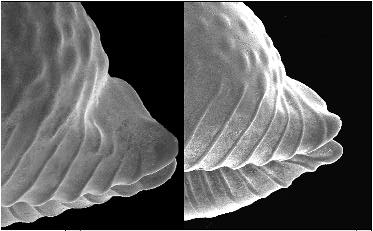
Fig. 5: The characteristic posterior extremity of a Pustularia
(columellar view)
Left: P. chiapponii
n. sp., right: P. bistrinotata. (SEM photos). Note the
connected pustules in P. chiapponii.
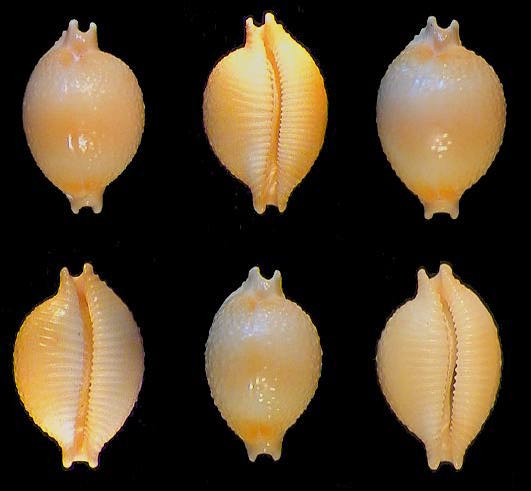
Typical specimens of Pustularia chiapponii
|
