Is Naria leforti a valid
species?
Is Naria leforti a valid
species?
The isolate Island of Rapa Nui, better known
as Easter Island bears only few species of Cypraeidae: the elusive
Cribrarula garciai, and three species in the genus Naria:
caputdraconis, englerti and leforti. Latter was described
as a subspecies of the widespread Naria cernica. The
elusive garciai is so far known only from a small series
of specimens collected in caves at Easter Island, whereas englerti
and caputdraconis have also been found at Sala y Gomez,
still further east towards the South American continent. The
leforti has been collected alive in small numbers, I was
fortunate enough to study most of the specimens that have been
collected in the past years. Comparing the Easter Island population
with all other populations of Naria cernica known to
me I arrive at a point to question that considering leforti
a mere subspecies of cernica is quite correct.
Naria cernica
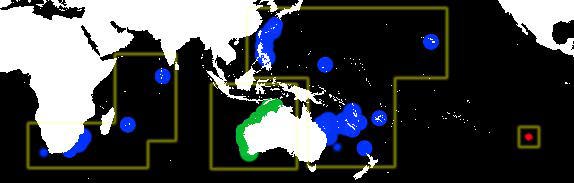
has one of the widest ranges of any known cowry. It is common
in three areas, marked with yellow in the map:
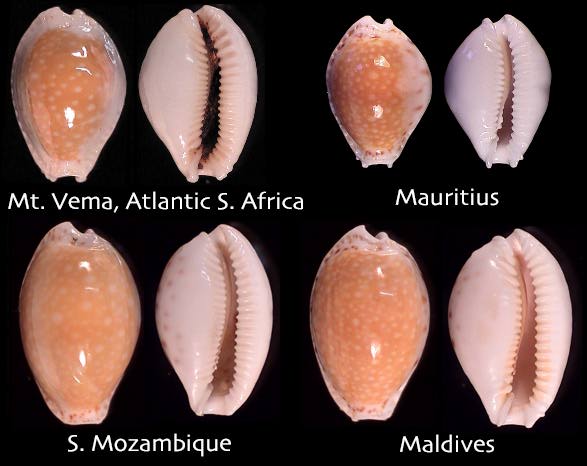
1) the western Indian Ocean group: this is
the typical cernica cernica.
It is oval to deltoidal, inflated and yellow to orange dorsally. The
aperture is rather widNaria It is common in depths around 20 to 30 m at
Mauritius, occasionally it is found ex pisce in Natal and Southern
Mozambique, few shells have been found at depth of 20-25 m in the
Maldives, and a single shell was supposedly collected at 45 m on the
submerged volcanic rock called Mount Vema, 600 km offshore the South
African coast, in the Atlantic. (Nate 2021: This "record" turned out to
be a made-up hoax of a notorious gangster whose inventiveness has
caused considerable damage in due cause).
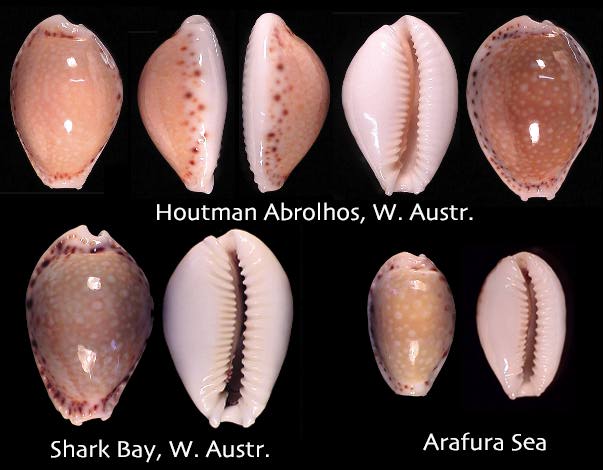
2) The Western Australian group: this area
is inhabited by the subspecies cernica viridicolor. It
is more depressed, deltoidal and callused, the dorsum is greenish
or greyish orange rather than bright yellow. The aperture is
a bit narrower. It lives between the intertidal zone to about
100 m.
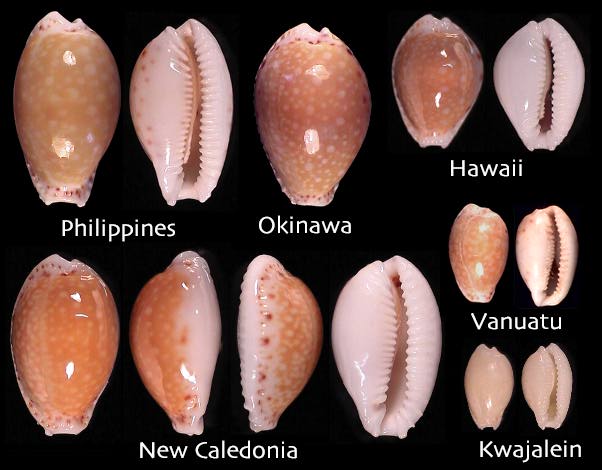
3) The Pacific group: these populations were
given different varietal (or subspecific) names: cernica ogasawarensis
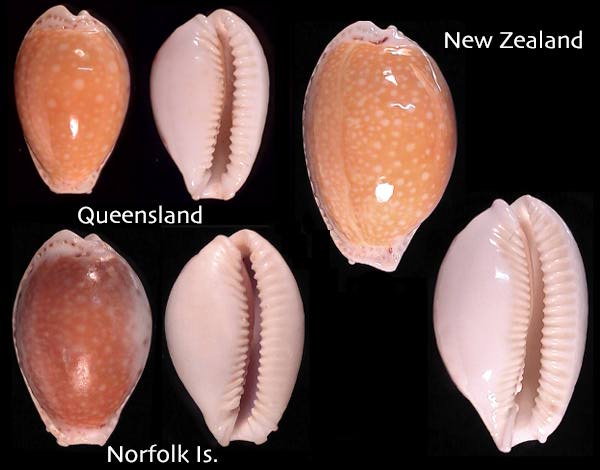
(Japan, Okinawa, the Philippines), cernica tomlini (Queensland,
New Caledonia, Vanuatu), cernica kermadecensis (Kermadec
Is. and New Zealand) and cernica marielae (Hawaii). The
conchological differences between these four formae are inconsistent.
Generally, the western Pacific populations have larger dorsal
spotting and rather long teeth. Their distinction from the group
1 cernica cernica as Pacific subspecies is still under
study, and likely to be possible on account of their zoogeography.
All three geographic groups share a large
amount of common conchological features. Only the Western Australian
viridicolor seems to maintain a certain degree of consistence
to be maintained as a subspecies whereas generally, the various
cernica-populations show the conchological variability
of a single, widespread species. The only exception to this being
leforti
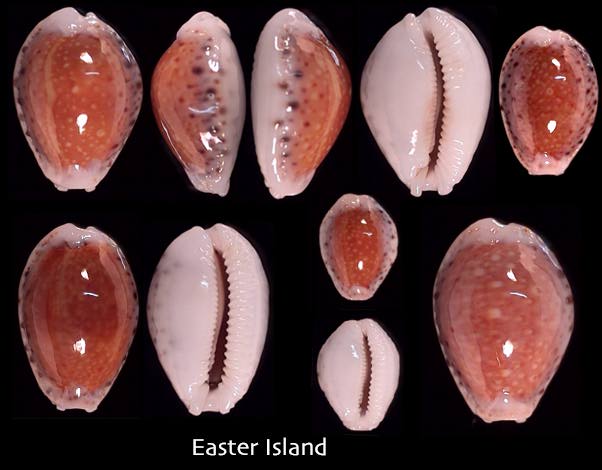
of Easter Island. First of all, the fusing anterior columellar teeth
are a feature seldom encountered in CypraeidaNaria The finer,
much shorter columellar teeth are another distinct feature not found in
any of the cernica-populations. The
dense marginal spotting is also found in some cernica,
but in these it never forms distinct little tubercles as in leforti.
Other characteristics such as the excessive amount of callus
at the extremities and the margins are surely adaptations to
the environment at Easter Island: excessive formation of callus
is also an outstanding feature of Cribrarula garciai.
The conchological distinctness of leforti, along with this geographic
isolation does not seem to fit into the otherwise rather fluent
and undefined variation-scheme of cernicNaria My personal view on
leforti is therefore changed to considering it a valid
species with a preliminary question-mark. The answer can be given
by DNA studies, which will shortly be carried out on this fascinating
and rare cowry.
Note 2021: The molecules barely support the separation of leforti as subspecies (see G3 Vol. 1 p. 241).
Many thanks to Bret and Michael