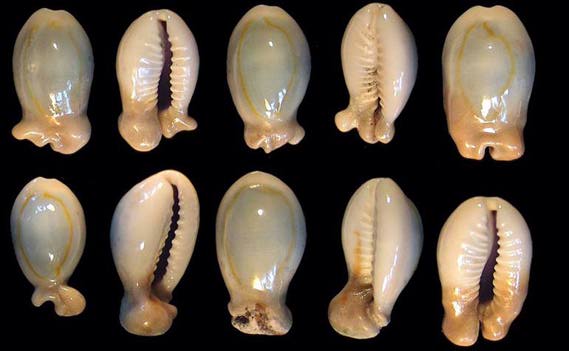
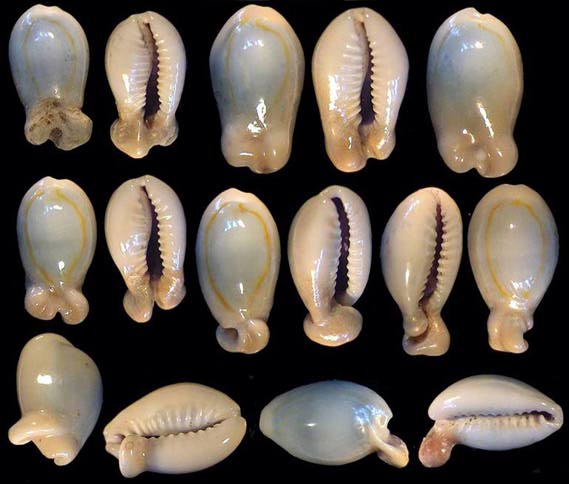
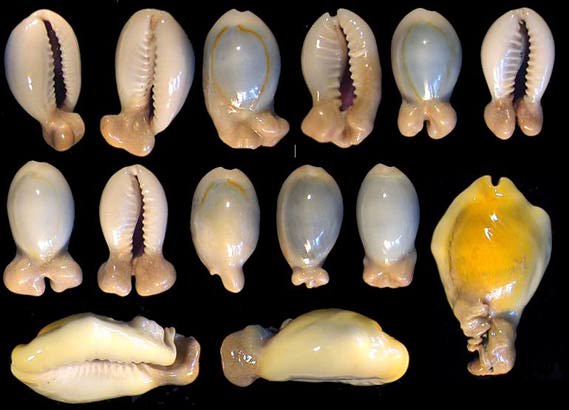
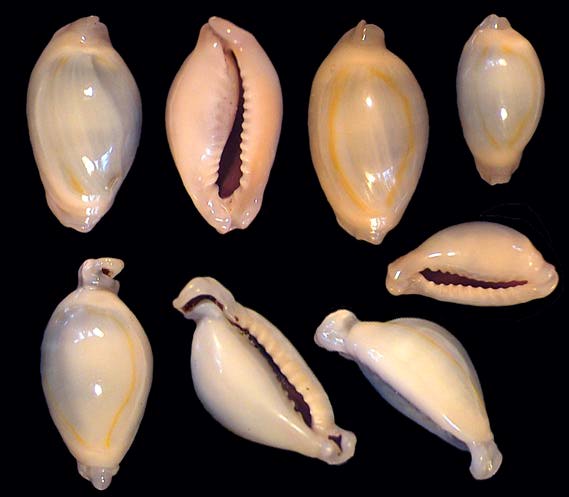
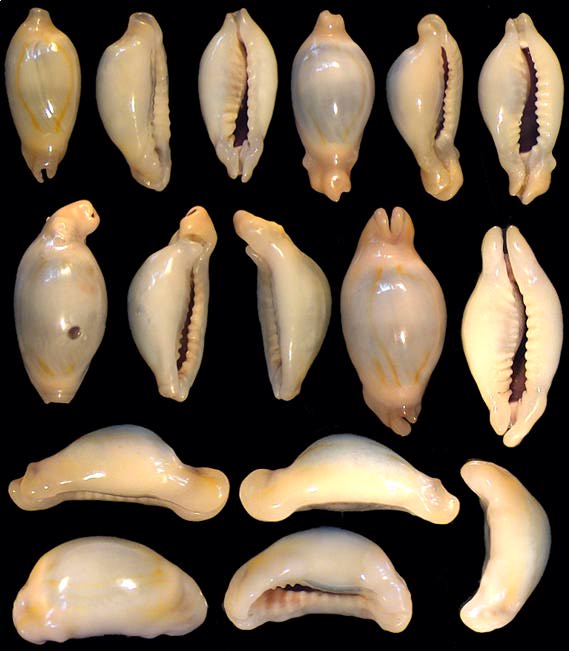
Monetaria annulus from Pemba Is., Tanzania
Monetaria annulus
from Pemba Is., Tanzania
The freak forms shown here were unknown until about 1998 when
few specimens appeared in Tanzania. In the years after, hundreds
of shells followed.
The phenomenon has even been given the name
"appendiculata".
There are three types of such freaks:
The Hookers: one end of the anterior is prolonged to
a hook that normally curls left, rarely right
The Bunnies: Both sides of the anterior form spines
or knobs, making the shell look like a bunny.
The Boats: both extremities rostrated, similar to New
Caledonian shells
All these freaks are very rare in an extreme state as shown here.
The exact origin is so far unknown. Personally, I speculate that
the cause of these shells is parasitism.
As the material the callus-accumulations
consist of resemble pearls in their elementary components
(see
Lorenz 1999: Beitraege zur Kenntnis der Ringkauri Erosaria
annulus. Schriften zur Malakozoologie 13: 1-105 pl. 1-6).
A parasite might live in the mantle cavity and cause a signal
that there is a disturbance. The repair cells react with accumulating
repair-substance, finally forming these unusual appendiculations.